'Truly scared': Blazes outpace firefighters in Indonesian Borneo / Photo: © AFP

Toiling around the clock, haggard Indonesian firefighters on Borneo island cannot keep up with the blazes devouring landscapes and shrouding communities in a cloying haze.
They are fighting a perilous battle with limited weapons against fires blamed in part on a stronger-than-usual episode of the El Nino climate phenomenon parching Southeast Asia.
Experts also blame climate change, decades of forest degradation and slash-and-burn land clearing practices that have changed the naturally fire-resistant landscape.
"We are exhausted. Sometimes we carry out firefighting until dawn. Sometimes we don't sleep," said Sampe Ritonga, fire chief for Sintang regency.
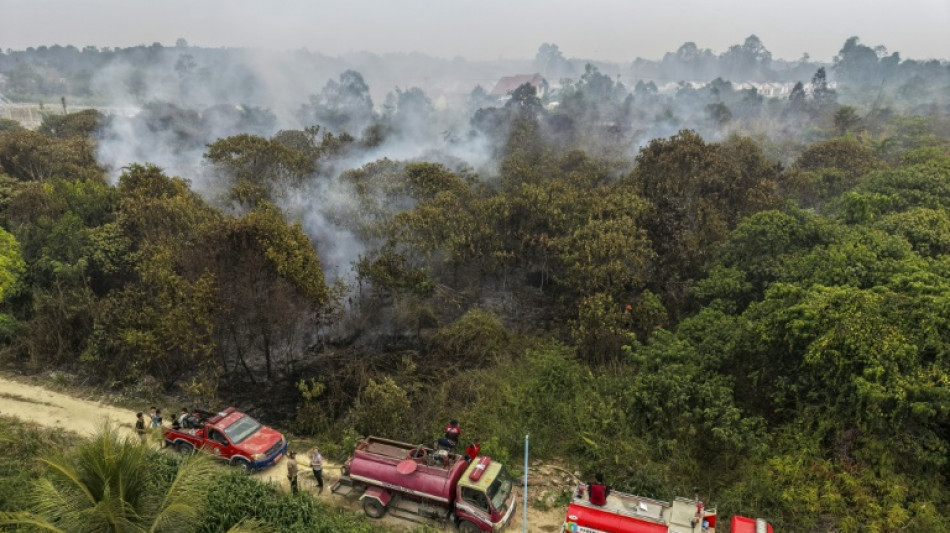
"Our facilities and infrastructure for firefighting are very limited," he told AFP, standing on the smouldering embers of a peatland fire separated from a residential settlement by a narrow dirt road.
Behind him, veiled by the haze, the sun appeared as an eerie, rust-coloured ball in the brown-grey sky.
Sampe's team only has two 6,000-litre fire engines, and deploys one at a time while the other refills. They also face a shortage of hoses.
The team has fought dozens of fires this month.
With river levels low, "we look for available water in ditches... (and) small rivers", some far from active burn sites, Sampe said.
"So there are difficulties because they have to first carry out firefighting with high intensity, and second look for water," he added.
"With the limitations we have, we try as hard as we can to extinguish the fires and also to reduce the smoke."
Nearby, locals gathered to observe the team's efforts, offering drinking water to first responders.
"There are many houses here, and that is what we have to protect," said Sampe.
- 'Crackling sound' -
Resident Sutrismi, 47, said she was at home on Saturday when she heard a "crackling sound", looked out of the window and saw smoke rising from the peatland across the road.
Peatland fires, common in the area, generally smoulder and spread under the soil for weeks or months, emitting huge quantities of smoke and only rarely causing surface blazes.
"First thing, I looked for help. I contacted the village head, asked for assistance," Sutrismi told AFP.
"I am scared. Truly scared."
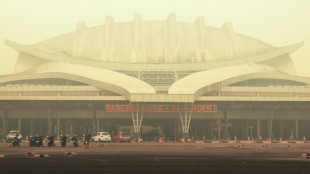
Some 400 kilometres (250 miles) away in Pontianak -- the capital of West Kalimantan province -- people have been breathing foul air for weeks.
The haze can be smelled even indoors in the city of about 700,000 people.
At one point on Sunday, the level of PM2.5 pollution exceeded 500 micrograms per cubic metre, according to IQAir, a Switzerland-based monitor.
That is more than 100 times the World Health Organization's recommended safe limit for airborne particles so small they can enter deep into the lungs and even the bloodstream, with potentially dire consequences for health.
Hundreds of schools have been closed indefinitely in West Kalimantan due to air pollution, with about 200,000 pupils learning from home, according to the education ministry.
The province has also recorded a surge in respiratory ailments.
"We really hope there will be some assistance or grants for us, so we can be faster, more alert and more responsive," said Sampe.
West Kalimantan governor Ria Norsan said the province was doing its best.
"We do not want officers in the field to work with limitations," he said in a statement to AFP.
"Every report regarding shortages of personnel, equipment, water, or other needs must be conveyed immediately so that solutions can be found."
The provincial government has said it has nearly 14,500 fire-fighting personnel out in the field, with nine aircraft available for water-bombing, three for patrols and one for cloud-seeding operations trying to make rain.
- Climate connection -
Environmental campaigners say rapacious forest and peatland destruction is the root cause of the fires.
"The peat is drained by extractive plantations, monoculture plantations, whether oil palm or pulpwood," Greenpeace Indonesia forest campaigner Belgis Habiba told AFP in Pontianak.
"When the water is drained, the peat dries and becomes flammable."
According to Greenpeace estimates using government data, some 35 million people in Indonesia are exposed to toxic haze.
Smoke from the fires has also affected communities in the neighbouring Malaysian part of Borneo and beyond.
"The haze is massive and everywhere, and it's actually very unfit for people to breathe," Belgis said.
She urged the Indonesian government to declare the fires a national disaster, "so that all resources are mobilised... to build health access for residents, rescue wildlife and so on".
According to the Nusantara Atlas fire tracker, more than 285,000 hectares have burnt in Indonesia so far this year.
Official data show 38,000 hectares have burnt in West Kalimantan.
The current El Nino event, which will last into next year, is likely to be one of the strongest in decades, according to the United Nations.
A.Kwok--ThChM