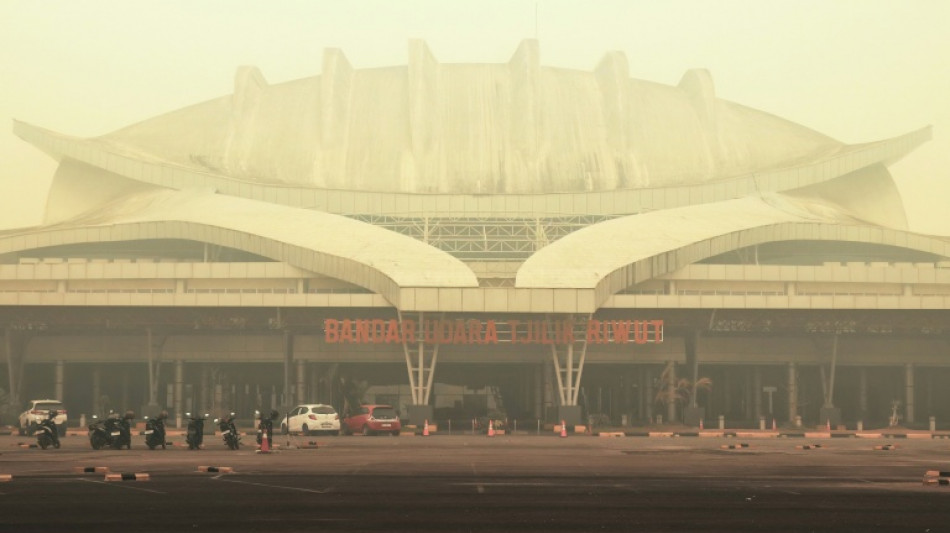
Indonesia haze chokes neighbours, but little legal recourse / Photo: © AFP

Haze from Indonesian wildfires has blanketed neighbouring Malaysia and Singapore for more than a month, closing schools and sending respiratory complaints skyrocketing.
It is not the first time Indonesian haze has caused a regional pollution crisis, but neighbouring countries have few options for legal recourse, experts say:
- Case at the ICJ -
Suggestions that Malaysia and Singapore take Indonesia to the UN's highest judicial organ, the International Court of Justice in The Hague, face a basic obstacle:
"The main issue is jurisdiction, as the ICJ generally requires the consent of both states," said Professor Mohd Hazmi Mohd Rusli of Universiti Sains Islam Malaysia.
The ICJ can only hear a dispute where states have accepted its jurisdiction, for example through a special agreement, compatible declarations recognising the court's compulsory jurisdiction, or a treaty clause referring disputes to it.
Indonesia, Malaysia and Singapore are neither signatories nor parties to the 1979 Convention on Long-range Transboundary Air Pollution, a European-centred treaty framework intended to curb cross-border air pollution.
And experts agree Indonesia would be unlikely to willingly accept ICJ jurisdiction on the issue.
All three countries are parties to the ASEAN Agreement on Transboundary Haze Pollution, but the 2002 deal has no clause on litigation before the ICJ.
- What about ASEAN? -
The ASEAN Agreement on Transboundary Haze Pollution is a legally binding regional treaty, intended to prevent and monitor cross-border haze from land and forest fires, and to mitigate its effects.
But its enforcement provisions are limited.
"It is legally binding, but it does not provide a mechanism for one member state to simply sue another," said Hazmi.
Instead, it seeks to solve the problem through "national action and regional cooperation".
Legal analysts say ASEAN's emphasis on consensus, sovereignty and non-interference puts the brakes on how much diplomatic pressure can be applied to member states over domestic land management and fire enforcement.
"For now, I think the more practical approach is stronger ASEAN cooperation, including hotspot monitoring, information sharing, prevention and stronger enforcement against illegal burning," Hazmi said.
- Civil action -
One option could be for Malaysians or Singaporeans to try to sue companies linked to the fires in an Indonesian court, said Azam Hawari, a legal expert at the environmental law charity, ClientEarth.
However, "claimants would need to show a link between the company's activities, the haze that reached them, and their losses," Azam said, adding he was not aware of such a case having been brought successfully.
Added Hazmi: "Transboundary haze does not automatically mean Indonesia is internationally responsible."
"There must still be sufficient evidence to establish the link between activities in Indonesia and the harm suffered in Malaysia or Singapore," he said.
- Previous attempts -
Singapore enacted its own Transboundary haze Pollution Act in 2014, after pollution levels spiked into hazardous territory the year before, followed by another episode in 2015.
The law aimed to punish companies whose activities outside Singapore caused or contributed to unhealthy levels of haze in Singapore.
Enforcement proved a major weakness because it relied heavily on cooperation from foreign authorities.
Establishing responsibility was also challenging because it required authorities to share maps pinpointing fire hotspots, and conflicting or overlapping land rights could further complicate matters.
Bringing a case against some companies with no presence in Singapore also made collecting fines or damages hard.
Singapore's investigations into four Indonesian companies over their alleged role in the 2015 transboundary haze remain open and proved a source of diplomatic tensions with Jakarta at the time.
Singapore will now most likely "wait for Indonesia to finger certain companies first before we take action against these same companies under the Act", said Professor Alan Tan, an environmental law expert at the National University of Singapore.
"Otherwise, any action that Singapore takes would appear to the Indonesians to be unilateral, and could be politically controversial."
Tan said: "Regrettably, not much has changed by way of how the root causes of fires remain unaddressed in Indonesia."
V.Fan--ThChM