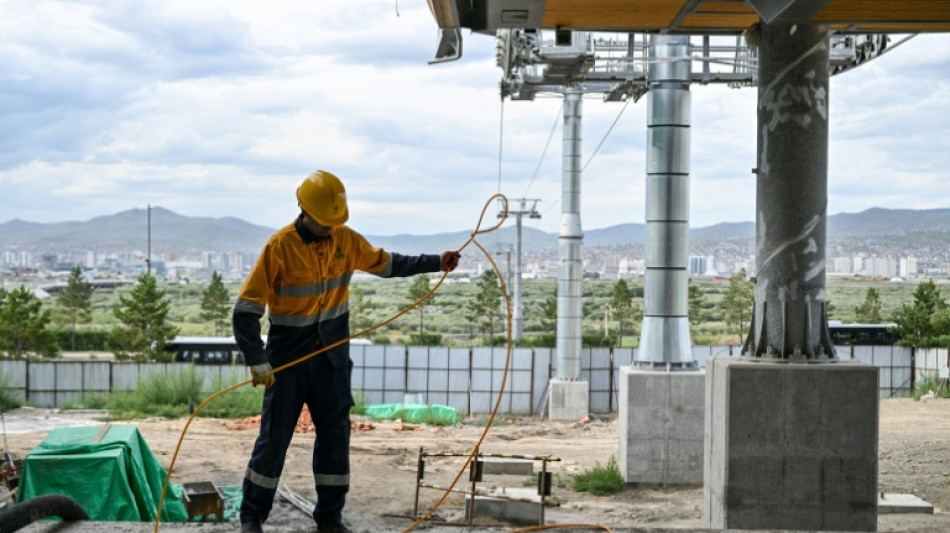
Cable car offers small hope for Mongolia's gridlocked capital / Photo: © AFP

Mongolia's capital Ulaanbaatar has long been plagued by notorious traffic jams and suffocating winter smog -- the result of breakneck urban growth and infrastructure that has struggled to keep up.
Developers now hope that a 4.2-kilometre (2.6-mile) cross-river cable car might help on the margins, cutting a three-hour journey to just minutes.
Weary residents, however, have long wished for a more ambitious response to the city's heavy traffic and pollution problems.
"I think (the cable car) might improve things a bit," 68-year-old Narantsetseg Aleksandr told AFP in one of Ulaanbaatar's sprawling northern suburbs.
"For families living up on these -remote hillside areas, cable cars could be very beneficial since they wouldn't have to rely entirely on buses," he said.
Authorities have long touted various plans to reduce pollution and traffic, which sound "effective on paper" but ended up being "mostly talk", he said.
"There isn't much actual work or real tangible progress being made."
For more than a decade, an underground metro system has been touted for the city to tackle congestion -- but work has yet to begin.
For 25-year-old truck driver Enkhbayar Myanganbayar, metro promises always seemed "far beyond realistic expectations" as congestion in the capital has worsened.
"Ever since I was a child, various ministers have promised to build a metro," he told AFP.
"It was obvious from the start that it was untrue."
- 'A lot of sense' -
In contrast, the Tuul River cable car -- spearheaded by French firm Poma with a concessional loan from the French government -- is already under development and expected to be completed by the end of the year, potentially followed by more lines.
"The project's cost is low and construction is very fast compared with a metro," project manager Cecile Broi told AFP.
Mongolia's capital has expanded significantly since the end of the Soviet-allied communist era.
In 1990, it was home to around half a million people. Now, Ulaanbaatar's population exceeds 1.5 million.
While the city centre is nestled in the Tuul River valley, its sprawling suburbs stretch into the surrounding mountainous areas.
The project is a "perfect illustration of a situation where cable transport makes a lot of sense", Broi said.
By car, getting between the line's two stations can take as long as three hours when traffic is at its worst, she said, while a ride on the cable car will take just 12 minutes.
Construction on the electric cable car, which Poma says will be capable of transporting 2,300 passengers per hour, began last March.
The line will soar over a major thoroughfare, as well as the wide Tuul River floodplain and the Trans-Mongolian Railway.
- 'Exhausted' and ill -
During cold winters, Ulaanbaatar is frequently ranked as one of the world's most polluted cities and regularly exceeds World Health Organization recommendations for air quality.
For 42-year-old resident Erdenejargal Khorolsuren, solutions could not come fast enough.
She told AFP that the city's incessant traffic has negatively impacted her son's education.
Five years ago, when he began attending a school across the city, "he was full of energy and enthusiasm, but over time the long commute exhausted him", she said.
"His motivation to attend school plummeted and he became constantly fatigued and sick with frequent headaches."
Narantsetseg said that air pollution severely affects quality of life, particularly during the frigid winters when residents in the "ger" districts -- named after traditional nomadic dwellings -- burn coal or other solid fuels to heat their homes.
"Schoolchildren cough a lot from the smoke and catch frequent colds... Buying medicine when (they) get sick puts a real financial strain on us," he said.
Broi, the project manager, acknowledged that a single cable car line will not be a panacea for all of Ulaanbaatar's longstanding woes.
"The usual model is to build a cable transport system that... allows the public to discover the technology, understand how it works and become familiar with this mode of transport," she said.
"Of course, the idea afterwards is to build more of them."
G.Fung--ThChM