‘Shanghai Daughter’ Reconstructs a Father’s Past in China’s Rubber Forests

In her feature debut, director Shen Zhongmin combines fiction and documentary practice to revisit her late father’s decade as a sent-down youth on a state rubber farm in Xishuangbanna.
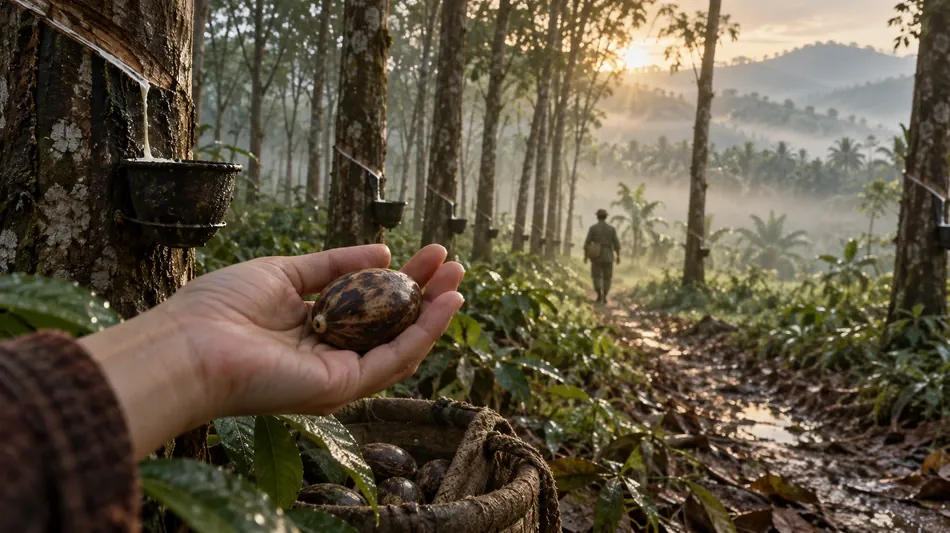
At the Shanghai premiere of her first feature film, “Shanghai Daughter,” director Shen Zhongmin brought a rubber seed collected in the forests of Xishuangbanna, nearly 3,000 kilometers away in southwestern China. The seed came from the landscape where her late father spent a decade working, and it has become a symbol of the history, environmental change, and family memory explored in the film.
Shen’s father was one of millions of urban Chinese youths sent to rural regions under the Down to the Countryside Movement, which lasted from the mid-1950s through the late 1970s. He worked on a state-run rubber farm close to China’s border with Myanmar but told his daughter little about that period of his life.
Shen, 41, also works under the name Agnis Shen. Before becoming a filmmaker, she was a culture editor at the Shanghai magazine The Bund and wrote “The Traveler’s Desire,” a collection of short stories. She first went to Xishuangbanna in 2011, one year after her father died. She returned repeatedly, following traces of his life and meeting people from the same generation.
Nearly a decade after that first journey, Shen began developing the film. Her encounters in the region and widespread reporting about a herd of wild Asian elephants traveling north from Xishuangbanna helped shape the project. The elephants’ route had drawn public attention to the rubber plantations that altered parts of the area’s rainforest habitat.
“Shanghai Daughter” blends a fictional central character with documentary encounters. Ming, a Shanghai woman played by Liang Cuishan, travels to Xishuangbanna in search of people who knew her father. Along the way she finds workers’ dormitories facing demolition and a changing landscape where mining and modern agriculture are replacing old rubber farms.
Rubber tappers, village doctors, ethnic Dai residents, and ecological researchers appear as themselves. Their testimony places one family’s search inside a larger history of migration, state agricultural development, and environmental transformation. For Shen, the film asks how people can reconstruct the past when firsthand records are scarce and those who lived through it have often remained silent.
The film premiered internationally in the Panorama section of the Berlin International Film Festival in February. It was later selected by the Hong Kong International Film Festival and the Malaysia International Film Festival. Its Shanghai premiere took place on Sept. 19.
At least a dozen former sent-down youths, now in their 70s, traveled about an hour by subway to attend the Shanghai screening. They shared photographs from their years in Xishuangbanna, including pictures featuring Shen’s father, Shen Wanxiong, and posed with the director.
Among them was 73-year-old former rubber tapper Shen Weilong, who worked beside Shen Wanxiong and described him as his best friend. Looking at one photograph, he joked that it failed to show how handsome Shen’s father had been and told the audience to look at his daughter instead. Reflecting on his peers, he became tearful and said their generation was rarely discussed even as its remaining time grew shorter.
The title carries several meanings. Shen explained that villagers near the farms originally used “Shanghai daughters” for girls left behind by sent-down youths, sometimes allowing the label to replace their individual names. Because of her own father’s history, Shen came to see herself as another kind of Shanghai daughter. The expression suggested two distinct but intersecting lives: one beginning in Shanghai, the other 3,000 kilometers away in Xishuangbanna.
She chose “daughter” rather than a broader term such as “woman” because of its gentleness and its potential to approach a painful subject through repair. One of the first Dai expressions her father taught her was “long yin,” meaning girl. The film extends the idea beyond a single father-daughter relationship, connecting different daughters and different generations.
Shen said she did not want the work to remain trapped within historical injury or to treat the period only through criticism. Her goal was to make the history relevant to the present and directed toward the future, while emphasizing renewed empathy and the possibility of healing.
During development, she gathered oral histories, consulted archives, and reconnected with researchers at the Chinese Academy of Sciences who study rainforest restoration. Yet she deliberately kept much of that concrete research in the background while drafting the screenplay. She wanted sensory experience and observation to come first, arguing that stated opinions can divide viewers while perception can remain open and shared.
One journalist later asked whether the method might be understood through ecofeminism. Shen considered the suggestion perceptive because it points beyond a human-centered perspective and rejects a structure in which one person or group treats everyone else as the other.
The region’s plants and terrain are central to the film. While conducting fieldwork, Shen often walked through Xishuangbanna and began to view the landscape as a theater in its own right. Generations have planted rice, corn, bananas, rubber, and more recently dragon fruit. A small area of primary forest protected by Dai villagers survives on a hillside, while her father’s dormitory and the former rubber plantation lie beneath or among newer developments.
Shen believes land can retain stories after the people connected to them disappear. Crops, forest fragments, buildings, and altered ground preserve subtle evidence of decisions made over more than half a century, even when they cannot speak in human language.
The rubber seed she carried to the premiere represented what she calls a transformation of cause and effect. More than 50 years ago, workers cleared primary rainforest and planted rubber to meet national development goals, often with little personal choice. The ecological consequences, including damage to biodiversity, became clearer only later.
Researchers from the Chinese Academy of Sciences are now rehabilitating degraded rubber groves. Their aim is not to recreate primary rainforest, which they consider scientifically unrealistic, but to restore balance among species. In poor-quality groves created by unplanned planting and tapping, they introduce plants capable of connecting plantation habitat with native tropical forest and rebuild layers within the ecosystem.
To Shen, the restoration work takes the result of an earlier decision and inserts a more constructive cause within it. The relationship between seed and fruit therefore serves as a metaphor for changing inherited consequences. The production also took her to Malaysia, where she saw some of the earliest rubber trees planted in the country. Without rubber’s historical transplantation, she noted, the large-scale plantations of Xishuangbanna and many stories surrounding them would not exist.
Shen chose a hybrid of fiction and documentary because she regards the border between the two as unstable, like the boundary between dreams and waking life. A conventional documentary focused solely on her search or her relationship with her father would, in her view, have made the project too narrow.
Creating Ming as a fictional figure allowed Shen to draw from her experience while leaving viewers room to enter the story. Appearing as herself would have placed the film more strictly under the expectations of factual autobiography and could have limited the audience’s ability to connect its own memories to the work.
Her father’s silence shaped the production process. Shen did not know that he had tapped rubber until she entered a plantation and learned what his generation had planted and harvested. At first she avoided contacting his former colleagues, even though she knew they could supply extensive firsthand testimony. She wanted the film to begin from the gap between father and daughter: he had died before she could ask, leaving her to search for the missing years.
She was also reluctant to reopen memories that could be painful for the former workers, particularly for what began as a small personal project. After the Shanghai premiere, however, she spent the following morning replying to their messages while members of the group prepared to meet for a reunion lunch and discuss the film.
One of her father’s former colleagues wrote to thank the screenwriter, creative team, and director for giving what the person described as a fitting close to 50 years of sent-down-youth experience. The response brought the film’s central act of reconstruction back to the generation whose lives first led Shen into the rubber forests.
Y.Su--ThChM