RYCEF
0.4000

The Nobel Prize in Literature was awarded on Thursday to Canadian poet Anne Carson for her modern twists on Greek mythology and antiquity that have inspired new forms of contemporary writing, the Swedish Academy said.
The 76-year-old -- who announced in 2024 that she has Parkinson's disease -- was honoured "for her bold and inventive oeuvre that, in playful dialogue with the classical tradition, has created new forms for contemporary literature," the Academy said.
The permanent secretary of the Academy, Ingrid Carlberg, said she had briefly spoken to Carson.
"We didn't have so much time to speak. All she had time to tell me was that she is for the moment in Iceland, where she's listening to the wind."
"She was taken by surprise, but very happy. I could hear that in her voice."
Carson has for more than 15 years spent part of the year in Iceland, where she holds citizenship, according to Icelandic broadcaster RUV.
A professor of classics with a background in dead languages, literature, anthropology and history, she was described by The New York Times in 2001 as "one of the great pasticheurs."
Her unique contemporary poetry earned her several key literary prizes in the 1990s, including the 1996 Lannan Award and the 1997 Pushcart Prize.
A year later, "Autobiography of Red: A Novel in Verse" -- loosely based on the Greek myth of the monster Geryon and Herakles but transformed into a modern tale of a gay love triangle -- received widespread praise.
The Academy called it a "spectacular form of epic poetry with its great lyrical qualities".
- 'Author for our time' -
The Academy said almost all of Carson's literary production "has centred upon the intersection between the philologist's obsession with words and the poet's desire for new meaning."
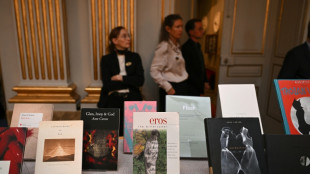
It singled out her 2010 poem "Nox", printed on one continuous sheet of paper in homage to her brother who died in 2000, as "an unforgettable work".
"Palpable here is a deep sense of loss that works its way up from below. The result is a creation as sculptural as it is literary, an epitaph in the form of a box containing an accordion-fold-out of pictures, letters and other written texts dedicated to her dead brother."
It also highlighted her translations from Classical Greek, which "may be regarded as independent works in their own right".
Academy member Steve Sem-Samberg called Carson "an author for our time", in an interview with the Nobel Foundation.
"She connects our contemporary ways of living, always through the antiquity."
"She uses the myths, the characters, the stories, the fables from that time to and puts them into a modern context. And the mixture between those two gives an enormous energy to her writing," he said.
Sem-Sandberg told AFP: "When you're inside her work, you immediately recognise her voice and her themes. Nobody writes like her."
Carson spoke of her Parkinson's in the London Review of Books in 2024.
"A symptom particularly mortifying to me was that my handwriting disintegrated."
"I used to take pleasure in writing in notebooks, shelves of them, day after day, year after year. Now the upright strokes bend or break or go in all directions, vowels shrink to blobs, slant loses its smooth smart angle, it all looks embarrassing."
Carson had been mentioned as a possible Nobel laureate for years, though some experts said the Academy was unlikely to honour another Canadian so soon after the 2013 prize to short story author Alice Munro.
With her Icelandic citizenship, she is also the country's second author to win the prize after Halldor Laxness in 1955.
- Women under-represented -
Many literary critics expected the award to go to a woman this year, given the frequent criticism directed at the Academy over the overrepresentation of Western white men among its picks.
There have been just 19 women laureates out of 122 since the Nobel literature prize was first awarded in 1901.
A 2018 sex assault scandal left the Academy in tatters and more than half of its 18 members were replaced.
Since then, every other literature laureate has been a woman.
Last year, the award went to Hungary's Laszlo Krasznahorkai, whose works explore themes of postmodern dystopia.
The Nobel Prize comes with a diploma, a gold medal and $1.2 million.
Carson will receive her award from King Carl XVI Gustaf in Stockholm on December 10, the anniversary of the 1896 death of scientist and prize creator Alfred Nobel.
po/jll/gv
E.Lau--ThChM