The China Mail - Fingerprint Study Finds Women and Teenagers Helped Build China’s Terracotta Army

USD -
AED 3.672977
AFN 65.0004
ALL 81.626056
AMD 360.510494
ANG 1.789785
AOA 918.000068
ARS 1541.585196
AUD 1.421494
AWG 1.8
AZN 1.687821
BAM 1.756231
BBD 2.013047
BDT 124.13403
BGN 1.747831
BHD 0.377298
BIF 3001.5
BMD 1
BND 1.281647
BOB 12.038845
BRL 5.378401
BSD 0.99943
BTN 95.119137
BWP 13.826143
BYN 2.945822
BYR 19600
BZD 2.010084
CAD 1.403845
CDF 2314.502233
CHF 0.830025
CLF 0.025026
CLP 988.180036
CNY 6.66605
CNH 6.664565
COP 3169.93
CRC 454.457699
CUC 1
CUP 23.987213
CVE 99.224987
CZK 21.885969
DJF 177.719677
DKK 6.712575
DOP 60.370006
DZD 135.277004
EGP 56.089099
ERN 15
ETB 163.857782
EUR 0.89807
FJD 2.244197
FKP 0.75114
GBP 0.751865
GEL 2.570499
GGP 0.75114
GHS 11.650139
GIP 0.75114
GMD 73.501784
GNF 8795.000128
GTQ 7.63805
GYD 209.438376
HKD 7.845495
HNL 26.831951
HRK 6.76901
HTG 130.948372
HUF 329.9395
IDR 18180
ILS 3.123155
IMP 0.75114
INR 95.29225
IQD 1515.218182
IRR 1864649.999685
ISK 121.91994
JEP 0.75114
JMD 158.527332
JOD 0.708968
JPY 158.288042
KES 130.000272
KGS 87.448599
KHR 4075.50088
KMF 441.999797
KPW 899.999961
KRW 1344.385001
KWD 0.31101
KYD 0.832963
KZT 455.005455
LAK 22525.000169
LBP 89550.000228
LKR 332.317142
LRD 170.240229
LSL 16.670086
LTL 2.95274
LVL 0.60489
LYD 6.430047
MAD 9.852994
MDL 17.990957
MGA 4540.985152
MKD 55.296394
MMK 2099.630718
MNT 3601.077836
MOP 8.076272
MRU 40.199425
MUR 47.570073
MVR 15.460443
MWK 1737.000259
MXN 18.68429
MYR 4.076599
MZN 63.900258
NAD 16.670073
NGN 1342.29009
NIO 36.780453
NOK 9.278675
NPR 152.193532
NZD 1.780202
OMR 0.384502
PAB 0.999421
PEN 3.447629
PGK 4.480862
PHP 63.9685
PKR 276.5266
PLN 3.956803
PYG 5850.263778
QAR 3.643866
RON 4.804297
RSD 105.523987
RUB 80.494213
RWF 1479.735463
SAR 3.750314
SBD 8.064647
SCR 13.975633
SDG 601.49594
SEK 9.93486
SGD 1.283198
SHP 0.749344
SLE 22.874984
SLL 20969.504398
SOS 571.202795
SRD 37.615504
STD 20697.981008
STN 22.000027
SVC 8.745235
SYP 13001.999685
SZL 16.657163
THB 33.787499
TJS 9.205205
TMT 3.5
TND 2.998649
TOP 2.40776
TRY 49.837799
TTD 6.78409
TWD 32.445899
TZS 2644.428012
UAH 45.57773
UGX 4352.413493
UYU 40.211023
UZS 12008.530699
VES 886.72915
VND 25856.5
VUV 118.98361
WST 2.767767
XAF 589.095335
XAG 0.01869
XAU 0.000247965444
XCD 2.70255
XCG 1.801308
XDR 0.707052
XOF 589.095335
XPF 107.090743
YER 236.149886
ZAR 16.687205
ZMK 9001.197055
ZMW 20.164415
ZWL 321.999592
SSP 5745.470209
MXV 2.106899
  • RYCEF

    0.4000

    19.71

    +2.03%

  • CMSC

    0.0000

    20.4

    0%

  • BTI

    0.4200

    56.05

    +0.75%

  • BP

    0.2800

    44.43

    +0.63%

  • RBGPF

    1.6000

    67

    +2.39%

  • RIO

    -0.1500

    94.41

    -0.16%

  • AZN

    -0.4300

    166.15

    -0.26%

  • GSK

    0.4600

    49.7

    +0.93%

  • BCE

    -0.4100

    20.56

    -1.99%

  • NGG

    -0.2500

    75.24

    -0.33%

  • VOD

    -0.0400

    16.58

    -0.24%

  • RELX

    -0.4500

    33.07

    -1.36%

  • BCC

    -0.5500

    76.59

    -0.72%

  • CMSD

    -0.0300

    20.27

    -0.15%

  • JRI

    -0.2500

    10.77

    -2.32%

Fingerprint Study Finds Women and Teenagers Helped Build China’s Terracotta Army

Fingerprint Study Finds Women and Teenagers Helped Build China’s Terracotta Army

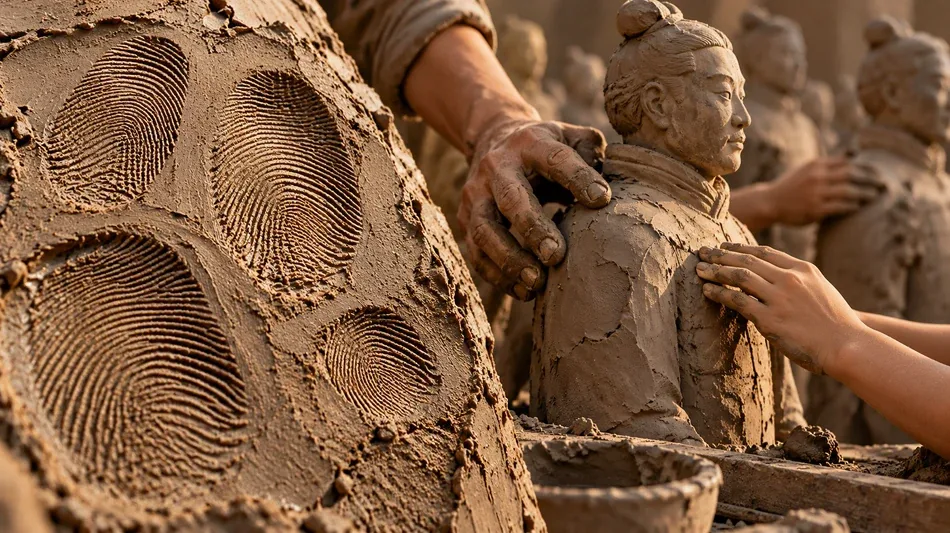
Women and adolescents as well as adult men took part in producing China’s 2,000-year-old Terracotta Army, according to a new fingerprint study that examines the labor behind the mausoleum of the first emperor, Qin Shi Huang. The researchers analyzed ancient prints preserved on clay figures and assessed the makers’ li

Text size:

Women and adolescents as well as adult men took part in producing China’s 2,000-year-old Terracotta Army, according to a new fingerprint study that examines the labor behind the mausoleum of the first emperor, Qin Shi Huang. The researchers analyzed ancient prints preserved on clay figures and assessed the makers’ likely ages and sexes.

The work was conducted by the Emperor Qinshihuang’s Mausoleum Site Museum in Xi’an, Shaanxi province, and the School of Archaeology at Shandong University in Jinan. It is scheduled for publication in Volume 82 of the Journal of Cultural Heritage at the end of 2026. Domestic media reported the findings this week.

Earlier accounts of Qin dynasty labor, dating from 221 to 206 BC, relied heavily on legal texts and often treated adult men as the default workforce; 15 was reported as the minimum age for service. Earlier fingerprint research also did not fully address the overlap in ridge size between women and adolescent boys, differences between ancient and modern prints or the shrinkage of clay during firing.

The research team used a Bayesian mixture model to incorporate those uncertainties. It assigned probabilities for possible age and sex, analyzed mean ridge breadth, or the thickness of fingerprint ridges, and compared the measurements with values projected from growth curves.

Researchers examined 79 well-preserved fingerprints on 36 figures from Pit 1 at the Qin mausoleum. Their estimates attributed 45% of the prints to males, 32.7% to females and 22.3% to juveniles younger than 15. The results provide quantitative biological evidence against the assumption that large state craft projects relied only on adult male labor.

The authors said the pattern is consistent with historical material describing state workshops where men and women worked together and experienced adults worked beside juveniles who may have served as helpers or apprentices. They also said the method offers a new framework for studying the ages and sexes of workers involved in ancient craft production.

The paper notes important limits. The percentage of fingerprints in each category does not necessarily equal the percentage of workers because several prints may have come from one person. Experienced artisans may also have left fewer prints, which could inflate the apparent share attributed to juveniles.

The comparison database presents another source of uncertainty: it is based on modern Czech-Caucasian fingerprints rather than East Asian samples and contains more female prints, conditions that may affect the estimates. The authors therefore frame the findings as probabilistic evidence, not an exact census of the workforce.

T.Luo--ThChM