The China Mail - Google hails 'key milestone' in quantum computing

USD -
AED 3.672497
AFN 64.99979
ALL 80.742224
AMD 360.119907
ANG 1.789785
AOA 918.000449
ARS 1547.512201
AUD 1.427114
AWG 1.8
AZN 1.695151
BAM 1.737338
BBD 2.013458
BDT 124.459802
BGN 1.747831
BHD 0.37735
BIF 3010
BMD 1
BND 1.277909
BOB 12.120755
BRL 5.460101
BSD 0.999711
BTN 94.558763
BWP 13.724402
BYN 2.982914
BYR 19600
BZD 2.010562
CAD 1.39706
CDF 2315.000267
CHF 0.816503
CLF 0.02453
CLP 965.430226
CNY 6.67355
CNH 6.67376
COP 3229.36
CRC 454.091218
CUC 1
CUP 23.992112
CVE 98.896657
CZK 21.61525
DJF 177.720122
DKK 6.65239
DOP 60.604398
DZD 135.956026
EGP 54.717302
ERN 15
ETB 164.071845
EUR 0.88999
FJD 2.244198
FKP 0.745268
GBP 0.741965
GEL 2.600226
GGP 0.745268
GHS 11.631305
GIP 0.745268
GMD 74.000096
GNF 8855.000058
GTQ 7.639521
GYD 209.448686
HKD 7.84505
HNL 26.868429
HRK 6.76901
HTG 130.971046
HUF 322.693501
IDR 18110.4
ILS 3.153899
IMP 0.745268
INR 94.51575
IQD 1515.529716
IRR 1883408.502243
ISK 121.579569
JEP 0.745268
JMD 158.455068
JOD 0.709015
JPY 158.401996
KES 129.920112
KGS 87.450166
KHR 4064.827605
KMF 440.999835
KPW 899.999961
KRW 1341.484997
KWD 0.310805
KYD 0.833041
KZT 451.807175
LAK 22506.673299
LBP 89519.744527
LKR 332.641939
LRD 169.939285
LSL 16.455617
LTL 2.952739
LVL 0.60489
LYD 6.409977
MAD 9.765444
MDL 17.929301
MGA 4515.192027
MKD 54.78946
MMK 2099.52083
MNT 3598.087189
MOP 8.077598
MRU 40.663904
MUR 47.090014
MVR 15.455015
MWK 1733.399066
MXN 18.60899
MYR 4.071298
MZN 63.910474
NAD 16.455325
NGN 1346.42026
NIO 36.784529
NOK 9.29659
NPR 151.29402
NZD 1.778304
OMR 0.384501
PAB 0.999773
PEN 3.450426
PGK 4.485918
PHP 63.345497
PKR 276.534117
PLN 3.904405
PYG 6061.763543
QAR 3.644609
RON 4.754098
RSD 104.67979
RUB 81.801499
RWF 1471.012787
SAR 3.756339
SBD 8.051718
SCR 13.701544
SDG 601.500853
SEK 9.731575
SGD 1.27865
SHP 0.745545
SLE 22.909978
SLL 20969.504398
SOS 571.349894
SRD 37.563974
STD 20697.981008
STN 21.763752
SVC 8.747096
SYP 13001.999685
SZL 16.44674
THB 33.593497
TJS 9.221818
TMT 3.51
TND 2.979449
TOP 2.40776
TRY 50.043203
TTD 6.776725
TWD 32.836099
TZS 2649.998018
UAH 45.52523
UGX 4104.021853
UYU 40.19489
UZS 11886.139647
VES 890.0366
VND 25704.5
VUV 119.472328
WST 2.779309
XAF 583.794901
XAG 0.019139
XAU 0.000246069955
XCD 2.70255
XCG 1.801579
XDR 0.707052
XOF 583.794901
XPF 105.938734
YER 236.175008
ZAR 16.39546
ZMK 9001.202271
ZMW 20.274394
ZWL 321.999592
SSP 5745.96484
MXV 2.094656
  • RYCEF

    0.4000

    19.71

    +2.03%

  • CMSC

    0.0000

    20.4

    0%

  • BTI

    0.4200

    56.05

    +0.75%

  • BP

    0.2800

    44.43

    +0.63%

  • RBGPF

    1.6000

    67

    +2.39%

  • RIO

    -0.1500

    94.41

    -0.16%

  • AZN

    -0.4300

    166.15

    -0.26%

  • GSK

    0.4600

    49.7

    +0.93%

  • BCE

    -0.4100

    20.56

    -1.99%

  • NGG

    -0.2500

    75.24

    -0.33%

  • VOD

    -0.0400

    16.58

    -0.24%

  • RELX

    -0.4500

    33.07

    -1.36%

  • BCC

    -0.5500

    76.59

    -0.72%

  • CMSD

    -0.0300

    20.27

    -0.15%

  • JRI

    -0.2500

    10.77

    -2.32%

Google hails 'key milestone' in quantum computing
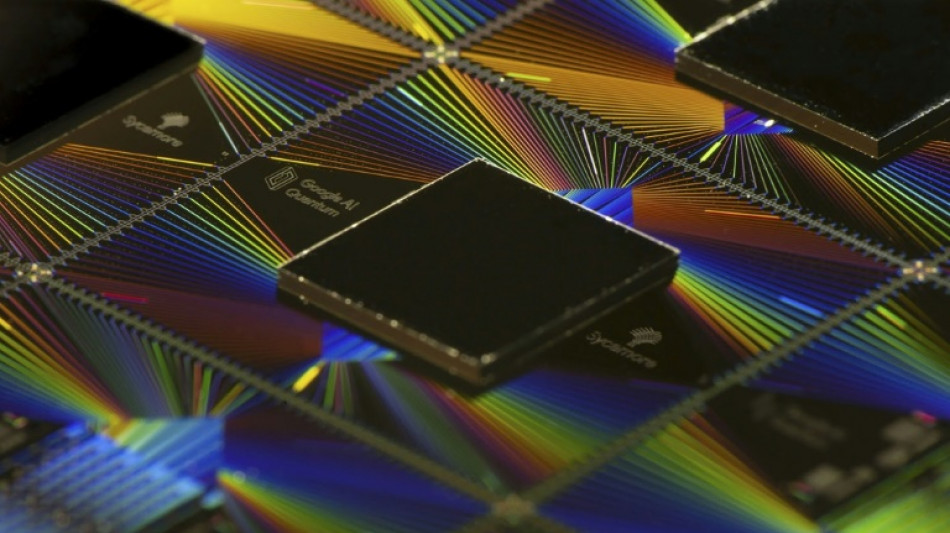
Google hails 'key milestone' in quantum computing / Photo: © GOOGLE/AFP/File

Google hails 'key milestone' in quantum computing

Google scientists said Wednesday they have passed a major milestone in their quest to develop effective quantum computing, with a new study showing they reduced the rate of errors -- long an obstacle for the much-hyped technology.

Text size:

Quantum computing has been touted as a revolutionary advance that uses our growing scientific understanding of the subatomic world to create a machine with powers far beyond those of today's conventional computers.

However the technology remains largely theoretical, with many thorny problems still standing in the way -- including stubbornly high error rates.

In new research published in the journal Nature, the Google Quantum AI lab described a system that can significantly decrease the error rate.

That could give the US tech giant a step up on its rivals such as IBM, which is also working on superconducting quantum processors.

While traditional computers process information in bits that can be represented by 0 or 1, quantum computers use qubits, which can be a combination of both at the same time.

This property, known as superposition, means that a quantum computer can crunch an enormous number of potential outcomes simultaneously.

The computers harness some of the most mind-boggling aspects of quantum mechanics, including a phenomenon known as "entanglement" -- in which two members of a pair of bits can exist in a single state, even if far apart.

- 'Magic' -

But a problem called decoherence can cause the qubits to lose their information when they leave their quantum state and come into contact with the outside world.

This fragility causes high error rates, which also increase with the number of qubits, frustrating scientists wanting to ramp up their experiments.

However Google's team said it had demonstrated for the first time in practice that a system using error-correcting code can detect and fix errors without affecting the information.

The system was first theorised in the 1990s, however previous attempts had just thrown up more errors, not less, said Google's Hartmut Neven, a co-author of the study.

"But if all components of your system have sufficiently low error rates, then the magic of quantum error correction kicks in," Neven told a press conference.

Julian Kelly, another study co-author, hailed the development as "a key scientific milestone", saying that "quantum error correction is the single most important technology for the future of quantum computing".

Neven said the result was still "not good enough, we need to get to an absolute low error rate".

He added that "there are more steps to come" to achieve the dream of a useable quantum computer.

Google claimed in 2019 it had passed a milestone known as "quantum supremacy", when the tech giant said its Sycamore machine executed a calculation in 200 seconds that would have taken a conventional supercomputer 10,000 years to complete.

However the achievement has since been disputed, with Chinese researchers saying last year that a supercomputer could have beaten Sycamore's time.

H.Ng--ThChM



