
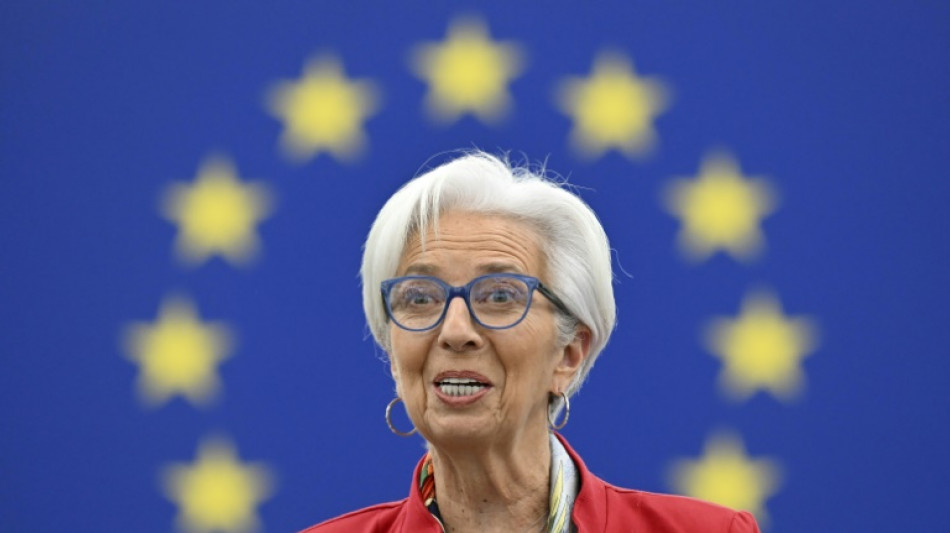
ECB seen hiking rates again, but for how much longer? / Photo: © AFP

The European Central Bank is all but certain to raise interest rates again on Thursday, shifting analysts' attention to how much higher policymakers plan to go in the months ahead to tame inflation.
The ECB's 26-member governing council will "very, very likely" raise interest rates by another half a percentage point at its meeting in Frankfurt, president Christine Lagarde said last week.
It would be the sixth successive increase, leaving the ECB's three main rates 3.5 percentage points higher since July.
The ECB has hiked rates at an historically fast pace to cool consumer prices after energy and food costs shot up in the wake of Russia's war in Ukraine.
With Thursday's decision "a done deal", investors will be more interested in clues about the ECB's future moves, said ING bank economist Carsten Brzeski.
He predicts a "heated discussion" between dovish policymakers wanting to slow down rate hikes to ease the economic pain of higher borrowing costs, and "hawks" pushing to stay the course as inflation remains well above the ECB's two-percent goal.
"The March hike will be less important than what is signalled for May and beyond," Deutsche Bank economists said in a preview note.
- 'Resilient' eurozone -
In the United States, where the Federal Reserve started hiking rates earlier and more aggressively than the ECB, hopes are dimming that the US central bank could soon pause its tightening.
After economic data came in stronger than expected, Fed chief Jerome Powell recently said the "ultimate level of interest rates is likely to be higher than previously anticipated".
The picture is murkier in the eurozone, with revised data showing that the economy stagnated in the fourth quarter of 2022, instead of recording weak growth as initially estimated.
Declining energy prices in recent months have helped slow inflation, which reached 8.5 percent in February, down from 8.6 percent in January.
But excluding volatile energy and food costs, core inflation hit a fresh record high of 5.6 percent, bolstering the argument for further interest rate rises.
Lagarde has vowed to do "whatever it takes" to restore price stability in the 20-nation currency club.
The eurozone economy has proved "resilient" to the fallout from the Ukraine war, she said last week, and unemployment remains low.
Nevertheless, the bank is keeping a close eye on wage growth as higher consumer prices fuel demand for pay rises across Europe -- adding to inflationary pressures.
- New forecasts -
"The ECB needs to be prepared to climb further. We suspect it is," the Deutsche Bank economists said.
Many analysts expect the ECB's bank deposit rate, currently at 2.5 percent, to peak at 3.5-4.0 percent this summer and remain there for some time.
The ECB will be armed with new economic forecasts on Thursday to help guide its decisions.
Back in December, the bank expected inflation to soften to 3.4 percent in 2024 and 2.3 percent in 2025.
Given the recent plunge in natural gas prices, observers now predict a downward revision of those figures.
The ECB does not expect a recession in 2023, and any upward revisions to economic growth forecasts would make it easier for policymakers to back more monetary tightening.
The ECB could on Thursday also give an update on the unwinding of its massive bond portfolio, another key lever in the fight against inflation.
The bank in March began shrinking its balance sheet, a process known as "quantitative tightening (QT)", by 15 billion euros ($16 billion) a month on average.
"As long as market conditions remain favourable, the bank will probably accelerate QT in July," said Capital Economist analyst Jack Allen-Reynolds.
B.Carter--ThChM



