The China Mail - German unions call major transport strike

USD -
AED 3.672504
AFN 64.99959
ALL 80.761235
AMD 360.982284
ANG 1.789785
AOA 917.999795
ARS 1547.4941
AUD 1.424725
AWG 1.8
AZN 1.703496
BAM 1.737655
BBD 2.013789
BDT 124.482471
BGN 1.747831
BHD 0.377511
BIF 2987.543757
BMD 1
BND 1.278142
BOB 12.12307
BRL 5.461698
BSD 0.999876
BTN 94.576825
BWP 13.727633
BYN 2.983457
BYR 19600
BZD 2.010946
CAD 1.395365
CDF 2315.000158
CHF 0.814045
CLF 0.024532
CLP 965.497729
CNY 6.67355
CNH 6.66769
COP 3229.4
CRC 454.196116
CUC 1
CUP 23.996482
CVE 97.96631
CZK 21.568402
DJF 178.04787
DKK 6.639715
DOP 60.044158
DZD 135.847037
EGP 54.720699
ERN 15
ETB 164.108289
EUR 0.888299
FJD 2.24025
FKP 0.745268
GBP 0.741285
GEL 2.597406
GGP 0.745268
GHS 11.633527
GIP 0.745268
GMD 74.000152
GNF 8857.12128
GTQ 7.640777
GYD 209.490556
HKD 7.84374
HNL 26.874159
HRK 6.76901
HTG 130.993736
HUF 321.820972
IDR 18089.05
ILS 3.153904
IMP 0.745268
INR 94.292795
IQD 1515.805747
IRR 1883408.497579
ISK 121.350142
JEP 0.745268
JMD 158.490264
JOD 0.709023
JPY 157.906976
KES 129.939873
KGS 87.450338
KHR 4065.567945
KMF 440.999846
KPW 899.999961
KRW 1344.389738
KWD 0.31072
KYD 0.8332
KZT 451.907529
LAK 22510.972511
LBP 89536.844537
LKR 332.702525
LRD 169.971747
LSL 16.458322
LTL 2.95274
LVL 0.60489
LYD 6.411145
MAD 9.767223
MDL 17.932726
MGA 4516.054516
MKD 54.694998
MMK 2099.52083
MNT 3598.087189
MOP 8.0795
MRU 40.672394
MUR 47.089769
MVR 15.454964
MWK 1733.74558
MXN 18.549496
MYR 4.049303
MZN 63.909535
NAD 16.458322
NGN 1345.80733
NIO 36.791229
NOK 9.290185
NPR 151.327626
NZD 1.769895
OMR 0.384494
PAB 0.999964
PEN 3.451055
PGK 4.486835
PHP 63.136501
PKR 276.584484
PLN 3.896245
PYG 6062.867601
QAR 3.645272
RON 4.745298
RSD 104.493047
RUB 81.798631
RWF 1471.300315
SAR 3.756339
SBD 8.051718
SCR 13.898677
SDG 601.501901
SEK 9.70178
SGD 1.276795
SHP 0.745545
SLE 22.910107
SLL 20969.504398
SOS 571.481881
SRD 37.56398
STD 20697.981008
STN 21.767813
SVC 8.74869
SYP 13001.999685
SZL 16.449882
THB 33.443033
TJS 9.223662
TMT 3.51
TND 2.979992
TOP 2.40776
TRY 50.042497
TTD 6.77808
TWD 32.955404
TZS 2649.997953
UAH 45.533522
UGX 4104.696412
UYU 40.202925
UZS 11888.515735
VES 890.036604
VND 25690
VUV 119.472328
WST 2.779309
XAF 582.685991
XAG 0.018789
XAU 0.000241577987
XCD 2.70255
XCG 1.801979
XDR 0.707052
XOF 582.685991
XPF 105.958029
YER 236.174995
ZAR 16.332032
ZMK 9001.185115
ZMW 20.278266
ZWL 321.999592
SSP 5745.96484
MXV 2.087959
  • RYCEF

    0.4000

    19.71

    +2.03%

  • CMSC

    0.0000

    20.4

    0%

  • BTI

    0.4200

    56.05

    +0.75%

  • BP

    0.2800

    44.43

    +0.63%

  • RBGPF

    1.6000

    67

    +2.39%

  • RIO

    -0.1500

    94.41

    -0.16%

  • AZN

    -0.4300

    166.15

    -0.26%

  • GSK

    0.4600

    49.7

    +0.93%

  • BCE

    -0.4100

    20.56

    -1.99%

  • NGG

    -0.2500

    75.24

    -0.33%

  • VOD

    -0.0400

    16.58

    -0.24%

  • RELX

    -0.4500

    33.07

    -1.36%

  • BCC

    -0.5500

    76.59

    -0.72%

  • CMSD

    -0.0300

    20.27

    -0.15%

  • JRI

    -0.2500

    10.77

    -2.32%

German unions call major transport strike
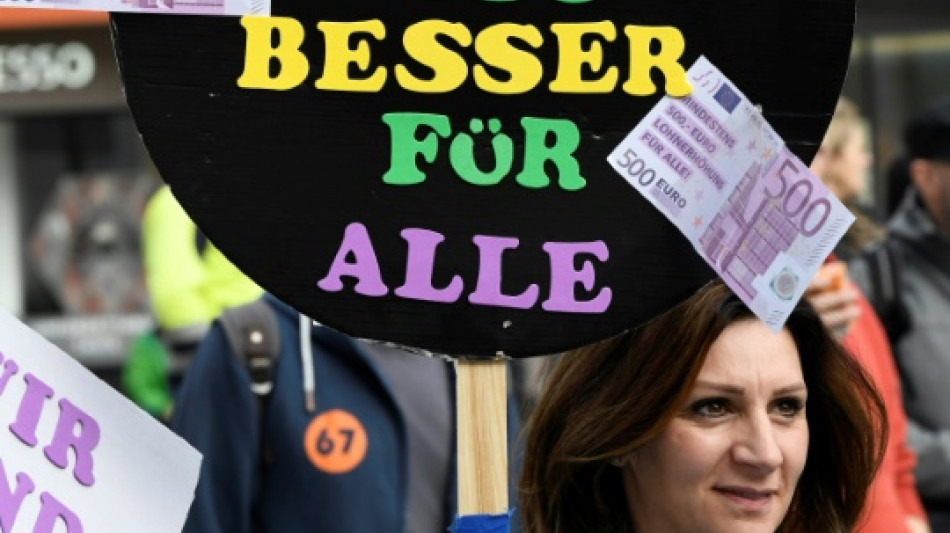
German unions call major transport strike / Photo: © AFP

German unions call major transport strike

Transport across much of German will be paralysed Monday as workers strike demanding higher wages to cope with surging inflation, the latest industrial action in Europe's top economy.

Text size:

Staff at airports, ports, the railways, buses and subways will walk out across large parts of the country, the Verdi and EVG unions announced on Thursday.

"We think there will be extensive participation in the strike," Verdi chief Frank Werneke told a press conference.

EVG chief Martin Burkert accused employers -- who have mostly refused hefty pay demands -- of "turning a blind eye to the economic hardship of the workers that we represent".

It follows a series of strikes in recent months in Germany in numerous areas, from the postal service to airports and local transport.

Like in many other countries, Germans are struggling with high inflation -- it hit 8.7 percent in February -- after Russia's invasion of Ukraine sent food and energy costs soaring.

Verdi represents some 2.5 million public sector employees, while EVG represents workers on the railways and at bus companies.

It is rare for unions to join forces to call a strike in Germany, and it follows a series of failed talks with employers in recent weeks.

Verdi is demanding a rise of 10.5 percent in monthly salaries, while EVG is demanding a 12 percent rise for those it represents.

Employers, mostly the state and public sector companies, have so far refused the demands, instead offering a rise of five percent with two one-off payments of 1,000 ($1,100) and 1,500 euros, this year and next.

- Spreading strikes -

The announcement of fresh industrial action came ahead of a third round of salary negotiations for public sector workers, which begin on Monday.

Transport services have already been hit by strikes.

Earlier in March, Bremen, Berlin, Hamburg and Hanover airports cancelled more than 350 flights after security staff walked out while bus and metro staff in Frankfurt also staged a strike.

On the other side, employers representatives are warning that unions are making unreasonable demands and risk alienating the public with the growing wave of strike action.

"What impression is created of the public service, especially at a time when we are talking about a disproportionate shortage of skilled workers?" said Karin Welge, from the Confederation of Municipal Employers' Associations.

"We have a common duty to strengthen the public service."

Some unions have however succeeded in winning big pay increases.

Postal workers won average monthly increases of 11.5 percent earlier in March, and in November IG Metall, Germany's biggest union, won hikes totally 8.5 percent for almost four million employees that it represents.

Strikes have spread across public services, from hospitals to nurseries, as the hard-fought pay talks play out.

Earlier this week, teachers staged a demonstration in Berlin.

"We are a rich country and I think society should be able to say that we give children... a good education," said Jan Exner Konrad, 34.

"We just can't guarantee that right now because there are far too few teachers and many students in the classes."

O.Yip--ThChM



