The China Mail - Coming years 'critical' to slash plastic pollution: UN

USD -
AED 3.672494
AFN 64.999743
ALL 80.761235
AMD 360.982284
ANG 1.789785
AOA 917.000094
ARS 1547.506848
AUD 1.426544
AWG 1.8
AZN 1.697068
BAM 1.737655
BBD 2.013789
BDT 124.482471
BGN 1.747831
BHD 0.377511
BIF 2987.543757
BMD 1
BND 1.278142
BOB 12.12307
BRL 5.460698
BSD 0.999876
BTN 94.576825
BWP 13.727633
BYN 2.983457
BYR 19600
BZD 2.010946
CAD 1.39503
CDF 2314.999866
CHF 0.81448
CLF 0.024532
CLP 965.479702
CNY 6.669799
CNH 6.66659
COP 3229.75
CRC 454.196116
CUC 1
CUP 23.996482
CVE 97.96631
CZK 21.56415
DJF 178.04787
DKK 6.637502
DOP 60.044158
DZD 135.825634
EGP 54.653305
ERN 15
ETB 164.108289
EUR 0.88795
FJD 2.24175
FKP 0.743037
GBP 0.741195
GEL 2.605024
GGP 0.743037
GHS 11.633527
GIP 0.743037
GMD 74.503195
GNF 8859.999896
GTQ 7.640777
GYD 209.490556
HKD 7.844265
HNL 26.874159
HRK 6.76901
HTG 130.993736
HUF 321.798964
IDR 18102
ILS 3.15995
IMP 0.743037
INR 94.510797
IQD 1515.805747
IRR 1883408.498647
ISK 121.310194
JEP 0.743037
JMD 158.490264
JOD 0.709012
JPY 157.938497
KES 129.95052
KGS 87.449977
KHR 4065.567945
KMF 441.000169
KPW 899.999961
KRW 1343.175028
KWD 0.31068
KYD 0.8332
KZT 451.907529
LAK 22510.972511
LBP 89536.844537
LKR 332.702525
LRD 169.971747
LSL 16.458322
LTL 2.95274
LVL 0.60489
LYD 6.411145
MAD 9.767223
MDL 17.932726
MGA 4516.054516
MKD 54.652015
MMK 2099.845134
MNT 3601.453525
MOP 8.0795
MRU 40.672394
MUR 47.009856
MVR 15.455007
MWK 1733.74558
MXN 18.570715
MYR 4.048101
MZN 63.910382
NAD 16.458322
NGN 1346.410288
NIO 36.791229
NOK 9.297399
NPR 151.327626
NZD 1.771905
OMR 0.384504
PAB 0.999964
PEN 3.451055
PGK 4.486835
PHP 63.100501
PKR 276.584484
PLN 3.89515
PYG 6062.867601
QAR 3.645272
RON 4.742802
RSD 104.472028
RUB 81.802231
RWF 1471.300315
SAR 3.756339
SBD 8.051718
SCR 13.835724
SDG 601.506428
SEK 9.703815
SGD 1.276498
SHP 0.745545
SLE 22.909899
SLL 20969.504398
SOS 571.481881
SRD 37.563991
STD 20697.981008
STN 21.767813
SVC 8.74869
SYP 13001.999685
SZL 16.449882
THB 33.434032
TJS 9.223662
TMT 3.51
TND 2.979992
TOP 2.40776
TRY 50.043497
TTD 6.77808
TWD 33.008496
TZS 2647.034973
UAH 45.533522
UGX 4104.696412
UYU 40.202925
UZS 11888.515735
VES 893.768982
VND 25682.5
VUV 119.655093
WST 2.783161
XAF 582.45706
XAG 0.019006
XAU 0.000242506548
XCD 2.70255
XCG 1.801979
XDR 0.707052
XOF 582.45706
XPF 105.958029
YER 236.175026
ZAR 16.354298
ZMK 9001.195056
ZMW 20.278266
ZWL 321.999592
SSP 5745.516508
MXV 2.089813
  • RYCEF

    0.4000

    19.71

    +2.03%

  • CMSC

    0.0000

    20.4

    0%

  • BTI

    0.4200

    56.05

    +0.75%

  • BP

    0.2800

    44.43

    +0.63%

  • RBGPF

    1.6000

    67

    +2.39%

  • RIO

    -0.1500

    94.41

    -0.16%

  • AZN

    -0.4300

    166.15

    -0.26%

  • GSK

    0.4600

    49.7

    +0.93%

  • BCE

    -0.4100

    20.56

    -1.99%

  • NGG

    -0.2500

    75.24

    -0.33%

  • VOD

    -0.0400

    16.58

    -0.24%

  • RELX

    -0.4500

    33.07

    -1.36%

  • BCC

    -0.5500

    76.59

    -0.72%

  • CMSD

    -0.0300

    20.27

    -0.15%

  • JRI

    -0.2500

    10.77

    -2.32%

Coming years 'critical' to slash plastic pollution: UN
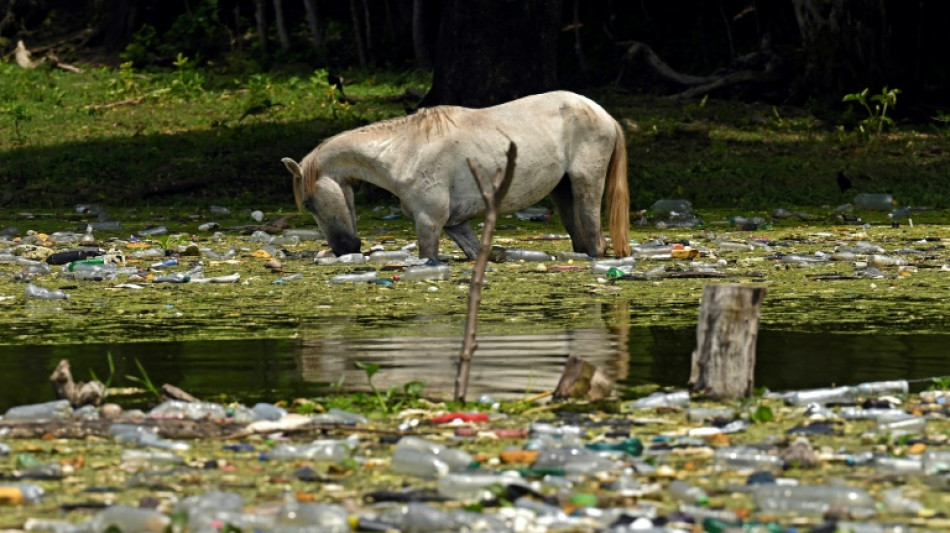
Coming years 'critical' to slash plastic pollution: UN / Photo: © AFP

Coming years 'critical' to slash plastic pollution: UN

The world must halve single-use plastics and slash throwaway consumption to stem the tide of environmental pollution, according to a UN report on Tuesday that warns the next few years are critical.

Text size:

Concern is growing about the impacts of microplastics -- produced when plastic products break down in the environment -- which have been found from the deepest oceans trenches to top of Mount Everest.

In humans, they have been detected in blood, breast milk and placentas.

The report by the United Nations Environment Programme (UNEP) comes two weeks before negotiators from nearly 200 countries meet in Paris for a new round of negotiations aimed at reaching a legal agreement next year to end plastic pollution.

It lays out a three-pronged plan based on reuse, recycling and diversifying the materials used -- to help slash plastic pollution 80 percent by 2040 overall and cut single-use plastic production by half.

The report cited research estimating plastic could emit 19 percent of global greenhouse gas emissions by 2040.

That would essentially prevent the world from meeting its Paris Agreement commitment to limit the rise in the planet's average temperature to 1.5 degrees Celsius above the pre-industrial level.

"The way we produce, use and dispose of plastics is polluting ecosystems, creating risks for human health and destabilising the climate," said Inger Andersen, UNEP executive director.

She said the roadmap laid out in the report "dramatically reduces these risks, through adopting a circular approach that keeps plastics out of ecosystems, out of our bodies and in the economy".

- Reuse, recycle, replace -

In 2020, approximately 238 million metric tonnes (mmt) of waste from short-lived plastics -- like packaging that ends up in municipal waste -- was generated worldwide.

Roughly half of that was mismanaged -- for example dumped in the environment or burned.

Without significant changes, UNEP expects annual plastic waste to reach 408 mmt by 2040, including 380 mmt of new fossil-fuel-based plastics. That would mean some 227 mmt of plastics would end up in the environment.

The report estimates that with a range of "systems change" solutions, that pollution figure could be reduced to 41 mmt.

But the report says there is no time to waste.

"The next three to five years present a critical window for action to set the world on the path towards implementing the systems change scenario by 2040," it warned.

Reuse in particular was identified as the most effective measure -- cutting plastic pollution up to 30 percent by 2040 -- with the introduction of things like refillable water bottles, packaging take-back schemes and "reverse vending machines".

While governments have to incentivise the shift, consumers will have to "forego convenience of disposable and get used to products looking less shiny".

Better recycling could cut pollution by a fifth, the report found, while replacing plastics with alternatives, like paper or other compostable materials, could help cut waste another 17 percent.

O.Yip--ThChM



