The China Mail - Germany in recession as inflation, higher interest bite

USD -
AED 3.672494
AFN 64.999743
ALL 80.761235
AMD 360.982284
ANG 1.789785
AOA 917.000094
ARS 1547.506848
AUD 1.426544
AWG 1.8
AZN 1.697068
BAM 1.737655
BBD 2.013789
BDT 124.482471
BGN 1.747831
BHD 0.377511
BIF 2987.543757
BMD 1
BND 1.278142
BOB 12.12307
BRL 5.460698
BSD 0.999876
BTN 94.576825
BWP 13.727633
BYN 2.983457
BYR 19600
BZD 2.010946
CAD 1.39503
CDF 2314.999866
CHF 0.81448
CLF 0.024532
CLP 965.479702
CNY 6.669799
CNH 6.66659
COP 3229.75
CRC 454.196116
CUC 1
CUP 23.996482
CVE 97.96631
CZK 21.56415
DJF 178.04787
DKK 6.637502
DOP 60.044158
DZD 135.825634
EGP 54.653305
ERN 15
ETB 164.108289
EUR 0.88795
FJD 2.24175
FKP 0.743037
GBP 0.741195
GEL 2.605024
GGP 0.743037
GHS 11.633527
GIP 0.743037
GMD 74.503195
GNF 8859.999896
GTQ 7.640777
GYD 209.490556
HKD 7.844265
HNL 26.874159
HRK 6.76901
HTG 130.993736
HUF 321.798964
IDR 18102
ILS 3.15995
IMP 0.743037
INR 94.510797
IQD 1515.805747
IRR 1883408.498647
ISK 121.310194
JEP 0.743037
JMD 158.490264
JOD 0.709012
JPY 157.938497
KES 129.95052
KGS 87.449977
KHR 4065.567945
KMF 441.000169
KPW 899.999961
KRW 1343.175028
KWD 0.31068
KYD 0.8332
KZT 451.907529
LAK 22510.972511
LBP 89536.844537
LKR 332.702525
LRD 169.971747
LSL 16.458322
LTL 2.95274
LVL 0.60489
LYD 6.411145
MAD 9.767223
MDL 17.932726
MGA 4516.054516
MKD 54.652015
MMK 2099.845134
MNT 3601.453525
MOP 8.0795
MRU 40.672394
MUR 47.009856
MVR 15.455007
MWK 1733.74558
MXN 18.570715
MYR 4.048101
MZN 63.910382
NAD 16.458322
NGN 1346.410288
NIO 36.791229
NOK 9.297399
NPR 151.327626
NZD 1.771905
OMR 0.384504
PAB 0.999964
PEN 3.451055
PGK 4.486835
PHP 63.100501
PKR 276.584484
PLN 3.89515
PYG 6062.867601
QAR 3.645272
RON 4.742802
RSD 104.472028
RUB 81.802231
RWF 1471.300315
SAR 3.756339
SBD 8.051718
SCR 13.835724
SDG 601.506428
SEK 9.703815
SGD 1.276498
SHP 0.745545
SLE 22.909899
SLL 20969.504398
SOS 571.481881
SRD 37.563991
STD 20697.981008
STN 21.767813
SVC 8.74869
SYP 13001.999685
SZL 16.449882
THB 33.434032
TJS 9.223662
TMT 3.51
TND 2.979992
TOP 2.40776
TRY 50.043497
TTD 6.77808
TWD 33.008496
TZS 2647.034973
UAH 45.533522
UGX 4104.696412
UYU 40.202925
UZS 11888.515735
VES 893.768982
VND 25682.5
VUV 119.655093
WST 2.783161
XAF 582.45706
XAG 0.019006
XAU 0.000242506548
XCD 2.70255
XCG 1.801979
XDR 0.707052
XOF 582.45706
XPF 105.958029
YER 236.175026
ZAR 16.354298
ZMK 9001.195056
ZMW 20.278266
ZWL 321.999592
SSP 5745.516508
MXV 2.089813
  • RYCEF

    0.4000

    19.71

    +2.03%

  • CMSC

    0.0000

    20.4

    0%

  • BTI

    0.4200

    56.05

    +0.75%

  • BP

    0.2800

    44.43

    +0.63%

  • RBGPF

    1.6000

    67

    +2.39%

  • RIO

    -0.1500

    94.41

    -0.16%

  • AZN

    -0.4300

    166.15

    -0.26%

  • GSK

    0.4600

    49.7

    +0.93%

  • BCE

    -0.4100

    20.56

    -1.99%

  • NGG

    -0.2500

    75.24

    -0.33%

  • VOD

    -0.0400

    16.58

    -0.24%

  • RELX

    -0.4500

    33.07

    -1.36%

  • BCC

    -0.5500

    76.59

    -0.72%

  • CMSD

    -0.0300

    20.27

    -0.15%

  • JRI

    -0.2500

    10.77

    -2.32%

Germany in recession as inflation, higher interest bite
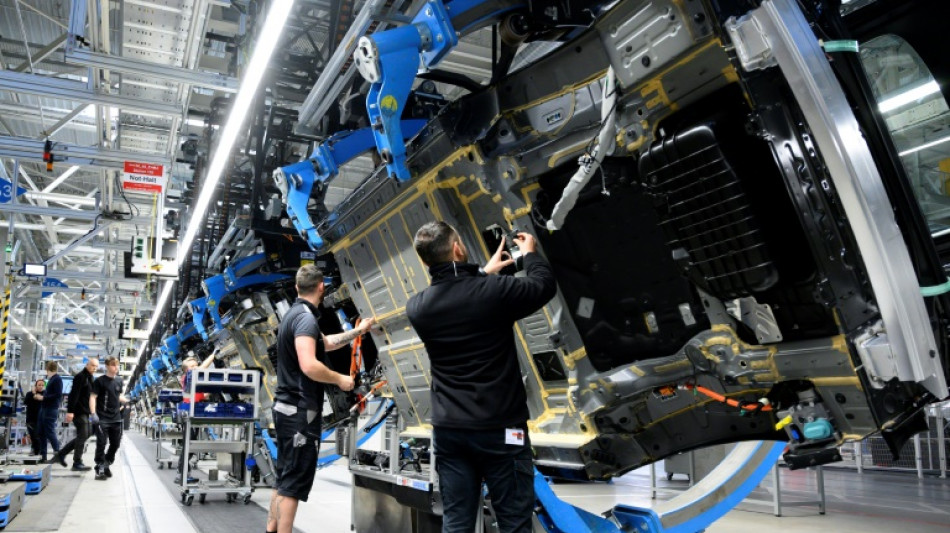
Germany in recession as inflation, higher interest bite / Photo: © AFP/File

Germany in recession as inflation, higher interest bite

Germany fell into a recession around the turn of the year, official figures published Thursday showed, as inflation and higher interest rates curbed demand in Europe's largest economy.

Text size:

Over the first three months of 2023, the economy shrank by 0.3 percent, the federal statistics agency Destatis said, downgrading an initial estimate of zero percent.

Following a 0.5-percent contraction in the last three months of 2022, it was Germany's second consecutive quarter of negative growth -- the threshold for a "technical recession".

The slump came as Germany battled a surge in energy prices in the wake of the Russian invasion of Ukraine, which has weighed on households and businesses.

The increased cost of energy has driven inflation, which sat at 7.2 percent in Germany in April, down only slightly from its peak towards the end of 2022.

"The persistence of high price increases continued to be a burden on the German economy at the start of the year," Destatis said in a statement.

The impact was felt particularly by consumers who reined in their spending on items such as food and clothing.

The negative revision to the growth figure was no surprise following a string of weak economic indicators, LBBW bank analyst Jens-Oliver Niklasch said.

"The early indicators suggest that things will continue to be similarly weak in the second quarter" of 2023, Niklasch said.

Industrial orders, which give a foretaste of factory output, plummeted in March when compared with the same month last year.

- 'Danger zone' -

Germany, which had long been heavily reliant on Russian energy imports, was left particularly exposed following the Russian invasion in February last year.

The curtailment of gas supplies in particular left Berlin scrambling to find new sources of energy and fill reserves ahead of what was anticipated to be a harsh winter at the end of 2022

The slump was "not the worst-case scenario of a severe recession" predicted by some following the Russian invasion, said Carsten Brzeski, head of macro at the ING bank.

But mild temperatures, a rebound in key market China and the easing of supply chain problems following the coronavirus pandemic were "not enough to get the economy out of the recessionary danger zone", Brzeski said.

"A drop in purchasing power, thinned-out industrial order books as well as the impact of the most aggressive monetary policy tightening in decades" were likely to drag on the economy further, he said, referring to the European Central Bank's interest rate hikes against inflation.

An anticipated slowdown in the US economy and the continuation of the war in Ukraine would also weigh on output, he said.

The figures will trouble policymakers in Berlin who in April raised their forecast for economic growth in 2023 to 0.4 percent, amid early year optimism.

German Chancellor Olaf Scholz had previously signalled confidence that Germany had done enough to fend off a painful economic contraction.

Germany's last recession came as the coronavirus pandemic swept through Europe at the start of 2020, prompting governments to effectively shut down large swathes of the economy.

K.Leung--ThChM



