
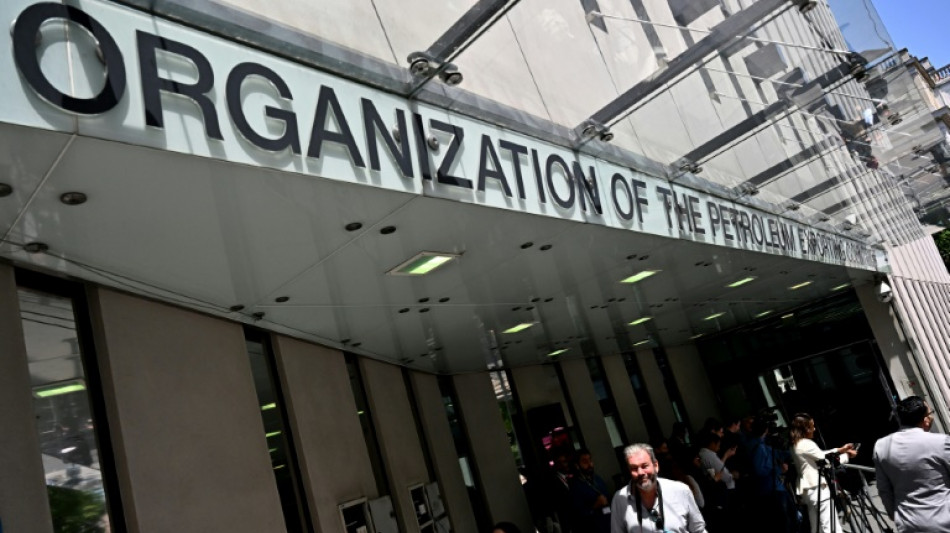
OPEC+ weighs fresh production cuts to rein in weak prices / Photo: © AFP

There are growing signs that major oil producers led by Saudi Arabia and Russia are considering slashing production further when they meet on Sunday in a bid to prop up prices.
The 13-member Organization of the Petroleum Exporting Countries (OPEC) is due to consult with 10 other oil-producing nations, including Russia, to review the grouping's future output policy.
The in-person OPEC+ meetings are set to take place from 0800 GMT Sunday in Vienna.
Analysts had expected OPEC+ producers to maintain their current policy, but signs emerged Saturday that staying the course might fall short of sufficiently stabilising the oil market.
In April, several OPEC+ members agreed to voluntarily cut production by more than one million barrels per day (bpd) -- a surprise move which briefly buttressed prices, but failed to bring about lasting recovery.
Oil producers are grappling with falling prices and high market volatility amid the Russian invasion of Ukraine, which has upended economies worldwide.
Most delegations remained tight-lipped or declined to comment on possible policy decisions as they arrived in the Austrian capital for their Saturday meetings.
Analysts were divided over whether heavyweights Riyadh and Moscow would keep the group on course with its current output policy, or further curtail production.
An output cut of 700,000 bpd to one million bpd was one of the options being discussed, a source close to the discussions told AFP, stressing that nothing was set in stone.
"There was no discussion of production volume today," Iran's OPEC governor Amir Hossein Zamaninia told AFP on Saturday, adding that all options still remained "on the table" for Sunday's gathering.
- Recession fears -
Oil prices have plummeted by about 10 percent since the April cuts were announced, with Brent crude falling close to $70 a barrel, a level it has not traded below since December 2021.
Traders worry that demand will slump, with concerns about the health of the global economy as the United States battles inflation with higher interest rates and China's post-Covid rebound stutters.
On arriving in Vienna, where OPEC is headquartered, Emirati energy minister Suhail Mohamed Al Mazrouei said he expected the outcome of Sunday's ministerial meeting to "balance the market and ensure we are ready for any challenges in the future".
Amid fears of economic slowdown, "the probability of a new production cut being announced has considerably increased", UBS analyst Giovanni Staunovo told AFP, adding that he still believed OPEC+ would decide on a rollover.
However, Yousef Alshammari of CMarkits said he expected Saudi Arabia "to push for a cut of at least half a million bpd".
- 'United front' -
It remains to be seen whether Riyadh will manage to convince Moscow to further curtail output, as Russia is dependent on oil revenues with its war in Ukraine dragging on and Western sanctions hitting its economy.
Russia's Deputy Prime Minister Alexander Novak "sees no need for OPEC+ to change course" because it would hardly benefit from higher prices, Commerzbank commodity analysts said in a research note.
Russia has been shipping its oil to India and China as the Asian giants soak up the cheap crude.
Saudi Arabia, on the other hand, "does need higher prices to balance its budget", Commerzbank analysts said, adding that the kingdom's break-even price is currently "at a good 80 dollars per barrel".
Despite the recent tensions, both OPEC+ top producers "will no doubt be keen to keep the cartel together, as it has more power thanks to the united front it is showing".
In March 2020 the alliance was pushed to the brink of collapse when Moscow refused to cut its oil production even as the Covid pandemic sent prices into freefall.
After negotiations broke down, Riyadh flooded the market by boosting its oil exports to record levels.
Both cartel leaders eventually came to an agreement.
"Saudi Arabia doesn't want that scenario to come back -- neither does Russia," said Alshammari.
Q.Yam--ThChM



