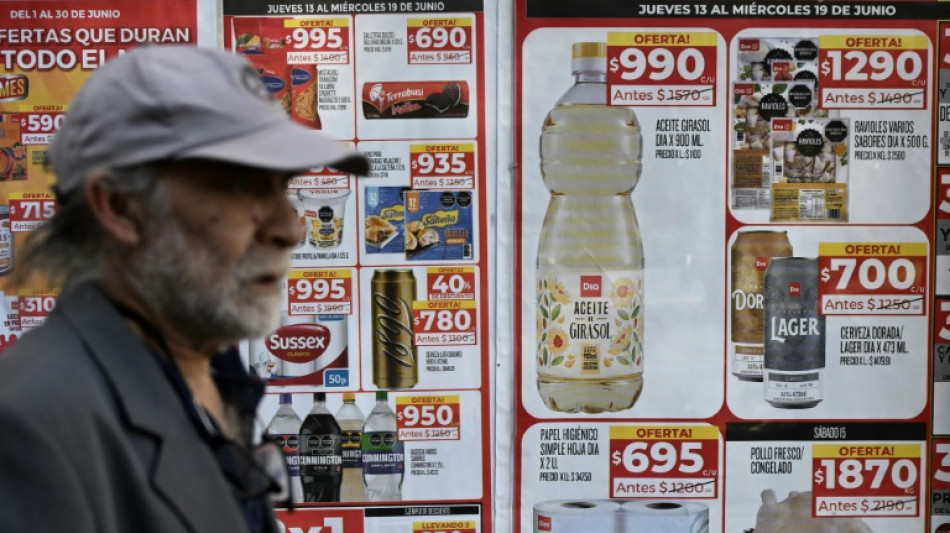
Argentine monthly inflation lowest in 2.5 years / Photo: © AFP

Monthly inflation in economically troubled Argentina came in at 4.2 percent in May, the lowest in two-and-a-half years, mainly due to a drop in consumption, the INDEC statistics agency said Thursday.
For the first five months of 2024, the rate came in at 71.9 percent, and year-on-year at 276.4 percent -- down from 289.4 percent registered in April but still at record high levels.
The rate fell for the fifth successive month in May.
In December, when budget-slashing President Javier Milei took office, inflation leapt by 25.5 percent, provoked by his devaluation of the peso by more than 50 percent.
Self-declared "anarcho-capitalist" Milei has vowed to halt Argentina's economic decline and reduce the budget deficit to zero.
He has slashed public spending, cut the cabinet in half, done away with 50,000 public jobs, suspended new public works contracts and ripped away fuel and transport subsidies.
In April, Milei hailed the South American country's first quarterly budget surplus since 2008.
Economy Minister Luis Caputo on Thursday celebrated the May data as indicating a "deepening of the ongoing disinflation process."
- 'Significant fall in consumption' -
Critics say Milei's few wins have come at the cost of the poor and working classes, and were unlikely to last.
Economist Hernan Letcher of the CEPA economics think tank told AFP the inflation drop was explained, in large part, by a "significant fall in consumption."
"We consultants expect that the process of reducing the rate of inflation will not continue in June," he said.
"The market expectation survey shows that a level in the order of five percent will be maintained until the end of the year."
Consumer consumption, manufacturing and construction have slumped under Milei's peso devaluation and budget cuts, with a 5.3 percent contraction in economic activity in the first quarter.
The International Monetary Fund expects the Argentine economy to contract by 2.8 percent this year, after a 1.6-percent decline in 2023.
The government this week reported a 16-percent increase in real wages in the private sector in April and a recovery of purchasing power that is the "most significant since 2009."
It is a relative figure, however, in a country where informal employment accounted for more than 45 percent of the work force even before the impact of Milei's austerity measures started hitting home.
Poverty in the South American country now stands at 55.5 percent, according to the Pontifical Catholic University's Social Debt Monitor.
Last month, Argentina introduced a 10,000-peso banknote, worth the equivalent of about $11 -- five times the face value of the previous biggest 2,000-peso bill.
Thursday's inflation data came hours after a first victory for Milei in the Senate, which approved a modified version of his economic liberalization package.
Milei's bill, which makes provision for privatization of state-owned companies and weakens labor protections, have raised the ire of workers and leftists, who fought running battles with police outside Congress on Wednesday.
The draft legislation must still be given a final green light by the lower house Chamber of Deputies.
Q.Yam--ThChM