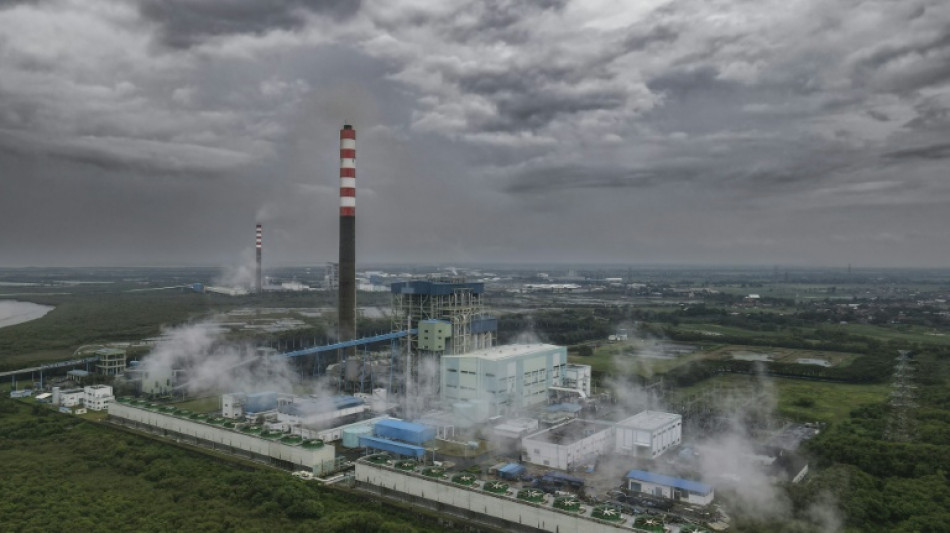
Back to black: facing energy shock, Asia turns to coal / Photo: © AFP

Asian countries are ramping up use of polluting coal to tackle energy shortages and price spikes linked to the Iran war, but the crisis could have an environmental silver lining.
While leaning on the fossil fuel will raise emissions in the near term, the energy crisis is demonstrating the risks of energy import dependence, and could push policymakers to embrace renewables faster, analysts told AFP.
"The ongoing Iran oil and gas crisis shows the importance of having domestic energy sources that are not exposed to the global commodity market, which coal is," said Amy Kong, research analyst at Zero Carbon Analytics.
"Countries like Vietnam who have rapidly increased their share of solar generation, have a stronger buffer against rising energy import prices," Kong said.
Much of Asia is heavily exposed to the energy crisis that has unfolded since the US-Israel attack on Iran began last month.
More than 80 percent of the crude oil and liquified natural gas (LNG) that passes through the Strait of Hormuz heads to Asia, according to the US Energy Information Administration.
Pakistan, India and Bangladesh are all major importers of LNG from Qatar, which said last week that its export capacity had been slashed by 17 percent because of Iranian attacks.
It warned it would be forced to declare force majeure for up to five years on some long-term LNG contracts, signalling it may be unable to fulfill the agreements.
- Higher prices -
Compounding the problem, most Asian countries do not have underground gas storage, according to the Institute for Energy Economics and Financial Analysis, leaving them especially vulnerable to price spikes.
As a result, many nations are bumping up use of coal, which can be sourced regionally or even domestically, to prevent power outages and protect citizens from severe price shocks.
While it cannot be substituted directly in LNG plants, countries can run existing coal power plants at a higher capacity or bring idle units back online.
The shift has come in wealthy and developing economies alike.
In South Korea, a cap on how much power can be generated from coal has been lifted, while Thailand is preparing to resume operations at two coal power units decommissioned last year.
In India, already highly dependent on coal for electricity generation, the fuel is now being substituted for cooking gas.
And in the Philippines, energy secretary Sharon Garin told AFP authorities "plan to ramp up cheaper coal, (domestic) natural gas, and renewables".
The increase in demand has pushed coal prices higher and even sparked talk of a windfall tax in coal-producing Indonesia, which reversed a decision taken last year to reduce production.
The shift is bad news for the environment in the short term. Coal is a top contributor to planet-warming greenhouse gases, and also a powerful air pollutant that is harmful for human health.
- 'Transition fuel' -
The shift will "impose substantial environmental and public health costs," said Dinita Setyawati, senior energy analyst for Asia at think tank Ember.
Asia's vulnerability is due in part to its heavy reliance on LNG, often promoted as a "transition fuel" -- a less polluting option than coal that can "bridge the gap" as countries move towards renewable energy.
Upfront costs for LNG plants can be lower than for renewables that may require grid upgrades.
But renewables are now cheaper in the long run, and the current crisis is illustrating their benefits in terms of stable supply, said Putra Adhiguna, managing director at Energy Shift Institute, an energy finance think tank.
"The story of gas as a stable transition fuel is highly in question," he said.
And while temporary increases in coal capacity are an attractive stopgap, the banking sector is reluctant to finance construction of new coal projects, concerned about stranded assets as nations are forced to phase down fossil fuels to meet their climate obligations.
That could help refocus policymakers' attention on the benefits of renewables, said Adhiguna.
"I think we already see a bit of that coming from Southeast Asian countries," he said.
"There have been all these debates about how we can't afford to spend the money (on renewables) upfront, but I think this security of supply issue is going to override that."
X.Gu--ThChM