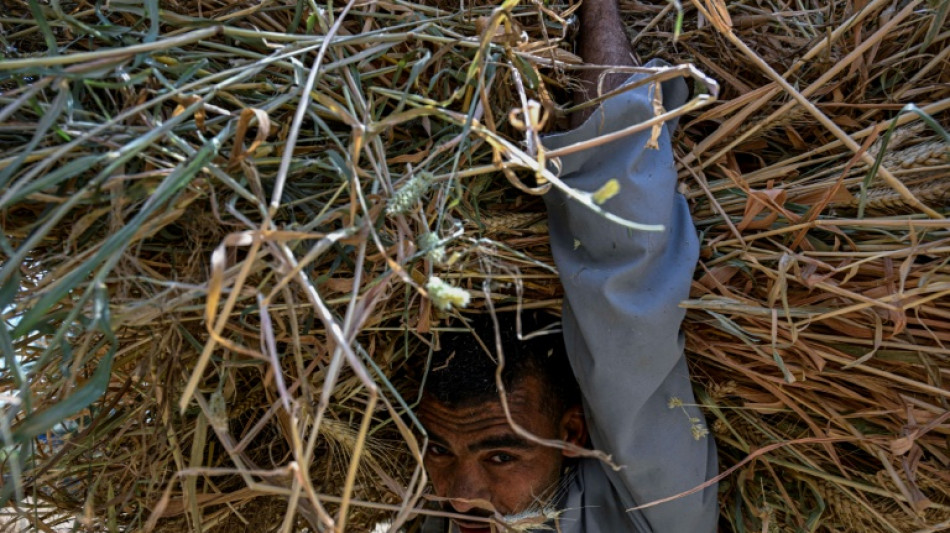
Egypt farmers hit by Iran war price surge / Photo: © AFP/File

Egyptian smallholders have seen their lives upended by the war in Iran, with soaring fertiliser and energy prices forcing many to lay off workers and reduce the amount of land they farm.
Before the United States and Israel launched the war that would end up engulfing the region, Ashraf Abu Ragab cultivated a full acre with a small crew.
Now he farms just half on his own after sacking the workers he once relied on, and has quit growing wheat, a fertiliser-intensive crop.
"Everything has become more expensive," the 45-year-old told AFP, standing among rows of maize and sesame in the village of Nazlet Al-Shobak, about 50 kilometres (30 miles) south of Cairo.
"Fertilisers, seeds, chemicals. The crops no longer cover their costs."
With most expenses nearly doubling since the war began, Abu Ragab said farming "no longer pays", forcing painful cutbacks.
"I used to have three workers. Now I work with my own hands."
He is among thousands of smallholders in the vast nation struggling with rising input costs, from fertilisers and fuel to seeds and feed, as the Iran war hits global markets.
In Nazlet Al-Shobak, irrigation pumps sit idle for hours to conserve fuel.
Some plots lie uncultivated, while thin lines of grass grown as animal fodder weave between vegetables to stretch scarce inputs.
Nearby, dusty sacks of potatoes are piled along the field edges, some loaded onto trucks, others left to sit for weeks, as farmers gamble on prices that rarely improve.
A short walk away, a threshing machine spews clouds of dust and chaff as wheat pours out in a steady stream, rattling into worn brown sacks at farmers' feet.
Watching the harvest, tenant farmer Mohamed Ragab, 40, doubts it will bring profit.
"I will barely get by," he told AFP.
- 'Difficult choices' -
Disruptions to shipping through the Strait of Hormuz, a vital artery for global trade, have hit energy and fertiliser supplies.
In peace time, about one-third of traded fertilisers pass through the waterway, along with one-fifth of liquefied natural gas and 35 percent of crude oil.
Higher fuel costs have directly impacted agriculture, from fertiliser production and irrigation to transport.
"A significant share of critical inputs is being affected," Maximo Torero, chief economist at the UN's Food and Agriculture Organization (FAO), told AFP.
"Farmers will have to make difficult choices, using fewer inputs, switching crops or reducing irrigation, all of which lower yields," he said.
Although Egypt produces seven to eight million tonnes of nitrogen fertiliser annually and exports more than half, domestic access remains uneven.
The strain is compounded by domestic pressures. Egypt relies heavily on imported fuel, leaving it particularly exposed to global energy shocks.
Fuel prices rose by up to 30 percent in March, while the pound has shed around 15 percent of its value since the war began, pushing up the cost of imported seeds and feed.
Nitrogen fertilisers are particularly affected, as natural gas dominates production costs.
Sherif El-Gebaly, head of the Chemical Industries Chamber, told AFP granular urea has risen to $700–$750 per tonne, up from about $400 before the war.
- 'Very hard' -
The strain on farmers contrasts sharply with how fertiliser producers are benefiting from higher global prices and strong export demand.
Abu Qir Fertilizers, one of Egypt's largest nitrogen producers, said unaudited first-quarter profits more than doubled.
"Producers can export or raise prices," said Nader Nour Eldeen, a former supplies ministry advisor and now a Cairo University agriculture professor.
"Smallholder farmers don't have that flexibility," he told AFP.
Hussein Abu Saddam, head of the Farmers' Syndicate, expects fertiliser-intensive crops such as wheat, maize and rice to decline if costs stay high.
"The coming season will be very hard," he said.
Wheat accounts for around a third of Egypt's cultivated land, making any pullback significant for supply.
Egypt also imports 12–14 million tonnes annually to sustain its subsidised bread system.
In Nazlet Al-Shobak, Abu Ragab said he lost about half his investment last season but continues working, uncertain about what comes next.
"If prices stay like this, many farmers won't be able to continue," Abu Saddam said.
Torero warned that even if the Strait of Hormuz reopens tomorrow, markets "will take six to eight months to recover".
"It's not only fertilisers, it's energy, packaging, plastics, cooling," he said. "A whole range of inputs is being disrupted across the value chain."
Q.Moore--ThChM