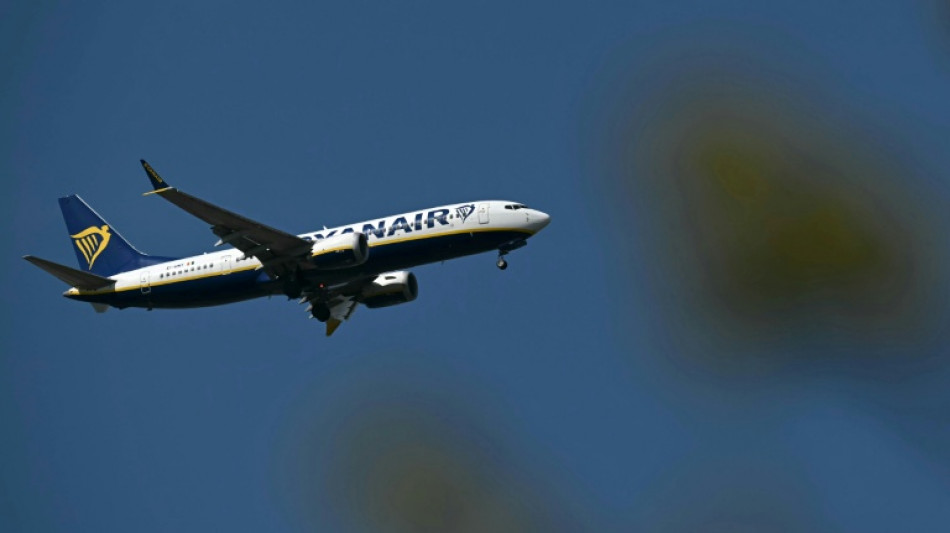
Ryanair flags Iran war uncertainty as annual profit jumps / Photo: © AFP

Irish no-frills carrier Ryanair reported Monday a sharply higher annual profit but warned that the Middle East war has clouded its outlook for the year ahead.
Profit after tax jumped 35 percent to 2.17 billion euros ($2.52 billion) in the 12 months to the end of March compared to the period a year earlier.
Chief executive Michael O'Leary said it was "far too early" to provide meaningful full-year profit guidance because of "significant fuel price/potential supply volatility".
"The conflict in the Middle East has created economic uncertainty and we still don't know when the Strait of Hormuz will reopen," he said in an earnings statement.
Oil prices have soared since the start of the US-Iran war in late February, resulting in much higher jet fuel costs.
Ryanair said it had hedged 80 percent of its fuel costs at $67 a barrel through to April 2027, which should help insulate its earnings amid "very volatile oil markets".
But its full-year outlook remains "heavily exposed to adverse external developments", including any escalation in the Middle East war.
Ryanair's share price fell around three percent in Dublin.
- Cost pressures -
Ryanair said its costs could rise in the year ahead as it faces a higher bill for unhedged fuel costs, as well as crew expenses and aircraft maintenance.
The company also expects European Union environmental taxes to rise by 300 million euros this year.
"Under normal circumstances, Ryanair would respond to cost pressures by putting up fares and passenger charges, but the market environment is currently too fragile," said Dan Coatsworth, head of markets at AJ Bell.
"Consumers are spooked by oil prices shooting up," he said, adding that "it's made the cost of living go up, and that drives more caution towards spending".
Coatsworth added, however, that Ryanair had "a strong enough balance sheet to weather any storms".
In its latest financial year, revenue increased 11 percent to 15.5 billion euros as ticket fares rose.
But fares for its peak July-September period, previously forecast to rise, are now trending flat.
"Pricing in recent weeks has eased somewhat in response to economic uncertainty caused by higher oil prices, the fear of fuel shortages and the risk of inflation adversely impacting consumer spending," O'Leary said.
The group carried 208 million passengers last year, a four-percent annual increase, and is targeting 300 million passengers by 2034.
It expects traffic to rise by another four percent in the current financial year, to 216 million passengers.
The airline added that talks to extend O'Leary's contract until April 2032 have almost concluded.
A.Zhang--ThChM