The China Mail - India launches first hydrogen-powered train in clean energy push

USD -
AED 3.672499
AFN 63.99961
ALL 82.034979
AMD 362.140294
ANG 1.790365
AOA 917.999912
ARS 1520.631701
AUD 1.432767
AWG 1.8025
AZN 1.703552
BAM 1.7375
BBD 2.011772
BDT 122.756127
BGN 1.683441
BHD 0.37705
BIF 2997.5
BMD 1
BND 1.277108
BOB 12.009896
BRL 4.982796
BSD 0.998867
BTN 96.254936
BWP 13.739983
BYN 3.068524
BYR 19600
BZD 2.008697
CAD 1.42143
CDF 2317.481055
CHF 0.83255
CLF 0.024652
CLP 973.389942
CNY 6.704597
CNH 6.703325
COP 3240.73
CRC 457.269266
CUC 1
CUP 23.971252
CVE 98.050042
CZK 21.69235
DJF 177.720235
DKK 6.644185
DOP 60.349837
DZD 134.518181
EGP 52.281398
ERN 15
ETB 161.019593
EUR 0.88888
FJD 2.24675
FKP 0.756613
GBP 0.753925
GEL 2.595002
GGP 0.756613
GHS 11.780375
GIP 0.756613
GMD 73.999933
GNF 8749.999935
GTQ 7.629057
GYD 208.966494
HKD 7.847935
HNL 26.830073
HRK 6.6963
HTG 130.793628
HUF 324.5925
IDR 17862.4
ILS 3.04465
IMP 0.756613
INR 96.37075
IQD 1310
IRR 1732150.000014
ISK 121.95001
JEP 0.756613
JMD 158.718596
JOD 0.709018
JPY 158.413006
KES 129.789879
KGS 87.450216
KHR 4062.500677
KMF 437.999646
KPW 900.000318
KRW 1339.645004
KWD 0.30955
KYD 0.832341
KZT 450.791818
LAK 22479.999927
LBP 89599.999618
LKR 330.203262
LRD 170.999693
LSL 16.529469
LTL 2.95274
LVL 0.60489
LYD 6.429705
MAD 9.967501
MDL 17.823955
MGA 4449.999824
MKD 54.682782
MMK 2099.06815
MNT 3597.6832
MOP 8.073986
MRU 40.159735
MUR 47.409919
MVR 15.409967
MWK 1740.999917
MXN 17.97222
MYR 4.085802
MZN 63.899783
NAD 16.630106
NGN 1324.049913
NIO 36.669827
NOK 9.554306
NPR 154.011674
NZD 1.77919
OMR 0.384504
PAB 0.998801
PEN 3.44625
PGK 4.453018
PHP 62.754503
PKR 276.999669
PLN 3.88604
PYG 5851.782097
QAR 3.643699
RON 4.753205
RSD 104.370051
RUB 84.748496
RWF 1474
SAR 3.74687
SBD 8.058541
SCR 13.999573
SDG 601.498917
SEK 9.99986
SGD 1.27802
SHP 0.75643
SLE 24.650311
SLL 20969.491881
SOS 571.496279
SRD 37.649671
STD 20697.981008
STN 22.225
SVC 8.739533
SYP 13002.000254
SZL 16.630049
THB 33.623027
TJS 9.208683
TMT 3.51
TND 2.994502
TOP 2.40776
TRY 49.200705
TTD 6.770431
TWD 31.792043
TZS 2630.002987
UAH 44.866159
UGX 4029.976056
UYU 40.303811
UZS 11789.999653
VES 870.279505
VND 25992
VUV 120.275684
WST 2.783099
XAF 583.067316
XAG 0.016309
XAU 0.000240227544
XCD 2.70255
XCG 1.800123
XDR 0.707052
XOF 583.067316
XPF 106.650213
YER 236.249982
ZAR 16.54319
ZMK 9001.202803
ZMW 19.751167
ZWL 321.999592
SSP 5720.889873
MXV 2.031744
  • RYCEF

    0.4000

    19.71

    +2.03%

  • CMSC

    0.0000

    20.4

    0%

  • BTI

    0.4200

    56.05

    +0.75%

  • BP

    0.2800

    44.43

    +0.63%

  • RBGPF

    1.6000

    67

    +2.39%

  • RIO

    -0.1500

    94.41

    -0.16%

  • AZN

    -0.4300

    166.15

    -0.26%

  • GSK

    0.4600

    49.7

    +0.93%

  • BCE

    -0.4100

    20.56

    -1.99%

  • NGG

    -0.2500

    75.24

    -0.33%

  • VOD

    -0.0400

    16.58

    -0.24%

  • RELX

    -0.4500

    33.07

    -1.36%

  • BCC

    -0.5500

    76.59

    -0.72%

  • CMSD

    -0.0300

    20.27

    -0.15%

  • JRI

    -0.2500

    10.77

    -2.32%

India launches first hydrogen-powered train in clean energy push
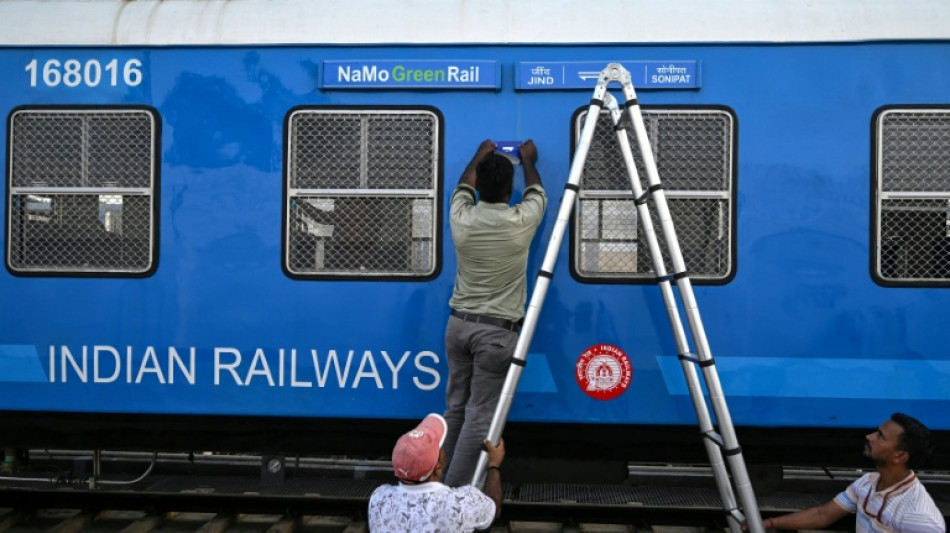
India launches first hydrogen-powered train in clean energy push / Photo: © AFP

India launches first hydrogen-powered train in clean energy push

India launched its first hydrogen-powered train Friday, joining a small group of nations testing the technology as part of efforts to decarbonise rail transport and cut dependence on fossil fuels.

Text size:

The project is part of a broader push to modernise one of the world's largest rail networks while reducing carbon emissions.

The 10-coach train runs along an 89-kilometre (55-mile) route between Jind and Sonipat in India's northern state of Haryana, powered by a 1,200-kilowatt hydrogen fuel cell propulsion system.

Officials described the system as the world's most powerful for a train.

Hydrogen trains use fuel cells to generate electricity by combining hydrogen and oxygen, emitting only water and steam.

"This is a very significant day in the direction of self-reliant India and sustainable development," Prime Minister Narendra Modi, who flagged off the inaugural journey, said in a social media post.

The railway ministry said the train was "developed entirely in India", although senior officials told reporters that some key components, including the fuel cells, were imported.

The ministry also inaugurated what it described as the country's largest railway hydrogen storage and refuelling facility in Jind, with a capacity of some 3,000 kilograms, to "support hydrogen-powered train operations".

The pilot project cost around $12 million, according to a senior railway official who acknowledged it was significantly more expensive than a comparable conventional service.

However, he said costs were expected to fall as the technology matures.

With the launch, India joins countries such as Germany, Japan, China and the United States that are testing or operating hydrogen-powered trains.

India's railways have undergone a major transformation since the first passenger steam train puffed out in 1853 from Mumbai.

In recent years, New Delhi has pumped billions of dollars in investment aimed at upgrading infrastructure, improving safety and expanding capacity.

The vast network carried 7.41 billion passengers and 1.67 billion tonnes of freight last year, official data shows.

India has also introduced its domestically designed Vande Bharat trains, which can reach speeds of up to 180 kilometres (112 miles) per hour.

At the same time, the country is building its first high-speed rail line using Japanese Shinkansen technology.

Officials expect the bullet train, designed to operate at up to 320 kph, to begin service on its first section in 2027.

H.Au--ThChM