Low water on Germany's Rhine river threatens new blow to economy / Photo: © AFP

Dwindling water levels on some of Germany's major rivers worsened by heat and drought are raising fears that badly constrained riverboat cargo traffic may deal yet another blow to the struggling economy.
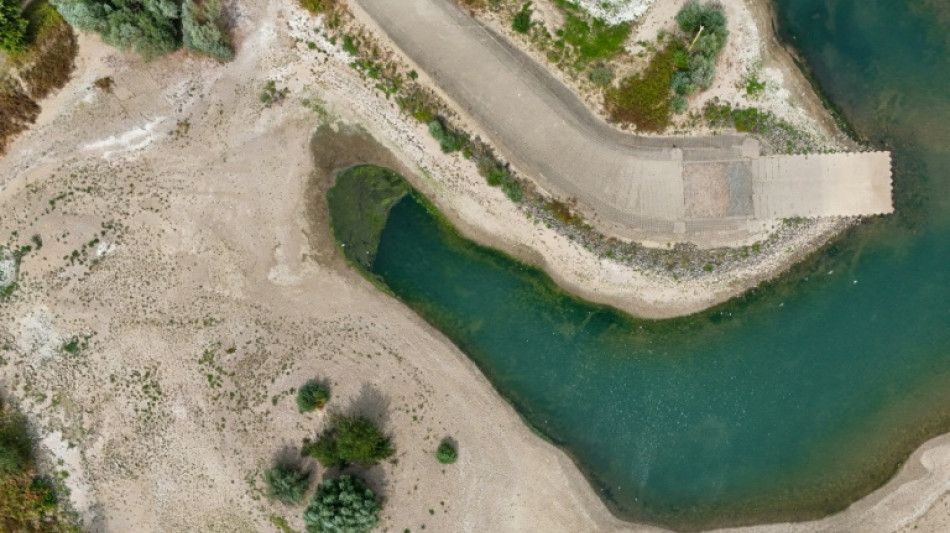
The Rhine riverbed is partially dry near steelmaker thyssenkrupp's blast furnaces in Duisburg, a picture of how the low waters pose a new challenge for German industry.
The mighty waterway also winds past car factories, chemical plants and big river ports as it passes through the industrial heartland of Europe's biggest economy.
Shallow water is imposing tighter limits on how much ship cargo can float down the river -- sending prices up for riverboat freight and heaping pressure on the government to act.
On Thursday, newly appointed Transport Minister Steffen Bilger plans to meet in Bonn with industrial executives, shipping companies and port bosses in hopes of finding practical solutions to the unfolding crisis.
Michael Ebling, economy minister for Rhineland-Palatinate state, has called on the government to fast-track a project to deepen a key stretch of the Rhine in Germany, arguing that this strategic waterway must remain operational year-round.
The river handles around 80 percent of Germany's inland waterway traffic, according to Rico Luman, an economist at ING.
Every year, some 285 million tonnes of goods travel along the river which links many of Germany's biggest industrial hubs with the major Dutch port of Rotterdam.
- Industry feeling the pinch -
The port in Duisburg, in Germany's steel-producing Ruhr region, has reported that vessel loading capacities have dropped to about one-third of their usual levels.
The lower loads have led to a 50 to 60 percent increase in the number of port calls in recent weeks, as well as a shift of cargo toward smaller vessels, rail and road transport.
In the oil sector, loads are sometimes capped at between 300 and 400 tonnes for 110-meter tanker barges, leading to a surge in the number of trips required.
That has driven up shipping rates, with prices hitting 200 euros ($230) per tonne this month for petroleum products shipped between the industrial city of Karlsruhe and the coastal ports of Amsterdam, Rotterdam and Antwerp.
That easily broke the previous record of 130 euros per tonne set in August 2022, according to the Dutch firm Insights Global.
For German industrial producers the blow comes at a difficult time, as many are already suffering from high energy costs, stiff global competition and US tariffs.
Thyssenkrupp has turned to shallow-draft ships to keep the necessary raw materials and finished products moving on the river. So too has chemicals giant BASF, which operates a massive production complex upstream from Duisburg in Ludwigshafen.
Speciality chemicals company Covestro said that shipping disruptions on the river are already affecting supply and production at certain cites. Covestro relies on the Rhine to ship more than 30 percent of its manufactured products and bring in nearly 75 percent of the needed raw materials.
Another German chemicals firm, the Cologne-based Lanxess, described the situation as "very difficult" with barge deliveries severely restricted and some loading and unloading areas inaccessible.
In the refining sector, Shell said it is making greater use of storage capacity and attempting to divert some shipments to rail, road, or pipelines.
- In need of a rainmaker -
Other modes of transport face higher costs and other constraints, making replacing the heavily loaded river barges a tough and expensive challenge.
Germany faces a chronic shortage of truck drivers, and a fresh surge in fuel prices thanks to the ongoing Middle East war.
The country's overloaded rail network, meanwhile, has long been the source of complaints for passengers.
State-owned rail freight operator DB Cargo said it is working with customers to find "pragmatic solutions... within the limits of available rail infrastructure capacity".
ING economist Carsten Brzeski noted that a 2018 drought shaved an estimated 0.3 percentage points off German growth, and said that the economic impact could be even more pronounced this year.
The lowest water levels on the Rhine normally do not come until September or October, Brzeski noted, but levels this week are already at unprecedented lows with little rain forecast.
Unless the German government can find a rainmaker, he quipped, the dry spell could be a tough blow to an economy that has finally returned to modest growth after a prolonged period of stagnation.
F.Brown--ThChM