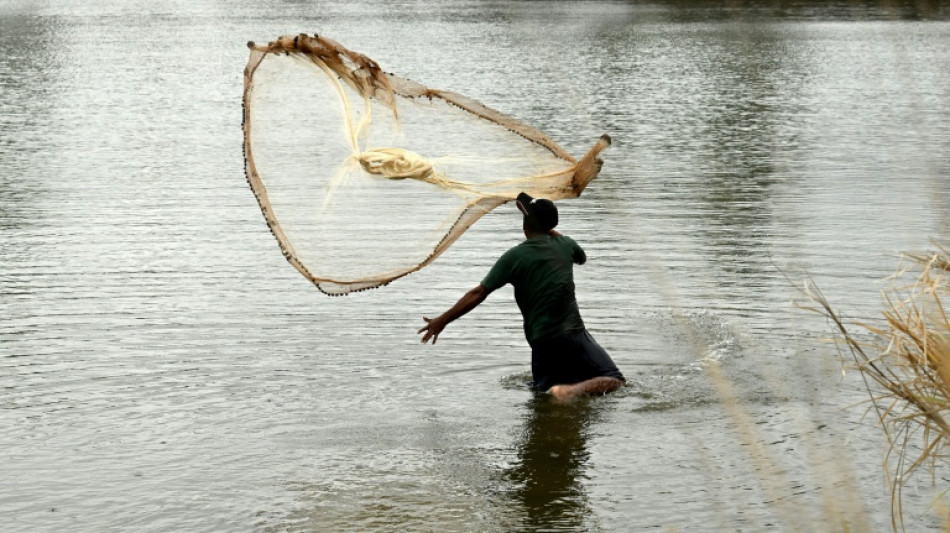
Fiji urges 'just' climate transition, financing at pre-COP gathering / Photo: © AFP

Fiji urged developed nations on Monday to back a just transition to renewable energy and support those most vulnerable to climate change with much-needed financing, as the UN "pre-COP" gathering kicked off in the Fijian city of Nadi.
This week's talks in Fiji and on the atoll nation of Tuvalu are aimed at drawing the world's attention to life on the frontline of climate change in the Pacific.
They are a precursor to the larger UN-sponsored global climate summit -- known as COP31 -- to be held next month in Turkey.
The South Pacific is among the most vulnerable regions in the world to global warming -- from rising sea waters jeopardising homes to increasing temperatures causing coral bleaching.
Fiji's climate minister Lynda Tabuya called for commitments from developing nations to a "just transition" -- with support for "countries in the world that suffer the most" at a news conference.
A UN report released in August found developing countries needed $310-$365 billion to adapt, yet had only $26 billion in adaptation finance available in 2023.
"We rely on and we appeal to countries to commit to climate finance, to commit to projects to help us to have a just transition away from fossil fuels," Tabuya said.
As head of this year's climate negotiations, major coal exporter Australia has faced accusations of hypocrisy -- its sales of the fossil fuel have boomed on the back of demand caused by the Middle East conflict.
Tabuya told journalists there had been "frank discussion" on Monday with Australian counterpart Chris Bowen and Pacific officials.
"Yes, we have sentiments expressed from certain countries," she said when asked if she backed calls from other Pacific leaders for Australia to halt expansions of coal and gas projects.
"But for the Pacific, it's important at this pre-COP that we find common ground. There will be things that we disagree on, but we can agree to disagree," Tabuya said.
- 'Hope' -
Also high on the agenda is a push by Pacific leaders for the world to stick to a target of limiting global warming to 1.5C and give more attention to the impact on oceans.
"Keeping 1.5 alive means hope -- hope for Tuvalu, hope for Kiribati, hope for small island atolls around the world," Bowen told journalists.
"We can actually come to this conversation and say, 'as a fossil fuel exporting nation, we can bring something different to the table'," he said.
Sea levels are also rising at a record pace, driven by warming oceans and glacier melt, according to the August UN report.
Up to 1.2 billion people could be displaced by 2050, with Pacific island countries experiencing sea level rise at twice the global average, the report released in August said.
- 'Act now decisively' -
Regional leaders have pitched the pre-COP as a chance to bring the world to the Pacific but have been forced to concede that the guest list will be smaller than they had hoped.
Among those attending will be Foreign Minister Shisir Khanal of Nepal, which is still reeling from August's Himalayan flood disaster which killed nearly 1,500 people and left 5,800 missing in Nepal and China.
Delegates will also take a one-day trip on Tuesday to low-lying Tuvalu, already laying plans to relocate its population if the country is consumed by the ocean.
Bowen confirmed on Monday that fourteen leaders -- the majority from the Pacific -- would attend that visit.
"Sea-level rise is not a future threat, it is a present reality," Tuvalu Prime Minister Feleti Teo told the UN General Assembly ahead of the climate talks.
The highest point in Tuvalu's capital Funafuti is just two metres (6.6 feet) above sea level.
"Tuvalu's message is clear: the world must act now decisively, collectively, and with urgency to protect the future for generations to come," Teo said.
W.Cheng--ThChM