Tata turmoil shines light on India succession woes / Photo: © AFP/File

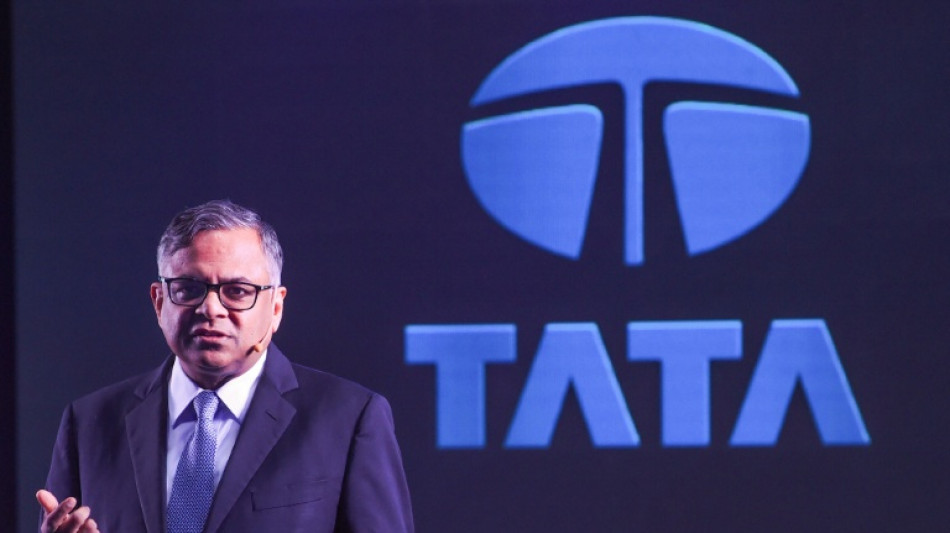
In little over a month, the chairman of India's corporate giant Tata Group has gone from seeking another term to announcing his departure to returning to the role.
The saga around N. Chandrasekaran, who has headed the multi-billion-dollar empire for nearly a decade, has laid bare the succession challenge confronting India's industrial behemoths.
The leadership battle at Tata Group, whose businesses span everything from Jaguar Land Rover cars to Apple iPhone assembly, has highlighted weaknesses in governance and the power struggle between boards and controlling families.
But the consequences extend far beyond shareholders, with a growing number of succession dramas shaking global confidence in India, whose economy relies heavily on corporate giants, analysts say.
The Tata fiasco came to a head last week when the board of Tata Sons, the group's holding company, granted Chandrasekaran another five-year term.
The announcement came despite objections from the Tata Trusts, the philanthropic entities that control the conglomerate and which is chaired by family patriarch Noel Tata.
"The mutiny of the board against the controlling shareholder is possibly a first, and not the right precedent for corporate India," independent advisory firm IiAS said in a note.
Tata is far from an isolated case: from banks to consumer goods, some of India's biggest companies have been rocked by leadership exits and botched handovers in recent months.
"In the last 18-24 months, we've seen a number of CEOs being churned at the top," Navnit Singh of executive search firm Korn Ferry told AFP.
"I do think boards may not be spending enough time looking at long-term succession. Often enough companies do not have a 'hit by the bus' contingent plan and are often caught off guard."
The roots of the Tata conflict run deep.
For much of the year, Chandrasekaran's future hung in the balance as Noel Tata raised concerns about losses at some group companies, investment spending and the possibility of listing Tata Sons.
- Leadership crisis -
The tensions intensified after the death of former patriarch Ratan Tata in 2024, leaving unresolved questions over how authority would be shared within India's largest conglomerate.
"When Ratan was alive, he didn't trust Noel Tata enough to make him the chairman of the Trusts," said Shriram Subramanian of advisory firm InGovern.
"He didn't ensure that there was a structured handover of power even when he was alive."
A succession crisis has also rocked India's largest private lender, HDFC Bank.
The bank's chief executive Sashidhar Jagdishan declined another term last month, an abrupt departure that came after the shock resignation of its chairman, forcing directors into a hurried search for new leadership.
At Godrej Consumer Products, chief executive Sudhir Sitapati secured shareholder approval for a second five-year term in August only to resign days later, fuelling speculation about tensions between management and the founding Godrej family.
Experts say such episodes reveal a failure by boards to prepare for leadership transitions before they become crises.
"Independent directors are meant to ask the uncomfortable question, 'who's next, and are they ready?' years before it becomes urgent," said Tulsi Jayakumar, an economics professor specialising in family business.
"Instead, most boards wait for a health scare or a boardroom crisis to even put succession on the agenda. That's not governance, that's crisis management wearing a governance hat."
- Ageing billionaires -
The Tata Group's annual revenues are roughly equivalent to about five percent of India's GDP, and it has become a key investor in strategic sectors including semiconductors, batteries and electronics manufacturing.
"When succession stumbles at a group the size of Tata, it isn't a private family matter, it's a systemic one," Jayakumar said.
Such conglomerates sit at the centre of supply chains, employ hundreds of thousands of people and play an outsized role in shaping investor confidence, she noted.
"A prolonged succession fight signals to global capital that governance in India still runs on personality, not process," she said.
The issue is particularly significant in a country where family-controlled businesses account for most economic activity.
India's ageing billionaires are preparing for one of the biggest intergenerational transfers of wealth globally to their children -- $382 billion according to UBS data -- which implies a massive shake-up in the way many of these empires will be run.
That transition could reshape some of the country's biggest corporate empires and test whether boards are prepared to manage increasingly complex successions.
"Succession planning is under far greater public scrutiny now," said Amit Tandon of IiAS, noting that investors understand that "when the baton is passed to the next generation... it changes the trajectory of the company".
"The best way to look at it is that succession planning is an art, not a science," he added.
"And Indian businesses haven't really cracked it yet."
X.Gu--ThChM