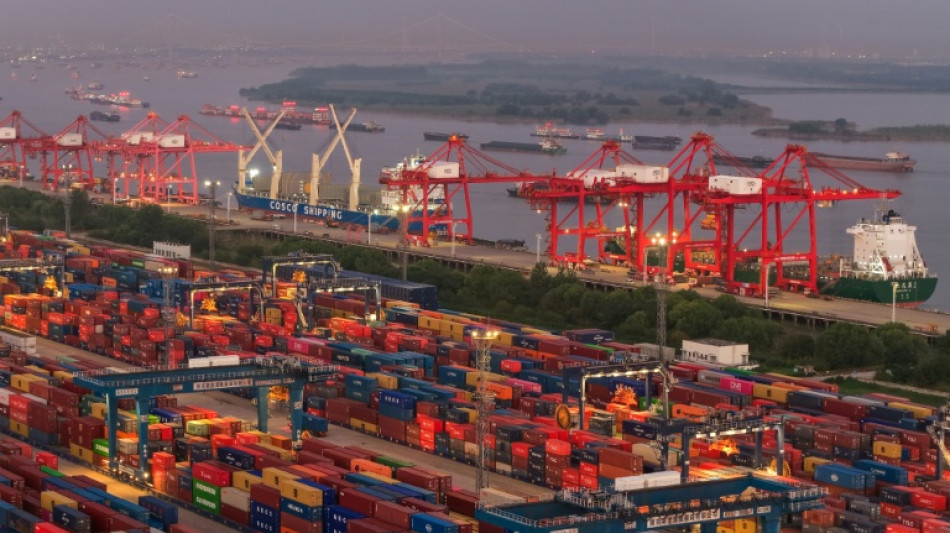
EU trade chief seeks to dial down China tensions / Photo: © CN-STR/AFP

The European Union's top commerce official was due in China on Thursday for talks aimed at bringing both sides back from the brink of a mutually damaging trade war.
The EU last year ran a trade deficit of around a billion euros ($1.1 billion) a day with China, caused by what many in the bloc see as Beijing's unfair trade practices.
But Europe can ill afford to anger China in case it throttles supplies of rare earth minerals that are vital for the continent's industrial sector.
The two days of discussions by EU trade commissioner Maros Sefcovic in Beijing come just as France and Germany, the bloc's two biggest powers, threaten to up the ante.
According to a letter seen by AFP on Monday, President Emmanuel Macron and Chancellor Friedrich Merz have urged the EU to ready a "credible instrument" to respond quickly to any escalation by Beijing, although China was not mentioned explicitly.
The proposed weapon -- to be discussed at an EU leaders' summit next week -- would give the European Commission the power to respond to a trade aggression within days.
- 'Wrong path' -
China immediately fired a warning shot after the letter, urging Paris and Berlin on Tuesday to steer clear of "protectionist" measures.
"We hope that France and Germany, as major economies in the world, will uphold openness, cooperation and free trade," the commerce ministry said in a statement.
"They should avoid going down the wrong path in the wrong way, only to ultimately suffer the consequences themselves."
The stakes are also high for President Xi Jinping, however, with China heavily reliant on exports in order to compensate for its wobbly domestic economy.
The EU parliament's trade committee chief, Bernd Lange, said ahead of Sefcovic's trip that this "economic crisis in China" gives the EU "bargaining power".
"The EU has a well-supplied toolbox to counter unfair subsidies, dumping, discriminatory procurement, and economic coercion. These instruments must be applied consistently and, where necessary, enhanced," Lange said in a statement.
- 'Tangible results' -
EU and Chinese officials have been negotiating since June, and Sefcovic raised hopes earlier this year when he said that he wanted "tangible results by October".
Sefcovic has identified three priorities: addressing surging imports in strategically important sectors, increasing European exports to China, and improving access to critical raw materials.
The EU is also seeking clearer export-licensing arrangements for rare earths and other materials after China introduced restrictions last year.
Brussels hopes to manage Chinese exports through voluntary limits, for example on hybrid cars shipped to the bloc. Beijing, though, firmly opposes import quotas.
Analysts are cautious about the prospects for a broad agreement being struck this week.
"But if one sector could be identified in which an export-restraint agreement with China could be tested, that would be a good step," Ignacio Garcia Bercero from Brussels think-tank Bruegel told AFP.
Zhu Tian, economics professor at Shanghai's China Europe International Business School, agreed, saying that the talks could yield agreements "on some specific issues".
T.Wu--ThChM