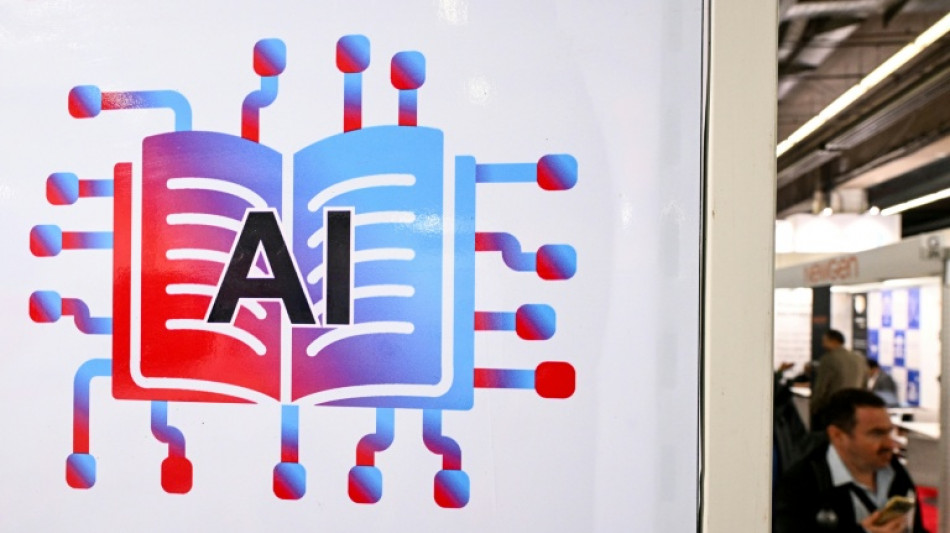
'Human-authored' book labels gain ground amid AI scandals / Photo: © AFP

Initiatives to label books as written by humans, and not artificial intelligence, are gaining ground following a string of scandals where authors were suspected of using the technology without admitting it.
Several labelling schemes, including from Britain, France and Germany, were being showcased at the world's biggest book industry fair in Frankfurt this week, where the challenges posed by AI were hotly debated.
Among recent cases where authors allegedly used AI, the most high-profile is that of Haitian-Canadian author Thelyson Orelien, which has rocked the French-language literary world. He has denied the claims.
The affair was a "real earthquake" for the French book trade, Charlotte Allibert, co-founder of Librinova, a self-publishing company and literary agency, told AFP.
The French group runs a scheme under which authors can get their books assessed and then labelled as a "human creation" for a small fee, with about 200 works so far given the stamp.
Writers who want the label have their works run through AI detection software and undergo an interview with an auditor, who also checks the book personally.
"It's reassuring for authors to know that we're committed to this issue," said Allibert.
"More and more, authors are afraid of being suspected of using AI -- self‑published authors even more so."
- 'Organic literature' -
Another scheme is from British startup Books By People, which this week announced its certification mark for human-authored works had been registered by the country's intellectual property office.
To get the stamp, titles have to meet the group's "organic literature" standards, which require the writing to originate from its author while allowing limited use of AI for tasks such as spelling or grammar checks.
"We want to create a comprehensive, transparent, reliable framework that publishers and authors can fall back on," Esme Dennys, the initiative's co-founder, told AFP.
"Anxiety around undisclosed AI use has increased in recent months -- we have been getting a lot more interest from people all over the world."
Publishers sign up to the scheme for a fee, and can then request to get their authors' books labelled with the Books By People mark.
The scheme launched with five independent publishers and is set to announce more members in the coming months.
In the United States, writers group the Authors Guild has introduced a "human authored" certification mark.
It is a self-certification system which requires authors to sign a licence agreement, and so far around 6,500 titles have received the stamp.
- Mounting scandals -
The controversy surrounding Orelien erupted last month when an anonymous X account alleged the 38-year old used AI to write his debut novel "It Was Either That or Die", based on analysis of excerpts by AI-detection websites.
He has denied the claims and believes the attacks on his work are racially motivated, although the scandal led to him being dropped from France's top literary prize.
There have also been a string of other cases in recent times.
Earlier this year publisher Hachette cancelled the release of horror novel "Shy Girl" by Mia Ballard in the United States and withdrew the book from sale in Britain over allegations of AI use.
In comments to the New York Times, Ballard denied personally using AI but said that an acquaintance she hired to edit the book, which was originally self-published, had used AI.
Despite the mounting scandals, some in the book trade view the idea of labels with scepticism.
Current schemes mostly allow a minimal use of AI, for example for research and grammar checks, but there are worries this could be open to interpretation.
There are also concerns it could be too easy to circumvent checks in the fledgling initiatives, and pass off AI-produced books as human-written.
Sebastian Guggolz, head of the German Publishers and Booksellers Association, said the book trade was struggling with what approach to take.
"There's no simple 'with AI' or 'without AI'," he said at the book fair, adding that basic schemes to categorise how much AI was used to produce a title could fall short.
"The question has to go deeper. It has to be addressed to each individual and to the entire industry: how do we want to make our practices transparent?"
B.Carter--ThChM