The China Mail - Chile says recent mass seabird death not due to avian flu

USD -
AED 3.672498
AFN 65.500615
ALL 80.193613
AMD 365.443623
ANG 1.789783
AOA 918.000237
ARS 1488.884988
AUD 1.410318
AWG 1.80125
AZN 1.69651
BAM 1.690479
BBD 2.011669
BDT 122.606854
BGN 1.696366
BHD 0.37668
BIF 2985.954449
BMD 1
BND 1.277583
BOB 11.640953
BRL 5.224027
BSD 0.998833
BTN 95.261679
BWP 13.45607
BYN 3.037988
BYR 19600
BZD 2.008816
CAD 1.386735
CDF 2272.999828
CHF 0.81207
CLF 0.023213
CLP 913.597878
CNY 6.743201
CNH 6.74271
COP 3131.8
CRC 449.371191
CUC 1
CUP 26.5
CVE 95.306625
CZK 20.9104
DJF 177.864212
DKK 6.45611
DOP 58.464065
DZD 131.663425
EGP 50.319598
ERN 15
ETB 161.573793
EUR 0.86366
FJD 2.234202
FKP 0.739036
GBP 0.737985
GEL 2.610486
GGP 0.739036
GHS 10.937378
GIP 0.739036
GMD 73.499284
GNF 8773.931458
GTQ 7.6209
GYD 208.928649
HKD 7.84745
HNL 26.775574
HRK 6.508499
HTG 130.645231
HUF 313.525496
IDR 17831
ILS 2.955104
IMP 0.739036
INR 95.45055
IQD 1308.440296
IRR 1374587.500085
ISK 122.809746
JEP 0.739036
JMD 158.174511
JOD 0.709023
JPY 159.172496
KES 129.260011
KGS 87.4499
KHR 4041.661265
KMF 426.999987
KPW 900.000294
KRW 1416.210142
KWD 0.30868
KYD 0.832361
KZT 463.468603
LAK 22542.892951
LBP 89443.536886
LKR 332.365271
LRD 181.287005
LSL 16.158607
LTL 2.95274
LVL 0.60489
LYD 6.359825
MAD 9.264013
MDL 17.319677
MGA 4300.099399
MKD 53.178616
MMK 2099.791609
MNT 3596.010349
MOP 8.073123
MRU 40.112364
MUR 47.110285
MVR 15.449836
MWK 1731.967674
MXN 17.014499
MYR 4.0841
MZN 63.909363
NAD 16.158607
NGN 1358.990007
NIO 36.760448
NOK 9.4342
NPR 152.41886
NZD 1.695795
OMR 0.381252
PAB 0.998833
PEN 3.368858
PGK 4.486797
PHP 61.465998
PKR 277.41994
PLN 3.72035
PYG 5995.073253
QAR 3.641125
RON 4.527397
RSD 101.421842
RUB 83.924901
RWF 1468.77566
SAR 3.750032
SBD 8.048583
SCR 13.755996
SDG 600.498186
SEK 9.513295
SGD 1.278565
SHP 0.740866
SLE 24.531123
SLL 20969.499227
SOS 570.811185
SRD 37.974497
STD 20697.981008
STN 21.176369
SVC 8.739358
SYP 13001.999906
SZL 16.156273
THB 33.12952
TJS 9.223994
TMT 3.51
TND 2.928476
TOP 2.40776
TRY 47.898702
TTD 6.76693
TWD 32.005016
TZS 2649.950305
UAH 44.681879
UGX 3710.618436
UYU 40.019016
UZS 11890.747223
VES 770.109097
VND 26148.5
VUV 117.940389
WST 2.73449
XAF 566.970915
XAG 0.015403
XAU 0.000229
XCD 2.70255
XCG 1.800078
XDR 0.707052
XOF 566.970915
XPF 103.081378
YER 237.195141
ZAR 16.18555
ZMK 9001.201046
ZMW 18.87722
ZWL 321.999592
  • CMSC

    -0.0250

    21.45

    -0.12%

  • CMSD

    -0.0100

    21.58

    -0.05%

  • BCC

    -0.8900

    83.24

    -1.07%

  • RBGPF

    0.0000

    71.34

    0%

  • BCE

    0.1500

    23.47

    +0.64%

  • NGG

    -0.1500

    81.05

    -0.19%

  • VOD

    0.2000

    16.42

    +1.22%

  • RYCEF

    0.1300

    20.84

    +0.62%

  • GSK

    -0.4785

    49.52

    -0.97%

  • RIO

    -0.4100

    95.68

    -0.43%

  • AZN

    -0.7900

    156.45

    -0.5%

  • JRI

    0.0635

    12.61

    +0.5%

  • RELX

    -0.2400

    34.43

    -0.7%

  • BTI

    -0.2900

    57.06

    -0.51%

  • BP

    0.2196

    42.53

    +0.52%

Chile says recent mass seabird death not due to avian flu
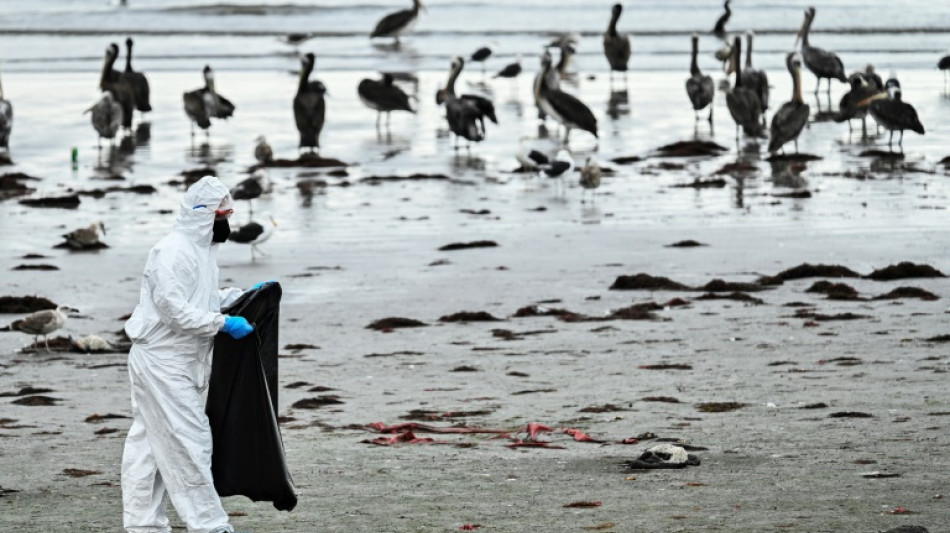
Chile says recent mass seabird death not due to avian flu / Photo: © AFP

Chile says recent mass seabird death not due to avian flu

Early tests indicate that the recent mass death of thousands of seabirds along Chile's northern coast were not caused by avian flu, authorities said Friday.

Text size:

Some 3,500 Guanay cormorants -- once known as the "billion dollar bird" for their connection to the European fertilizer industry -- have been found dead since May 26 near the coastal port of Coquimbo, according to Chile's Agricultural and Livestock Service (SAG).

Workers in biohazard suits collected hundreds of the dead cormorants, with their distinctive black-and-white coloration, along beaches in sight of restaurants and hotels.

Initial tests on the dead birds did not reveal presence of avian flu, which has wracked other parts of Chile, Jorge Mautz, regional director of the service, told AFP.

Residents of Coquimbo voiced surprise at the mass seabird deaths.

"It's never been seen before. The mortality of these birds is impressive," Edison Alfaro, a 47-year-old fisherman, told AFP.

Mautz said "something is happening in the sea" that is causing the death of the birds that feed each day in Pacific waters.

The Guanay cormorant holds a place in history books. The once-abundant species was a huge producer of guano on islands off Peru's coast, where the birds nested, in the 19th century, generating huge sums of money for European merchants trafficking in guano for use as fertilizer.

Over decades, millions of tons of guano were shipped to Europe, and guano became the main source of Peru's income in the latter half of the 19th century.

The extraction was so heavy that it destroyed breeding habitats for the cormorants, triggering a sharp decrease in their population.

Today, the Guanay cormorant is considered a threatened species.

Since late 2021, one of the worst global avian influenza outbreaks on record has seen tens of millions of poultry culled, mass wild bird die-offs and a rising number of infections among mammals in several countries.

Avian flu has plagued the coast of Chile since December 2022, killing thousands of penguins, pelicans and sea lions.

Chile estimates that around 10 percent of the 10,000 extant Humboldt penguins, a vulnerable species, have died. In addition, 9,000 sea lions have perished, double the number of all cases recorded in the last 14 years.

On March 29, the country's first case of human infection was confirmed, a 53-year-old patient who is still hospitalized.

In Cambodia, an 11-year-old girl fell ill in mid-February with a fever, cough and sore throat, and died from the H5N1 bird flu virus, according to the health ministry there.

E.Lau--ThChM