The China Mail - Abortion pill at the center of a US court battle

USD -
AED 3.672504
AFN 64.000177
ALL 82.446914
AMD 367.890259
ANG 1.790403
AOA 917.500536
ARS 1481.230498
AUD 1.451948
AWG 1.8
AZN 1.701068
BAM 1.715719
BBD 2.014659
BDT 123.237259
BGN 1.69088
BHD 0.377133
BIF 2976.647894
BMD 1
BND 1.294833
BOB 6.927015
BRL 5.177697
BSD 1.000237
BTN 94.653762
BWP 13.556631
BYN 2.932324
BYR 19600
BZD 2.011641
CAD 1.42352
CDF 2274.999786
CHF 0.809595
CLF 0.023405
CLP 921.119992
CNY 6.79395
CNH 6.794015
COP 3455.43
CRC 456.074635
CUC 1
CUP 26.5
CVE 96.734291
CZK 21.28865
DJF 178.123232
DKK 6.560215
DOP 59.627253
DZD 133.180272
EGP 49.242802
ERN 15
ETB 160.107467
EUR 0.87769
FJD 2.24775
FKP 0.75464
GBP 0.756325
GEL 2.640097
GGP 0.75464
GHS 11.325109
GIP 0.75464
GMD 73.500955
GNF 8768.31301
GTQ 7.631137
GYD 209.231633
HKD 7.84195
HNL 26.765154
HRK 6.615197
HTG 130.781681
HUF 312.73498
IDR 17903
ILS 2.97995
IMP 0.75464
INR 94.642008
IQD 1310.36086
IRR 1376000.000128
ISK 126.379895
JEP 0.75464
JMD 157.597396
JOD 0.709011
JPY 162.441504
KES 129.45015
KGS 87.449981
KHR 4025.844712
KMF 431.999758
KPW 900.00035
KRW 1550.829995
KWD 0.30975
KYD 0.833593
KZT 479.31644
LAK 22434.12886
LBP 89573.772793
LKR 336.095235
LRD 181.582861
LSL 16.36882
LTL 2.952739
LVL 0.60489
LYD 6.42603
MAD 9.401556
MDL 17.67459
MGA 4243.298842
MKD 54.123225
MMK 2099.487458
MNT 3582.059186
MOP 8.08008
MRU 39.968069
MUR 47.189819
MVR 15.45981
MWK 1734.473214
MXN 17.46815
MYR 4.084021
MZN 63.84992
NAD 16.369466
NGN 1381.919505
NIO 36.809762
NOK 9.92705
NPR 151.417455
NZD 1.76719
OMR 0.384504
PAB 1.000268
PEN 3.418588
PGK 4.393387
PHP 61.405503
PKR 278.14144
PLN 3.77006
PYG 6083.016418
QAR 3.656302
RON 4.602201
RSD 102.969983
RUB 78.156144
RWF 1466.200538
SAR 3.758263
SBD 8.065041
SCR 13.756228
SDG 600.500123
SEK 9.736502
SGD 1.294905
SHP 0.746601
SLE 24.800038
SLL 20969.503664
SOS 571.631598
SRD 37.494501
STD 20697.981008
STN 21.492548
SVC 8.752522
SYP 110.532098
SZL 16.366651
THB 33.232502
TJS 9.242505
TMT 3.51
TND 2.964393
TOP 2.40776
TRY 46.659799
TTD 6.789103
TWD 31.831993
TZS 2625.003026
UAH 44.826936
UGX 3666.127143
UYU 40.153526
UZS 12007.438858
VES 622.24352
VND 26315
VUV 119.95305
WST 2.78094
XAF 575.458928
XAG 0.017427
XAU 0.000251
XCD 2.70255
XCG 1.802639
XDR 0.716236
XOF 575.45388
XPF 104.621836
YER 238.602932
ZAR 16.372697
ZMK 9001.201353
ZMW 18.029889
ZWL 321.999592
  • RYCEF

    0.2900

    18.68

    +1.55%

  • RBGPF

    0.6100

    65.61

    +0.93%

  • RELX

    0.1300

    31.42

    +0.41%

  • GSK

    -0.3450

    52.465

    -0.66%

  • BCE

    -0.3530

    21.907

    -1.61%

  • AZN

    -3.6850

    187.265

    -1.97%

  • CMSC

    0.0622

    21.755

    +0.29%

  • VOD

    -0.4700

    13.22

    -3.56%

  • RIO

    0.1500

    94.44

    +0.16%

  • BTI

    -0.6000

    62.14

    -0.97%

  • BCC

    -1.2700

    77.99

    -1.63%

  • JRI

    0.0800

    12.94

    +0.62%

  • CMSD

    0.0400

    21.94

    +0.18%

  • NGG

    -0.5350

    83.225

    -0.64%

  • BP

    -0.1350

    37.215

    -0.36%

Abortion pill at the center of a US court battle
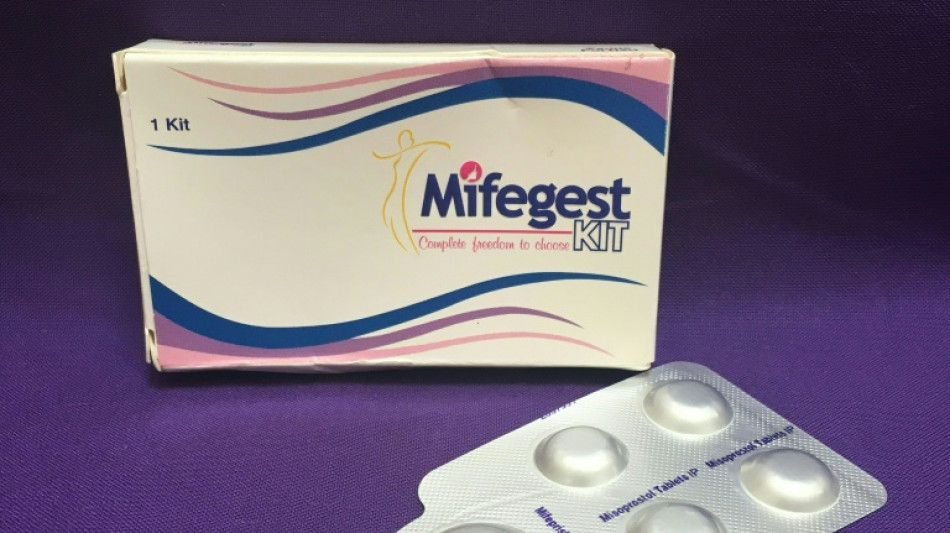
Abortion pill at the center of a US court battle / Photo: © PLAN C/AFP/File

Abortion pill at the center of a US court battle

A widely used abortion pill is at the center of the latest legal battle in America's ongoing debate over abortion.

Text size:

The US Supreme Court on Wednesday said that it would weigh in on restrictions imposed by a lower court on the drug mifepristone.

Here is the background on the drug and its use:

- How widespread is abortion pill use? -

According to the Guttmacher Institute, the pill accounted for more than half -- 53 percent -- of the 930,160 abortions documented by the reproductive health research and policy organization in the United States in 2020.

While the number of so-called medication abortions has gone up dramatically in the United States in recent years, it is still not as prevalent as in several European nations.

In France, for example, medication abortions represented 70 percent of the total number of abortions in 2020.

- How does it work? -

The abortion pill is different from the "morning after" pill, which is taken by a woman after sexual intercourse to prevent becoming pregnant.

The abortion pill is taken to induce an abortion once a woman confirms that she is pregnant.

The process in fact involves more than one pill. The first, mifepristone, also known as RU 486, stops a pregnancy from proceeding normally by blocking production of the hormone progesterone.

Another drug, misoprostol, is taken up to 48 hours later and causes cramps, bleeding and the emptying of the uterus.

Abortion pills can be used at home and a medical setting is not required.

- When was the abortion pill approved? -

The US Food and Drug Administration (FDA) gave the green light to mifepristone and misoprostol in 2000 for use up to seven weeks of pregnancy.

It was later approved for use up to 10 weeks of pregnancy, after which a woman would need to undergo an abortion through other means, such as vacuum aspiration.

The average cost of a medication abortion at Planned Parenthood is $580 but it can cost up to $800.

- Is it safe and effective? -

Use of the abortion pill during the specified time period is considered to be safe and effective by medical experts.

Pregnancies are successfully terminated in more than 95 percent of cases where the pill is used, according to studies.

Serious complications -- excessive bleeding, fever, infection or allergic reaction -- which require a medical consult, are rare.

The abortion pill does not work for ectopic pregnancies, which account for around two percent of all pregnancies and occur when a fertilized egg grows outside the uterus.

- Where is the pill available? -

Around 20 US states have banned or severely restricted access to abortions, including medication abortions, since the Supreme Court's ruling in June 2022 overturning the constitutional right to the procedure.

But anti-abortion groups are seeking to restrict access to mifepristone nationwide, including in states where abortion has remained legal.

The case before the Supreme Court concerns limiting the use of mifepristone to the first seven weeks of pregnancy, instead of 10, and blocking it from being distributed by mail.

T.Wu--ThChM