Dengue Fever Expands Into High Himalayas as Climate Change Warms Nepal

As Nepal’s mountains warm, disease-bearing mosquitoes are expanding their range into high-elevation areas, bringing dengue fever to densely populated regions that were previously safe. The virus has now reached 76 of the country’s 77 districts, marking a dramatic shift in the geographic footprint of insect-borne illnesses driven by climate change and rapid urbanization.
The warming of Nepal’s mountains is dramatically transforming some of the grandest landscapes on Earth, leading melting glaciers to collapse, thawing permafrost that can slide from steep peaks, and crumbling ice dams releasing vast lakes. But other impacts are barely the length of a fingernail.
As the alpine cold recedes, disease-bearing mosquitoes are taking its place. Over the past decade, researchers have documented Aedes aegypti—the primary mosquito species responsible for transmitting the dengue virus—at elevations up to 2,500 meters (8,200 feet). Its expansion into Nepal’s mid-hill and high-altitude regions is driving a major shift in the geographic footprint of insect-borne diseases in the Himalayas.
“In Nepal, Dengue used to be the problem of lower altitude regions, mainly the disease of Terai (the lowlands of Nepal and India),” says Sunita Baral, a research associate at Nepal Health Research Council. “When we were younger we used to hear and even experience the mosquito bite in Terai and we used to ignore going there during the monsoon and post-monsoon. But after a few years, a dengue outbreak occurred in hilly regions like Kathmandu and mosquitoes began to appear here.”
According to a literature review published in January in the journal Clinical Infection in Practice, dengue transmission in Nepal has escalated over the past two decades from localized outbreaks to major nationwide epidemics.
First reported in the country in 2004, the virus caused major public health crises in 2019, 2022 and 2023. Transmission is no longer restricted to the lowland Terai region along the border with India; sustained outbreaks now occur routinely in densely-populated areas at higher elevations. Recent health data reported by local Nepalese media shows the virus has reached 76 out of the country’s 77 districts, with roughly 9,000 recorded infections and at least six deaths in 2025 alone.
“Climate change has a huge impact on geographical distribution and establishment of these vectors in a new area,” explained Ishan Gautam, an associate professor at Tribhuvan University in Kathmandu. “Years ago they were only found in the tropical regions, but they have migrated thousands of meters up to Kathmandu Valley.”
The expansion is driven by a combination of changing climatic patterns, population mobility and unplanned urbanization. Higher average minimum temperatures allow Aedes mosquitoes to survive and reproduce at altitudes that previously acted as natural thermal barriers.
At the same time, rapid urban growth in cities like Kathmandu has created severe water infrastructure challenges. Chronic shortages lead residents to store water in open drums, buckets and construction cisterns, providing optimal breeding conditions for both Aedes aegypti and Aedes albopictus mosquitoes. Flash floods from unusually strong monsoons have overwhelmed municipal drainage systems and washed out water pipelines in cities like Kathmandu, leaving more standing water for breeding mosquitoes.
“They lay eggs in different types of building habitats, so as they disperse and continue to lay eggs in varying places, the population continues to increase,” Gautam continued. “Dengue vectors are rapidly increasing.”
Beyond climate conditions and urban density, specific biological characteristics of a given vector can accelerate the speed of disease transmission. According to Gautam, infected mosquitoes frequently bite seven to eight individuals before reaching repletion–the state of being fully engorged with a blood meal.
This high feeding frequency means a single infected vector can transmit the virus to multiple hosts within a short time frame, creating a transmission chain driven by a mix of biological compulsion and favorable climate conditions.
Despite these growing risks, public health response efforts are constrained by a widespread lack of community preparedness.
“Many of the communities who are at risk are not aware of dengue vectors and their likelihood of contracting dengue disease,” Gautam noted. “They don’t know about all of the potential breeding sites, so they aren’t able to eliminate them.”
The presence of multiple distinct strains of the virus circulating in Nepal further heightens the risk to public health. A secondary infection with a different strain significantly increases the likelihood of severe dengue, which can cause plasma leakage, severe bleeding and organ impairment.
Additionally, both Aedes aegypti and Aedes albopictus serve as vectors for other insect-borne diseases. Chikungunya is already documented in Nepal, and health officials warn that established vector populations create a serious risk for local Zika virus transmission.
“Due to the news of dengue outbreaks, communities are becoming more aware of dengue, but still they do not recognize mosquito breeding sites around their houses,” said Baral. “In newly affected mountain communities, dengue is still relatively unfamiliar, which can delay recognition and response.”
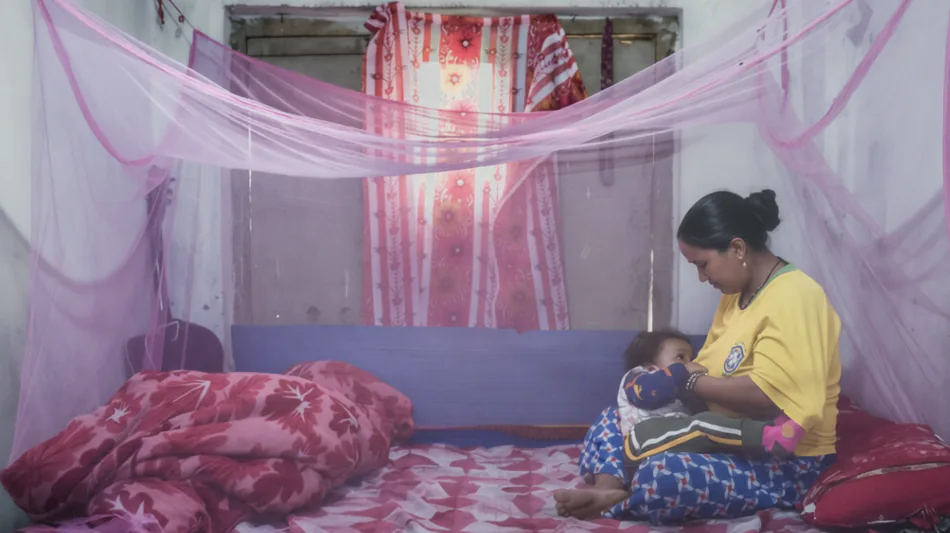
Because dengue-carrying mosquitoes bite during early morning and late afternoon hours, when most residents in the affected communities are awake and active, relying on bed nets while sleeping provides a false sense of security.
The implications extend beyond the emergence of individual diseases. Together, the presence of two competent vector species and multiple dengue serotypes suggests that Nepal’s mountain regions are becoming increasingly suitable for forms of transmission once associated primarily with warmer lowlands.
The warming trends unfolding in the Himalayas mirror shifts happening across tropical highlands globally, from the Colombian Andes to communities in Costa Rica’s central valley. Historically, these high-altitude regions were shielded from vector-borne illness because lower temperatures slowed mosquito development and virus transmission.
Erin Mordecai, an infectious disease ecologist at Stanford University, highlights that rising temperatures have already increased global dengue burdens by roughly 18 percent over historical baselines, hitting cooler highland regions hardest.
“This is projected to get much worse if we continue emitting huge amounts of carbon, but averting carbon emissions can limit the expansion of this devastating disease,” she said. “Nepal is a particularly troubling case because it is a carbon-negative country—it sequesters more carbon than it emits—and yet it is experiencing some of the most dramatic early effects of climate change, including expanded mosquito-borne disease burden.”
Response efforts in Nepal continue to face logistical and institutional hurdles. Disease surveillance systems in Nepal suffer from underfunding and underreporting, meaning local outbreaks are often detected late. Because a large proportion of people infected with dengue show only mild symptoms or remain asymptomatic, passive hospital-based surveillance captures only a fraction of total community transmission.
Without a widely available dengue vaccine in Nepal, control strategies rely heavily on Integrated Vector Management (IVM). Experts emphasize that mitigating future epidemics will require systematic community campaigns to eliminate standing water, structural improvements to municipal water infrastructure to reduce storage dependency and aggressive public education initiatives.
“My biggest fear is that climate change, rapid urbanization and increasing human movement will continue to create favorable conditions for Aedes mosquitoes to establish in areas that were previously unsuitable,” said Baral. “This means more communities that have little previous experience with dengue could become vulnerable. I am also concerned that outbreaks may become more frequent and less predictable.”
In some remote Himalayan communities, the first source of care may not be a hospital but from an amchi—a traditional healer using Sowa Rigpa, a centuries-old Tibetan medical practice. Amchi diagnose illness with methods such as pulse reading, examination of the tongue and urine and detailed conversation with the patient, but may not recognize the symptoms of dengue and other mosquito-borne infections that are new to the region.
Amchi Khedup Loden Gurung packs Sowa Rigpa medicines and checks a patient’s pulse in a clinic in Jomsom, Mustang. Amchi are traditional healers trained in Sowa Rigpa. Diagnosis is based on pulse reading (nad-par), visual examination of urine and tongue, and dialogue with the patient.
Although Amchi remain deeply trusted providers, their position outside formal disease-surveillance systems can make it harder for health authorities to recognize an emerging outbreak unless traditional practitioners and local health posts are closely connected.
Even if they are, as Aedes mosquitoes expand into previously unsuitable terrain, Baral worries the burden on the country’s healthcare capacity will escalate rapidly.
“We need to prepare now,” she warned, “rather than responding only after major outbreaks occur.”
Still, she remains hopeful that with targeted investments in research and community engagement, Nepal’s public health network can curb the threat before it spreads further.
“With sustained investment in surveillance, research, and community engagement, we have an opportunity to reduce the impact of dengue before it becomes even more widespread.”
E.Lau--ThChM