The China Mail - Heavier rains in East Africa due to human activity: study

USD -
AED 3.67315
AFN 63.00003
ALL 83.250363
AMD 377.359962
ANG 1.790083
AOA 916.999886
ARS 1367.988201
AUD 1.451368
AWG 1.8025
AZN 1.699565
BAM 1.695925
BBD 2.012738
BDT 122.6148
BGN 1.709309
BHD 0.37811
BIF 2970
BMD 1
BND 1.284247
BOB 6.920712
BRL 5.246899
BSD 0.999302
BTN 94.168452
BWP 13.739161
BYN 3.001028
BYR 19600
BZD 2.009859
CAD 1.385305
CDF 2285.495715
CHF 0.794982
CLF 0.023481
CLP 927.169942
CNY 6.90915
CNH 6.921097
COP 3687.54
CRC 463.31745
CUC 1
CUP 26.5
CVE 95.874996
CZK 21.258196
DJF 177.72012
DKK 6.48015
DOP 59.502097
DZD 133.041615
EGP 52.740899
ERN 15
ETB 157.149919
EUR 0.867301
FJD 2.250498
FKP 0.747836
GBP 0.750455
GEL 2.695052
GGP 0.747836
GHS 10.960345
GIP 0.747836
GMD 73.489851
GNF 8777.503027
GTQ 7.644781
GYD 209.069506
HKD 7.82573
HNL 26.519919
HRK 6.535902
HTG 130.870053
HUF 336.810126
IDR 16922
ILS 3.124098
IMP 0.747836
INR 94.18195
IQD 1310
IRR 1313299.999839
ISK 124.319947
JEP 0.747836
JMD 157.053853
JOD 0.709004
JPY 159.74101
KES 129.896773
KGS 87.450296
KHR 4014.999919
KMF 427.000262
KPW 900.057798
KRW 1508.260249
KWD 0.30721
KYD 0.832809
KZT 481.430095
LAK 21737.478349
LBP 89549.999826
LKR 314.289307
LRD 183.69759
LSL 17.049441
LTL 2.95274
LVL 0.60489
LYD 6.379876
MAD 9.33971
MDL 17.552896
MGA 4175.000202
MKD 53.472295
MMK 2099.983779
MNT 3583.827699
MOP 8.05281
MRU 40.109644
MUR 46.619727
MVR 15.459807
MWK 1735.999621
MXN 17.8445
MYR 3.994
MZN 63.910018
NAD 17.049938
NGN 1386.510643
NIO 36.720013
NOK 9.69139
NPR 150.669869
NZD 1.736395
OMR 0.384487
PAB 0.999298
PEN 3.4595
PGK 4.3095
PHP 60.232975
PKR 279.250161
PLN 3.71015
PYG 6540.378863
QAR 3.656504
RON 4.420301
RSD 101.858036
RUB 81.37321
RWF 1460
SAR 3.752011
SBD 8.041975
SCR 13.873228
SDG 600.999872
SEK 9.44017
SGD 1.285635
SHP 0.750259
SLE 24.549957
SLL 20969.510825
SOS 571.498421
SRD 37.562002
STD 20697.981008
STN 21.35
SVC 8.74425
SYP 111.44287
SZL 17.049868
THB 32.990307
TJS 9.563521
TMT 3.51
TND 2.923497
TOP 2.40776
TRY 44.3593
TTD 6.782836
TWD 31.988805
TZS 2574.999535
UAH 43.849933
UGX 3717.449554
UYU 40.512476
UZS 12190.000228
VES 466.018145
VND 26351
VUV 119.023334
WST 2.74953
XAF 568.80967
XAG 0.014809
XAU 0.000228
XCD 2.70255
XCG 1.80106
XDR 0.705441
XOF 566.504144
XPF 103.706186
YER 238.650424
ZAR 17.131555
ZMK 9001.207104
ZMW 18.762411
ZWL 321.999592
  • RBGPF

    -13.5000

    69

    -19.57%

  • RYCEF

    -0.6000

    15.3

    -3.92%

  • AZN

    -3.7400

    183.4

    -2.04%

  • CMSC

    -0.0900

    22.82

    -0.39%

  • NGG

    -1.8900

    82.4

    -2.29%

  • VOD

    -0.0900

    14.63

    -0.62%

  • RELX

    -0.4000

    32.07

    -1.25%

  • GSK

    -0.7600

    53.94

    -1.41%

  • RIO

    -1.7500

    85.79

    -2.04%

  • BCC

    -0.3600

    74.29

    -0.48%

  • BCE

    -0.0200

    25.47

    -0.08%

  • CMSD

    0.0700

    22.75

    +0.31%

  • BTI

    -0.1900

    58.26

    -0.33%

  • JRI

    -0.0300

    12.07

    -0.25%

  • BP

    0.7600

    46.17

    +1.65%

Heavier rains in East Africa due to human activity: study
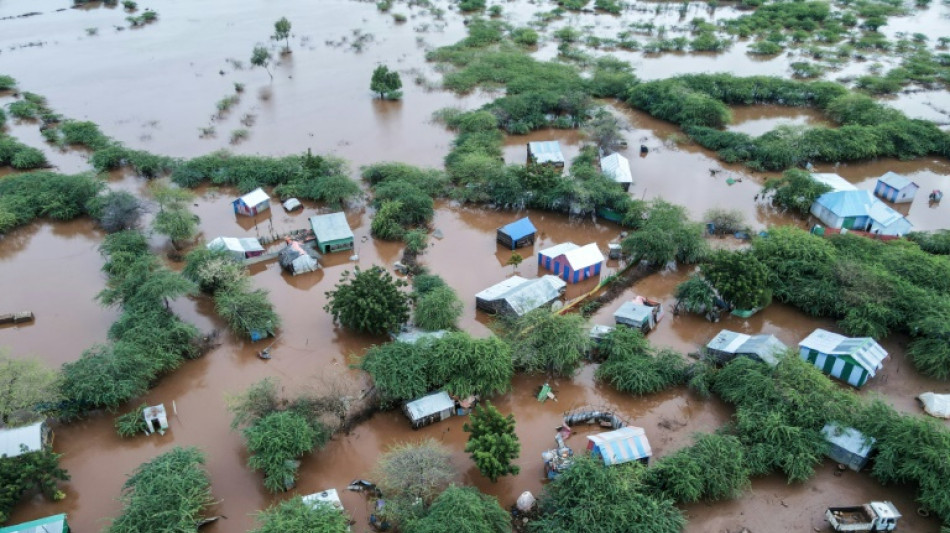
Heavier rains in East Africa due to human activity: study / Photo: © AFP/File

Heavier rains in East Africa due to human activity: study

Climate change caused by human activity made torrential rains that have lashed East Africa since October and killed more than 300 people up to twice as intense, a scientific study said Thursday.

Text size:

Somalia, Kenya and Ethiopia are grappling with heavy rainfall that has caused flooding in the latest devastating climate disaster to strike the region after a record drought.

Scientists from the World Weather Attribution (WWA) group said the current rainfall "was one of the most intense ever recorded in the region" between October and December.

"Climate change also contributed to the event, making the heavy rainfall up to two times more intense," they said, adding that the exact contribution of global warming was unknown.

The Indian Ocean Dipole (IOD) -- a climate system defined by the difference in sea surface temperature between western and eastern areas of the ocean -- also added to "unusually extreme" rainfall, the WWA report said.

"The scientists note that as long as the planet continues to warm, heavy rainfall events such as this one will be more frequent in East Africa," the report warned.

The Horn of Africa is one of the regions most vulnerable to climate change -- even though the continent's contribution to global carbon emissions is a fraction of the total.

"The prolonged hardship caused by the drought meant many people struggled to cope with the devastating rainfall" in the region, the report said.

The scientists called for the urgent phasing out of fossil fuels and reduction of emissions as the extreme weather "has the potential to overwhelm the response of governments and humanitarian organisations" in East Africa.

Extreme weather events are occurring with increased frequency and intensity.

The rains have displaced more than two million people in East Africa, almost half of them in Somalia alone.

The disaster has killed more than 100 people in Somalia, at least 165 in Kenya and 57 in Ethiopia.

In one of the hardest hit areas, the Somali region in eastern Ethiopia, cholera has claimed the lives of at least 23 people, with more than 700 confirmed cases.

M.Chau--ThChM