World added 50% more renewable energy but more needed: IEA / Photo: © AFP/File

The world added 50 percent more renewable energy capacity in 2023 over the previous year but more is needed in the battle against climate change, the International Energy Agency said Thursday.
The increase was the fastest growth rate in the past two decades and the 22nd year in a row that renewable capacity additions set a new record, the Paris-based IEA said.
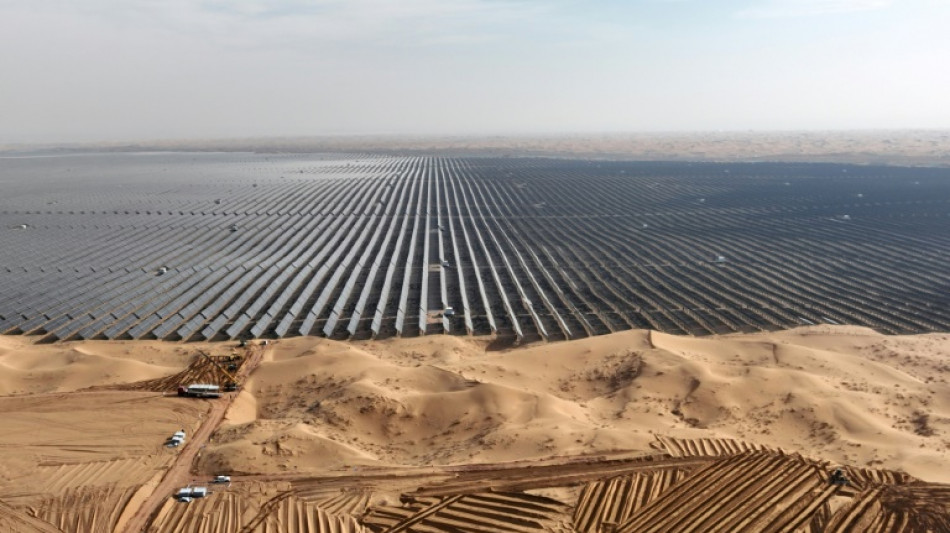
The rise was driven by China, the planet's biggest emitter of greenhouse gases but also what the IEA called "the world's renewables powerhouse".
Massively scaling up the deployment of solar and wind power while winding down the use of fossil fuels is crucial to achieving the goal of limiting global warming to 1.5 degrees Celsius from pre-industrial levels.
But the world is not on pace to reach the goal of tripling renewable capacity by 2030, a target agreed by nearly 200 nations at the UN's COP28 climate summit in Dubai last month, the IEA said.
The COP28 agreement also called for "transitioning away" from fossil fuels, but without setting a timeline and short of a "phase-out" demanded by many nations but opposed by oil giant Saudi Arabia.
Global renewable capacity is expected to increase 2.5 times from 2022 levels by the end of the decade, the agency's annual report on the sector found.
"It's not enough yet to reach the COP28 goal of tripling renewables, but we're moving closer –- and governments have the tools needed to close the gap," IEA Executive Director Fatih Birol said.
Birol said onshore wind and solar panels were less expensive now than fossil fuel plants in most countries.
"The most important challenge for the international community is rapidly scaling up financing and deployment of renewables in most emerging and developing economies," he said.
"Success in meeting the tripling goal will hinge on this," Birol added.
- All-time highs -
The agency, which advises developed countries on energy policy, said renewable capacity reached almost 510 gigawatts last year, with solar photovoltaics (PV) accounting for three-quarters of additions worldwide.
China commissioned as much solar PV last year as the entire world did in 2022, while the country's wind power additions rose by 66 percent year-on-year.
Increases in Europe, the United States and Brazil "also hit all-time highs", the energy watchdog said.
Prices for solar PV devices fell by 50 percent in 2023 compared to the previous year.
The IEA said costs are expected to fall further as global manufacturing capacity is forecast to significantly exceed demand by the end of 2024.
The wind industry, however, is facing "a more challenging environment due to a combination of ongoing supply chain disruption, higher costs and long permitting timelines", the report said.
- 'Not fast enough' -
Dave Jones, global insights programme director at the Ember think tank, said the sector's 2023 growth "makes it clear that a tripling of renewables is entirely achievable".
"We are increasingly on track not only for a peaking of fossil fuel use this decade, but for sizable falls in fossil fuel use," Jones said.
"2024 will be the year that renewables changed from a nuisance for the fossil fuel industry, to an existential threat," he added.
Dean Cooper, global energy lead at conservation group WWF, said renewable energy generation was increasing "fast but not fast enough".
"We will not avert climate catastrophe while fossil fuels continue to be burned," he said.
"Those who want to see a liveable planet should increase pressure on their government to convert words into action by demanding they urgently transform their energy systems," he said.
D.Peng--ThChM