US cannot meet Iran war-induced LNG shortfall: industry leaders / Photo: © AFP

Business leaders are warning that the United States lacks the infrastructure to alleviate a global LNG shortage caused by the US-Israel war on Iran, which has kept a fifth of the world's energy supplies from leaving the Gulf.
US President Donald Trump's commitment to fossil fuels has been typified by his "Drill, baby, drill" mantra and policies that have sidelined renewable energy.
At the CERAWeek energy conference in Houston this week, however, energy leaders said the US LNG industry has the reserves but not the capacity to quickly expand production.
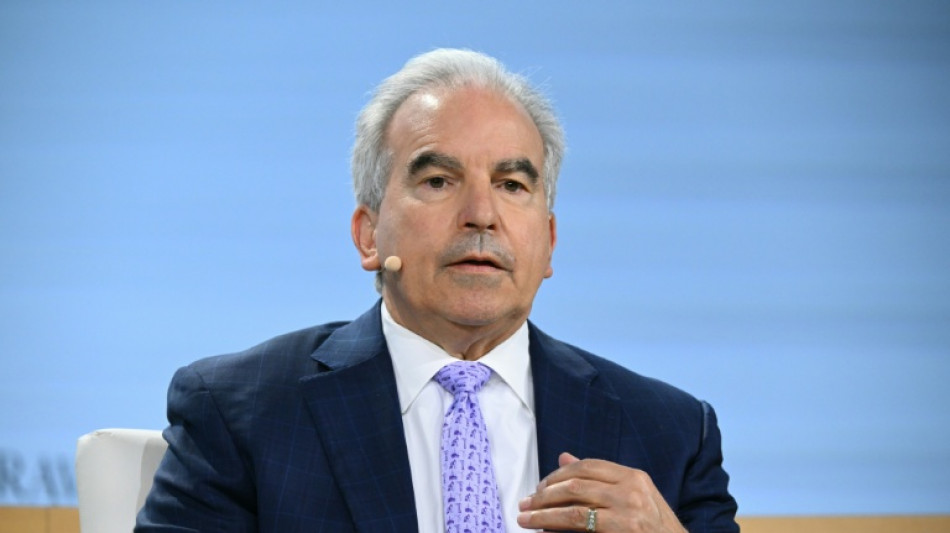
"We will not be able to make that volume up," said Charles Reidl, chief of the Center for Liquefied Natural Gas (CLNG), which represents several US giants in the sector.
"It's not that we don't have the resources to do it," he told AFP at CERAWeek, dubbed the "Davos of energy," which runs through Friday in Houston. "We don't have the infrastructure to provide it."
In response to US-Israeli strikes launched on February 28, Iran has virtually blocked the Strait of Hormuz, through which nearly 20 percent of the world's oil and liquefied natural gas flows.
Qatar, the world's second-largest LNG producer, has seen exports hit a brick wall due to the blockade, with Iran also carrying out strikes on its energy facilities.
That has turned attention to the United States, which in recent years has become the world's leading LNG exporter.
Since 2016, the United States has ramped up LNG production and its exports have increased 30-fold, according to the US Energy Information Administration.
Eight LNG export terminals are in operation, eight are under construction and nine more projects have been approved, according to the Federal Energy Regulatory Commission.
- European dependence -
Reidl said facilities were running hard, "at about 135 percent" of their usual capacity.
Still, "we have not reached a level of maturity in the US LNG space that we have extra supply available."
The crisis is causing concern in Europe -- the leading market for US LNG -- that it may not be able to build up gas reserves for next winter, or may have to do so at extremely high prices.
Europe has increased its dependence on US and Qatari LNG after Russia's 2022 invasion of Ukraine.
Asian nations -- the destination of 80 percent of oil and 90 percent of LNG that transits the Strait of Hormuz -- have been implementing demand conservation measures, said Jack Fusco, chief executive of major US LNG exporter Cheniere Energy.
"We're going to try to get as many molecules as we can to those countries in Asia that really need it," Fusco said Tuesday in Houston. "We're looking at our maintenance schedules really hard, but at the end of the day, we have to be safe and we have to be reliable."
- Permitting delays -
One perceived obstacle keeps surfacing in conversations at CERAWeek: the process of obtaining permits for building or expanding energy infrastructure.
Trump returned to power in January 2025 promising to "unleash" US energy resources. But administrative delays and political gridlock have hindered the expansion of US LNG, said Dena Wiggins, president of the Natural Gas Supply Association.
"There has been so much litigation and so much effort to stop projects by people who are opposed to them that I think that it's the permitting process that has gotten off the rails," she told AFP.
Environmental lawsuits have targeted current terminal projects. In the US Congress, several bills aimed at speeding up permitting have failed to pass.
But Wiggins said the current geopolitical crisis has created a window of opportunity, with both Democrats and Republicans pushing for permit reforms.
If projects are held up by the permit process, US Interior Secretary Doug Burgum urged companies to contact relevant government officials. "There is an opportunity that we haven't had before for bipartisan support," he said Wednesday in Houston.
Still, such reforms -- even with wider support -- cannot address the immediate shortages facing the world.
S.Davis--ThChM