The China Mail - Dust in the air eased slightly in 2023: UN

USD -
AED 3.67315
AFN 63.496406
ALL 82.896091
AMD 377.204398
ANG 1.790083
AOA 917.000216
ARS 1376.5596
AUD 1.438849
AWG 1.80225
AZN 1.690302
BAM 1.686202
BBD 2.015182
BDT 122.789623
BGN 1.709309
BHD 0.377574
BIF 2970
BMD 1
BND 1.279061
BOB 6.913944
BRL 5.238498
BSD 1.000522
BTN 94.115213
BWP 13.635619
BYN 2.965482
BYR 19600
BZD 2.012485
CAD 1.38105
CDF 2280.000305
CHF 0.791697
CLF 0.023228
CLP 917.190008
CNY 6.901496
CNH 6.90295
COP 3701.66
CRC 465.236584
CUC 1
CUP 26.5
CVE 95.625025
CZK 21.163501
DJF 177.71998
DKK 6.46449
DOP 60.374992
DZD 132.676934
EGP 52.532597
ERN 15
ETB 157.300918
EUR 0.86511
FJD 2.227203
FKP 0.747226
GBP 0.74823
GEL 2.695021
GGP 0.747226
GHS 10.949783
GIP 0.747226
GMD 73.501184
GNF 8780.00006
GTQ 7.657854
GYD 209.347342
HKD 7.81825
HNL 26.520413
HRK 6.518701
HTG 131.207187
HUF 334.947496
IDR 16599.65
ILS 3.11585
IMP 0.747226
INR 93.9515
IQD 1310
IRR 1313150.000316
ISK 123.89028
JEP 0.747226
JMD 157.605908
JOD 0.708994
JPY 159.421013
KES 129.75003
KGS 87.449203
KHR 4012.999967
KMF 426.999713
KPW 900.014346
KRW 1501.939956
KWD 0.30662
KYD 0.833829
KZT 482.773486
LAK 21584.99982
LBP 89550.000175
LKR 314.680461
LRD 183.650094
LSL 16.94044
LTL 2.952739
LVL 0.60489
LYD 6.375046
MAD 9.327502
MDL 17.495667
MGA 4170.000017
MKD 53.309984
MMK 2100.167588
MNT 3569.46809
MOP 8.057787
MRU 40.130189
MUR 46.469726
MVR 15.450073
MWK 1737.000017
MXN 17.775501
MYR 3.964504
MZN 63.904127
NAD 16.929835
NGN 1385.81034
NIO 36.720014
NOK 9.694297
NPR 150.586937
NZD 1.72228
OMR 0.384504
PAB 1.000578
PEN 3.460501
PGK 4.309501
PHP 59.995971
PKR 279.049697
PLN 3.69955
PYG 6510.184287
QAR 3.64399
RON 4.4077
RSD 101.592025
RUB 80.997729
RWF 1460
SAR 3.751633
SBD 8.042037
SCR 14.125039
SDG 601.000214
SEK 9.352803
SGD 1.281495
SHP 0.750259
SLE 24.550435
SLL 20969.510825
SOS 570.999967
SRD 37.340502
STD 20697.981008
STN 21.4
SVC 8.755292
SYP 110.948257
SZL 16.897886
THB 32.729925
TJS 9.58109
TMT 3.5
TND 2.9375
TOP 2.40776
TRY 44.348805
TTD 6.803525
TWD 31.928503
TZS 2570.058986
UAH 43.92958
UGX 3702.186911
UYU 40.504889
UZS 12200.000111
VES 462.09036
VND 26350
VUV 119.508072
WST 2.738201
XAF 565.560619
XAG 0.01403
XAU 0.000222
XCD 2.70255
XCG 1.803352
XDR 0.702492
XOF 563.501088
XPF 103.450054
YER 238.649988
ZAR 16.928502
ZMK 9001.210149
ZMW 18.736367
ZWL 321.999592
  • RBGPF

    -13.5000

    69

    -19.57%

  • CMSD

    0.0500

    22.68

    +0.22%

  • CMSC

    0.0400

    22.91

    +0.17%

  • RYCEF

    0.3000

    15.9

    +1.89%

  • BCC

    1.0800

    74.65

    +1.45%

  • BCE

    -0.3400

    25.49

    -1.33%

  • NGG

    1.9600

    84.29

    +2.33%

  • RIO

    0.7700

    87.54

    +0.88%

  • BTI

    0.6900

    58.45

    +1.18%

  • JRI

    0.2400

    12.1

    +1.98%

  • AZN

    1.3600

    187.14

    +0.73%

  • VOD

    0.0600

    14.72

    +0.41%

  • GSK

    1.7500

    54.7

    +3.2%

  • RELX

    0.0100

    32.47

    +0.03%

  • BP

    0.6200

    45.41

    +1.37%

Dust in the air eased slightly in 2023: UN
Dust in the air eased slightly in 2023: UN / Photo: © AFP

Dust in the air eased slightly in 2023: UN

The amount of dust in the air eased slightly in 2023, the United Nations said Friday, warning that poor environmental management was fuelling sand and dust storms.

Text size:

The UN's weather and climate agency called for greater vigilance in the face of climate change, as drier surface soil leads to more dust being carried in the wind.

"Every year, around 2,000 million tons of dust enters the atmosphere, darkening skies and harming air quality in regions that can be thousands of kilometres away, and affecting economies, ecosystems, weather and climate," the World Meteorological Organization (WMO) said in a report.

Surface dust concentrations in 2023 were slightly lower on average than in 2022, due to reduced dust emissions from regions including North Africa, the Arabian Peninsula, the Iranian Plateau, northern India, central Australia and northwestern China, the WMO said.

However, average concentrations were higher in western Central Asia, northern and central China and southern Mongolia.

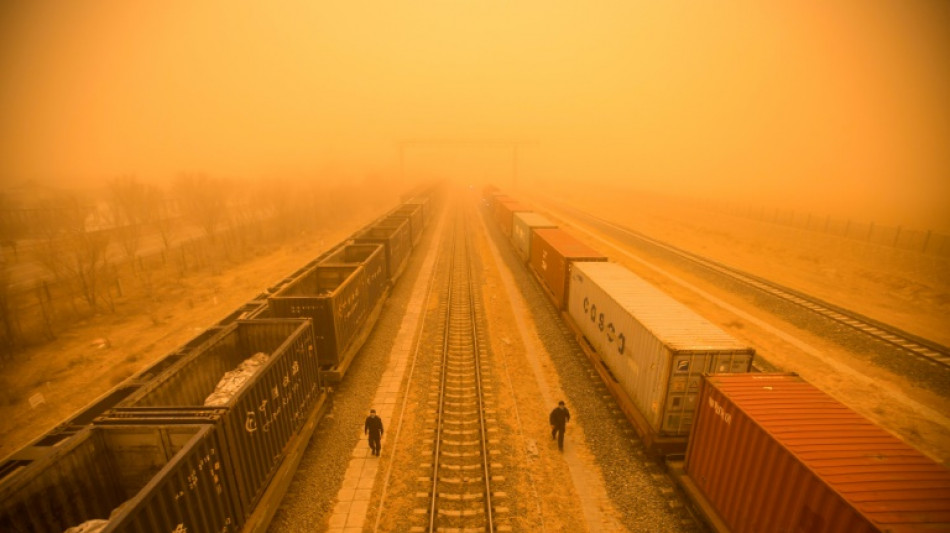
The most severe dust storm of the year swept across Mongolia in March 2023, affecting more than four million square kilometres (1.5 million square miles), including several provinces in China, the WMO said in its annual Airborne Dust Bulletin.

"It caused a dramatic decline in air quality, with PM10 (particulate matter with diameters of less than 10 micrometres) concentrations in some areas exceeding 9,000 microgrammes per cubic metre.

"It reduced visibility to less than 500 metres in parts of Beijing and led to significant disruptions in transportation and daily life, highlighting the need for effective warning systems."

Surface dust concentration peaked in parts of Chad, averaging 800 to 1,100 microgrammes per cubic metre.

- Human impact -

Dust can be transported long distances by the wind. Though mainly a natural phenomenon, human activity is also driving dust storms.

"We need to be vigilant in the face of continuing environmental degradation and current and future climate change," said WMO chief Celeste Saulo.

"Scientific evidence shows that human activities are having an impact on sand and dust storms. For example higher temperatures, drought and higher evaporation lead to lower soil moisture.

"Combined with poor land management, this is conducive to more sand and dust storms."

The WMO said there were some positives to dust being transported over the oceans.

It cited a new study which concluded that Saharan dust deposits in the Atlantic impact skipjack tuna by providing iron, phosphorus and elements that favour the growth of phytoplankton.

The agency also said monitoring and forecasting accuracy had improved in recent years, notably through a system first established in 2007.

July 12 marks the International Day of Combating Sand and Dust Storms.

X.Gu--ThChM