The China Mail - Quarter of China's energy now comes from non-carbon sources: white paper

USD -
AED 3.672504
AFN 65.000368
ALL 81.910403
AMD 376.168126
ANG 1.79008
AOA 917.000367
ARS 1431.790402
AUD 1.425923
AWG 1.8025
AZN 1.70397
BAM 1.654023
BBD 2.008288
BDT 121.941731
BGN 1.67937
BHD 0.375999
BIF 2954.881813
BMD 1
BND 1.269737
BOB 6.889932
BRL 5.217404
BSD 0.997082
BTN 90.316715
BWP 13.200558
BYN 2.864561
BYR 19600
BZD 2.005328
CAD 1.36855
CDF 2200.000362
CHF 0.77566
CLF 0.021803
CLP 860.890396
CNY 6.93895
CNH 6.929815
COP 3684.65
CRC 494.312656
CUC 1
CUP 26.5
CVE 93.82504
CZK 20.504104
DJF 177.555076
DKK 6.322204
DOP 62.928665
DZD 129.553047
EGP 46.73094
ERN 15
ETB 155.0074
EUR 0.846204
FJD 2.209504
FKP 0.735067
GBP 0.734457
GEL 2.69504
GGP 0.735067
GHS 10.957757
GIP 0.735067
GMD 73.000355
GNF 8752.167111
GTQ 7.647681
GYD 208.609244
HKD 7.81385
HNL 26.45504
HRK 6.376104
HTG 130.618631
HUF 319.703831
IDR 16855.5
ILS 3.110675
IMP 0.735067
INR 90.57645
IQD 1310.5
IRR 42125.000158
ISK 122.710386
JEP 0.735067
JMD 156.057339
JOD 0.70904
JPY 157.200504
KES 128.622775
KGS 87.450384
KHR 4033.00035
KMF 419.00035
KPW 900.021111
KRW 1463.803789
KWD 0.30721
KYD 0.830902
KZT 493.331642
LAK 21426.698803
LBP 89293.839063
LKR 308.47816
LRD 187.449786
LSL 16.086092
LTL 2.95274
LVL 0.60489
LYD 6.314009
MAD 9.185039
MDL 17.000296
MGA 4426.402808
MKD 52.129054
MMK 2100.115486
MNT 3570.277081
MOP 8.023933
MRU 39.850379
MUR 46.060378
MVR 15.450378
MWK 1737.000345
MXN 17.263604
MYR 3.947504
MZN 63.750377
NAD 16.086092
NGN 1366.980377
NIO 36.694998
NOK 9.690604
NPR 144.506744
NZD 1.661958
OMR 0.383441
PAB 0.997082
PEN 3.367504
PGK 4.275868
PHP 58.511038
PKR 278.812127
PLN 3.56949
PYG 6588.016407
QAR 3.64135
RON 4.310404
RSD 99.553038
RUB 76.792845
RWF 1455.283522
SAR 3.749738
SBD 8.058149
SCR 13.675619
SDG 601.503676
SEK 9.023204
SGD 1.272904
SHP 0.750259
SLE 24.450371
SLL 20969.499267
SOS 568.818978
SRD 37.818038
STD 20697.981008
STN 20.719692
SVC 8.724259
SYP 11059.574895
SZL 16.08271
THB 31.535038
TJS 9.342721
TMT 3.505
TND 2.847504
TOP 2.40776
TRY 43.612504
TTD 6.752083
TWD 31.590367
TZS 2577.445135
UAH 42.828111
UGX 3547.71872
UYU 38.538627
UZS 12244.069517
VES 377.985125
VND 25950
VUV 119.620171
WST 2.730723
XAF 554.743964
XAG 0.012866
XAU 0.000202
XCD 2.70255
XCG 1.797032
XDR 0.689923
XOF 554.743964
XPF 101.703591
YER 238.403589
ZAR 16.04457
ZMK 9001.203584
ZMW 18.570764
ZWL 321.999592
  • SCS

    0.0200

    16.14

    +0.12%

  • RBGPF

    0.1000

    82.5

    +0.12%

  • CMSD

    0.0600

    23.95

    +0.25%

  • GSK

    1.0600

    60.23

    +1.76%

  • CMSC

    -0.0400

    23.51

    -0.17%

  • BCC

    1.8700

    91.03

    +2.05%

  • RIO

    2.2900

    93.41

    +2.45%

  • BCE

    -0.4900

    25.08

    -1.95%

  • NGG

    1.1700

    88.06

    +1.33%

  • BP

    0.8400

    39.01

    +2.15%

  • BTI

    0.8400

    62.8

    +1.34%

  • RELX

    -0.7100

    29.38

    -2.42%

  • JRI

    0.0900

    12.97

    +0.69%

  • VOD

    0.4900

    15.11

    +3.24%

  • AZN

    5.8700

    193.03

    +3.04%

  • RYCEF

    0.2600

    16.88

    +1.54%

Quarter of China's energy now comes from non-carbon sources: white paper
Quarter of China's energy now comes from non-carbon sources: white paper / Photo: © AFP/File

Quarter of China's energy now comes from non-carbon sources: white paper

A quarter of all the energy China consumes now comes from non-carbon sources, according to research published Thursday, as Beijing rapidly pivots its huge economy to a greener footing.

Text size:

The country is the world's largest emitter of greenhouse gases, though has in recent years emerged as a global leader in renewable energy.

It has pledged to bring its emissions of planet-warming carbon dioxide to a peak by 2030 and to net zero by 2060.

A white paper published Thursday said the proportion of "clean energy" in total national consumption rose from 15.5 percent to 26.4 percent over the past decade, according to state news agency Xinhua. This also includes nuclear energy, according to the paper.

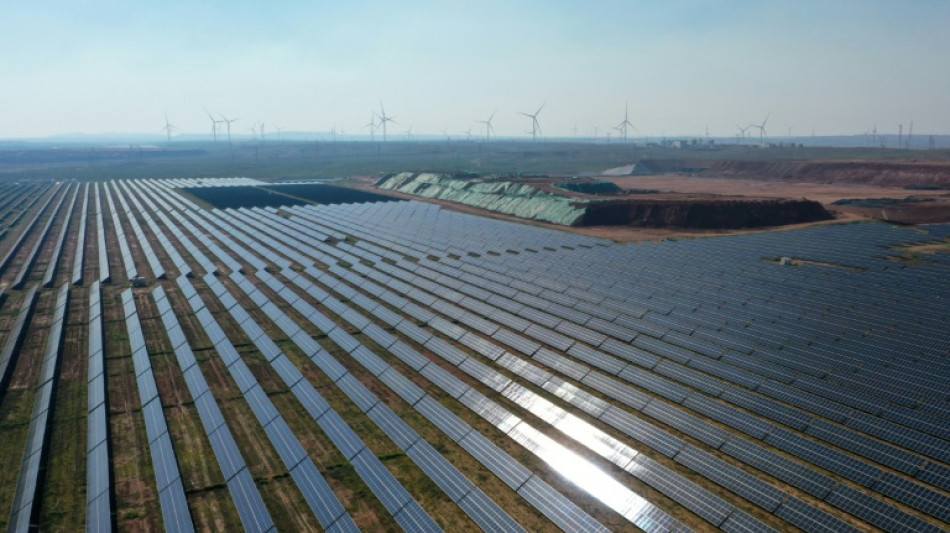
By the end of 2023, China's cumulative installed capacities of wind and solar power had increased elevenfold over the past decade, it added.

It said China was responsible for more than 40 percent of annual additions to global renewable energy capacity since 2013.

"China has... achieved historic breakthroughs in green and low-carbon energy development," the white paper said.

Under the Paris climate accord, countries have pledged to cut greenhouse gas emissions with a view to keeping global temperature rises below 1.5 Celsius above pre-industrial levels.

China has won plaudits for its efforts to rapidly ditch polluting energy sources such as coal, but has also resisted calls to act even more ambitiously.

Last week, its wind and solar capacity overshot a target set by President Xi Jinping nearly six years ahead of schedule.

Mismatched development in the country's renewables sector also means a significant amount of energy gets wasted, while turbulence in the domestic solar industry has pushed some firms into dire financial straits.

- 'Uncertain factors' -

China has the ability and is confident that it can achieve its goal of hitting peak carbon emissions before 2030, said Song Wen, head of law and institutional reform at the National Energy Administration.

But domestic energy demand is growing and "unpredictable and uncertain factors are increasing", Song said at a news briefing to mark the release of the white paper.

While renewables are making up an increasing share of China’s energy consumption, rising demand means that coal use and emissions are still on the rise.

"We must note that China is still a developing country, and we are advancing modernisation for a huge population," Song said.

"Huge efforts" are needed to achieve the goal of peak carbon and carbon neutrality, she added.

The white paper also rejected "all forms of decoupling" and any "severing of industrial and supply chains".

The United States and European Union have expressed concern that a surge of low-cost Chinese exports fuelled by Chinese government support in key sectors like solar and electric vehicles may pose a risk to global markets.

China has pushed back against these concerns, calling them "groundless".

"As a firm advocate of true multilateralism, China opposes all forms of unilateralism and protectionism," the white paper said.

K.Lam--ThChM