The China Mail - More than a million Indians flee as cyclone approaches

USD -
AED 3.672501
AFN 62.506089
ALL 82.669181
AMD 376.230888
ANG 1.790083
AOA 917.000205
ARS 1397.419905
AUD 1.435039
AWG 1.80225
AZN 1.698168
BAM 1.684191
BBD 2.010067
BDT 122.460754
BGN 1.709309
BHD 0.377554
BIF 2964.056903
BMD 1
BND 1.276953
BOB 6.911428
BRL 5.232697
BSD 0.997972
BTN 93.511761
BWP 13.674625
BYN 2.954524
BYR 19600
BZD 2.007225
CAD 1.37798
CDF 2277.502199
CHF 0.790095
CLF 0.023245
CLP 917.859895
CNY 6.892698
CNH 6.89933
COP 3705.32
CRC 464.994123
CUC 1
CUP 26.5
CVE 94.953305
CZK 21.086056
DJF 177.721517
DKK 6.448165
DOP 59.786189
DZD 132.455879
EGP 52.712803
ERN 15
ETB 154.279108
EUR 0.86298
FJD 2.24025
FKP 0.747226
GBP 0.747695
GEL 2.705024
GGP 0.747226
GHS 10.903627
GIP 0.747226
GMD 73.494926
GNF 8747.24442
GTQ 7.642594
GYD 208.863457
HKD 7.826905
HNL 26.426305
HRK 6.498703
HTG 130.855608
HUF 336.068985
IDR 16911
ILS 3.12835
IMP 0.747226
INR 93.932503
IQD 1307.361768
IRR 1313025.000474
ISK 124.089799
JEP 0.747226
JMD 157.486621
JOD 0.70901
JPY 159.030989
KES 129.699735
KGS 87.448502
KHR 4005.063378
KMF 425.999908
KPW 900.014346
KRW 1499.749794
KWD 0.30638
KYD 0.831676
KZT 481.782876
LAK 21486.820464
LBP 89375.339068
LKR 313.699656
LRD 183.13807
LSL 17.013787
LTL 2.95274
LVL 0.60489
LYD 6.362944
MAD 9.303745
MDL 17.455028
MGA 4166.899883
MKD 53.155845
MMK 2100.167588
MNT 3569.46809
MOP 8.04266
MRU 39.802636
MUR 46.459912
MVR 15.460083
MWK 1730.481919
MXN 17.755035
MYR 3.95603
MZN 63.909826
NAD 17.013787
NGN 1375.60972
NIO 36.726715
NOK 9.71795
NPR 149.61272
NZD 1.72145
OMR 0.384501
PAB 0.997963
PEN 3.451997
PGK 4.309899
PHP 60.082988
PKR 278.8205
PLN 3.68605
PYG 6511.920293
QAR 3.639338
RON 4.396498
RSD 101.327022
RUB 80.505242
RWF 1459.995436
SAR 3.753487
SBD 8.041975
SCR 14.903229
SDG 600.999956
SEK 9.33675
SGD 1.279698
SHP 0.750259
SLE 24.60458
SLL 20969.510825
SOS 570.306681
SRD 37.340034
STD 20697.981008
STN 21.09741
SVC 8.732681
SYP 110.948257
SZL 17.012336
THB 32.747502
TJS 9.575933
TMT 3.51
TND 2.927264
TOP 2.40776
TRY 44.35175
TTD 6.780508
TWD 31.967501
TZS 2567.558971
UAH 43.82926
UGX 3737.239351
UYU 40.671515
UZS 12175.463071
VES 458.87816
VND 26349.5
VUV 119.508072
WST 2.738201
XAF 564.849586
XAG 0.013713
XAU 0.00022
XCD 2.70255
XCG 1.798634
XDR 0.702492
XOF 564.869043
XPF 102.697908
YER 238.598421
ZAR 16.971984
ZMK 9001.199646
ZMW 18.887324
ZWL 321.999592
  • CMSC

    -0.0100

    22.87

    -0.04%

  • NGG

    0.2700

    82.33

    +0.33%

  • GSK

    0.9600

    52.95

    +1.81%

  • BCC

    1.6900

    73.57

    +2.3%

  • BTI

    -0.1600

    57.76

    -0.28%

  • AZN

    1.7100

    185.78

    +0.92%

  • BCE

    0.0700

    25.83

    +0.27%

  • RBGPF

    -13.5000

    69

    -19.57%

  • RIO

    0.9300

    86.77

    +1.07%

  • CMSD

    -0.1100

    22.63

    -0.49%

  • JRI

    0.1800

    11.86

    +1.52%

  • RYCEF

    -0.2800

    15.69

    -1.78%

  • BP

    1.2200

    44.79

    +2.72%

  • RELX

    -1.3500

    32.46

    -4.16%

  • VOD

    0.1800

    14.66

    +1.23%

More than a million Indians flee as cyclone approaches
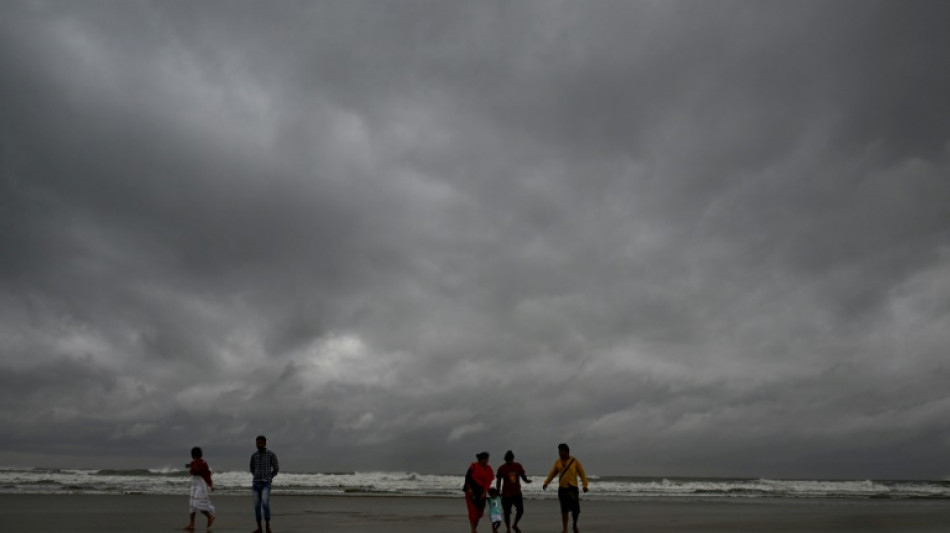
More than a million Indians flee as cyclone approaches / Photo: © AFP

More than a million Indians flee as cyclone approaches

At least 1.1 million people on India's eastern coast are fleeing to storm shelters inland, hours before a powerful cyclone is expected to hammer the low-lying region, ministers said Thursday.

Text size:

Cyclone Dana is likely to hit the coasts of West Bengal and Odisha states -- home to around 150 million people -- as a "severe cyclonic storm" late on Thursday, India's weather bureau said.

It predicts winds will be gusting up to 120 kilometres an hour (74 miles per hour).

Major airports will shut overnight, including key travel hub Kolkata, where heavy rain was already lashing the sprawling megacity.

The eye of the storm is predicted to make landfall early Friday, near the coal-exporting port of Dhamra, about 230 kilometres (140 miles) southwest of the megacity Kolkata.

It is also expected to impact neighbouring low-lying Bangladesh, where the leader of the interim government Muhammad Yunus said that "extensive preparations" are being made.

Crashing waves are expected to inundate swathes of coastal areas, with water predicted to surge up to two metres (6.5 feet) above usual tide levels.

Odisha state health minister Mukesh Mahaling told AFP that "nearly a million people from the coastal areas are being evacuated to cyclone centres".

In neighbouring West Bengal state, government minister Bankim Chandra Hazra said: "More than 100,000 people have so far been shifted to safer places."

- 'Save lives' -

Businesses in Puri, a popular beach resort, have been ordered to close, and tourists told to leave.

"All efforts are being made to face the cyclone and save lives," said Puri district magistrate Siddharth Swain.

Kolkata airport director Pravat Ranjan Beuria said flights will be suspended overnight Thursday due to "predicted heavy winds and heavy to very heavy rainfall".

The airport in the city of Bhubaneshwar will do the same, while scores of trains have been cancelled and ferries from Kolkata ordered to stay in port.

Bangladesh disaster minister Faruk-e-Azam told AFP that authorities were on "high alert" but evacuation orders had not been issued as it was predicted the worst of the storm would hit India.

"We are closely monitoring the cyclone's progress," he said.

Cyclones -- the equivalent of hurricanes in the North Atlantic or typhoons in the northwestern Pacific -- are a regular and deadly menace in the northern Indian Ocean.

Scientists have warned that storms are becoming more powerful as the world heats up due to climate change driven by burning fossil fuels.

Warmer ocean surfaces release more water vapour, which provides additional energy for storms, strengthening winds.

A warming atmosphere also allows them to hold more water, boosting heavy rainfall.

However, better forecasting and more effective evacuation planning have dramatically reduced death tolls.

In May, Cyclone Remal killed at least 48 people in India, and at least 17 people in Bangladesh, according to government figures.

C.Mak--ThChM