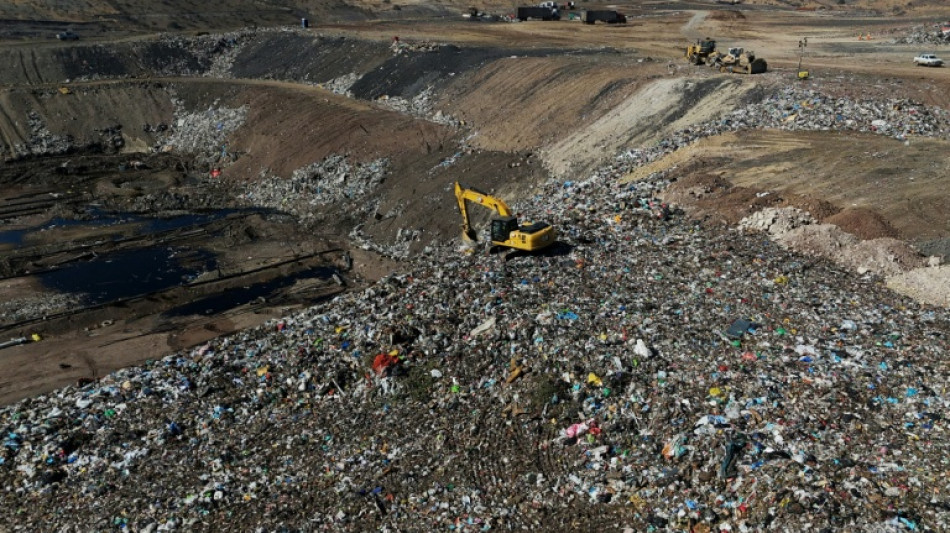
The Chilean town living with the world's most polluting dump / Photo: © AFP

From afar, Chile's Tiltil landfill almost resembles just another mountain, but the growing rubbish pile has created a daily nightmare of odors, flies and health concerns for residents nearby.
The site, located around 35 miles (60 kilometers) north of Santiago, is the world's largest source of human-generated methane emissions, according to the United Nations.
About 60 percent of the Chilean capital's waste this century -- around 18,000 tons per day -- has ended up in Tiltil.
As hungry birds of prey circle above, hundreds of garbage trucks trundle through the town below, leaving trails of rubbish in their wake.
The decomposing waste generates methane, which scientists say is responsible for at least a quarter of global warming.
In April, the United Nations Environment Programme (UNEP) placed the landfill at the top of a list of 50 human-made sites that emit the most methane in the world.
Thirty-five space satellites helped to detect that it generates some 100,000 metric tons of methane annually.
Methane gas may be imperceptible, but the garbage that produces it is not -- Tiltil's 17,000 inhabitants have grown increasingly concerned about the health impact of such drastic pollution.
The smell is "like excrement," said 68-year-old Patricio Velasquez, who shuts himself inside every summer due to the odor emanating from the dump.
- 'Flies in our mouths' -
The retired teacher lives less than two miles (around three kilometers) away from the 120-hectare landfill, which is roughly the size of 100 soccer fields.
"We're in the countryside. We should be breathing fresh air," Velasquez said.
"In the summer we used to take the table outside for lunch, but it got to a point where we couldn't eat because we had flies in our mouths and on our plates."
Methane is not considered toxic, but experts warn of the risks that emissions and air pollution pose to people in the surrounding area.
High concentrations of methane can cause "episodes of suffocation or headaches," Yuri Carvajal, president of the environmental department at the Medical College of Chile, told AFP.
"It's not that easy" to measure the effects on the population, said Carvajal, who recommended keeping people away from such sites.
The company KDM has been operating the landfill for 20 years.
A further 50 industrial sites are located in the area, including cement factories, animal farms and mining storage sites.
"There are numerous facilities that generate environmental impacts in a vulnerable area," Caroline Stamm, an associate professor at the Institute of Urban and Territorial Studies at the Catholic University of Santiago, told AFP.
"It's a case of environmental injustice," she said.
- 'Santiago's garbage dump' -
Tiltil authorities concede that they have little wiggle room.
"As a municipality, we do not have the legal authority to arbitrarily prohibit the establishment of new businesses, since in Chile there is freedom to engage in economic activities," councilor Nelda Gil told AFP.
AFP contacted KDM and the Chilean government for comment but did not receive a response from either.
"Cities don't have a proper waste separation system. Organic trash should be separated and shouldn't end up in a place like this," said Carvajal.
Chile generates an average of 1.1 kilograms of garbage per person per day and recycles just 0.8 percent, according to the environment ministry.
This figure is lower than the regional average of four percent, according to official figures.
Painter and Tiltil resident Raquel Carcamo has watched her town become "Santiago's garbage dump" over the years.
"They don't see us as a town. To them we're just another garbage can," she said.
B.Chan--ThChM