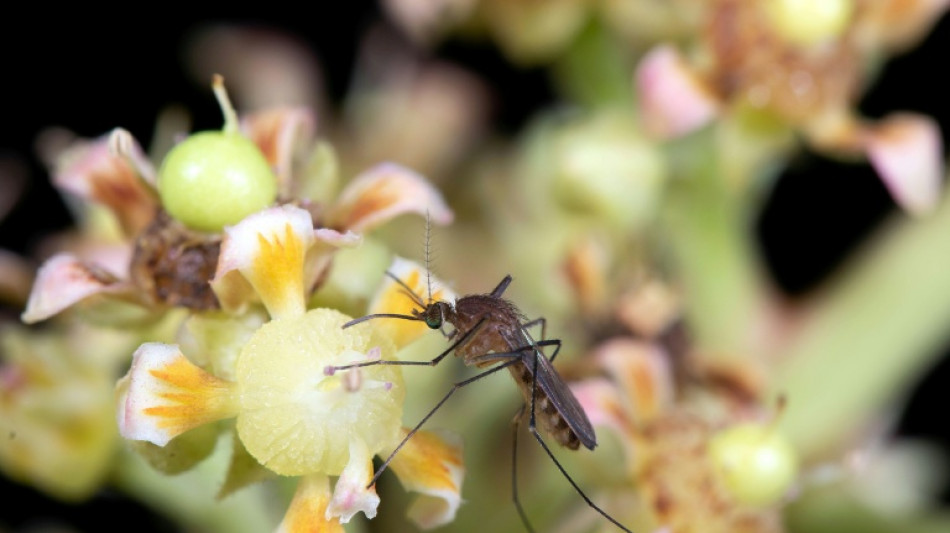
Mosquitoes: bloodsuckers and flower lovers / Photo: © Florida Medical Entomology Laboratory/AFP

When a mosquito tries to bite biology professor David Inouye during fieldwork among orchids in Colorado, he pauses before swatting the bug. If it's dusted with pollen, he lets it live.
"I give those mosquitoes a pass to help the orchids," Inouye says.
Mosquitoes are better known as bloodsuckers that spread malaria, dengue and other diseases, but at least some also play a little-known role as pollinators.
- Nocturnal nectar feeders -
There are more than 3,500 types of mosquitoes buzzing around the world, but only around 100 bite humans.
Only the females are out for blood, targeting humans and animals for protein they require to produce eggs.
But both male and female mosquitoes need to feed on the sugar and nectar from plants and flowers.
Yet their role in flower reproduction is far less studied than that of bees or butterflies.
"Part of it might be that many mosquitoes are either nocturnal or active at dusk or at dawn," Inouye, professor emeritus at the University of Maryland who is based in Colorado, told AFP.
"So it's a little less convenient to study them than it is to study bees that are flying in the middle of the day or butterflies that are only active when the weather is nice," he said.
Another reason their part in pollination is under-studied could be because scientists are more focused on the mosquitoes' role as carriers of diseases, said Lawrence Reeves, an entomologist at the University of Florida.
"I think that this is both a problem in science -- among those who study mosquitoes and just among the general public -- that that potential role is really just overshadowed by their role in vectoring disease," Reeves said.
"If we consider that mosquitoes are one of the relatively few kind of specialists of nectar and other plant sugars as their food source, we can kind of use that to calibrate what our expectation might be for their potential role as pollinators," he said.
- Scientific debate -
The extent of their role as pollinators, however, is a topic of debate in the scientific community.
"There are two camps in the scientific world," Chloe Lahondere, a mosquito expert and associate professor at Virginia Tech university in the United States, told AFP.
"One supports the idea that mosquitoes play an important role in pollination, the other believes mosquitoes are primarily nectar thieves and very rarely provide any benefit to plants," she said.
Lahondere led a 2019 study which found that Aedes mosquitoes are attracted by the scent of a type of orchid in the northwestern US state of Washington, sipping on their nectar and transferring pollen between the flowers.
"The association between the Platanthera obtusata orchid and Aedes mosquitoes is one of the few examples that shows mosquitoes as effective pollinators," said the study published in the Proceedings of the National Academy of Sciences.
The study said those mosquitoes include the Aedes aegypti species, which is considered one of the deadliest animals on Earth as it transmits dengue and yellow fever.
"After spending 10 years studying various plant/mosquito systems, I am convinced that mosquitoes play a more important role in ecosystems than we realise and participate in the pollination of many plants," Lahondere told AFP.
She said she has two papers in progress focusing on two invasive mosquito species in the United States and Europe, including the tiger mosquito, showing that both pollinate native plants with which they did not co-evolve.
"This demonstrates how easily mosquitoes adapt in the presence of new sugar resources," Lahondere said.
- 'Minor' pollinators -
Inouye has spotted mosquitoes covered in pollen from Platanthera obtusata orchids at his field site, the Rocky Mountain Biological Laboratory.
He has compiled a list of 76 mosquito species that have been recorded in papers as visiting flowers.
"I think it is pretty incontrovertible that there is at least some role of mosquitoes as pollinator," Inouye said.
While that role is "relatively minor" compared to bees or butterflies, their relationship with flowers should be further studied, he said.
"If it turns out that they are significant pollinators of more than that one orchid species, then that might influence people's decision whether they should pursue programmes of mass eradication of mosquitoes."
D.Wang--ThChM