Over 370 Afghan civilians killed in Pakistan conflict in three months: UN / Photo: © AFP/File

At least 372 Afghan civilians were killed in conflict between government forces and Pakistan in the first three months of the year, the United Nations reported on Tuesday, with more than half the deaths attributed to airstrikes on a drug rehab facility in Kabul.
Relations between Islamabad and Kabul have been fraught since the Taliban returned to power in 2021, and exploded into what Pakistan's defence minister called "open war" in February.
Islamabad accuses the Afghan Taliban government of sheltering militants behind a surge in attacks -- particularly the Pakistan Taliban, who have waged a violent campaign for years.
Afghan officials deny the charge and counter that Pakistan harbours hostile groups and does not respect its sovereignty.
"Between 1 January and 31 March 2026, UNAMA documented a total of 372 civilians killed and 397 injured as a result of cross-border armed violence" between Afghanistan's security forces and Pakistani military forces, the United Nations Assistance Mission in Afghanistan (UNAMA) said.
In a written response to the report, Islamabad said 130 Pakistani civilians and security personnel were killed since the beginning of this year.
On Monday, Pakistan's foreign ministry summoned Kabul's top envoy to Islamabad, saying a suicide attack that killed 15 people, mostly police officers, at the weekend was "masterminded by terrorists residing in Afghanistan".
Long-running cross-border clashes between Afghanistan and Pakistan escalated in October last year, leaving dozens dead, but after subsiding, they resumed at the end of February.
The UN mission, which has a mandate to monitor civilian casualties only in Afghanistan, said its report was based on checks with three independent sources.
The latest three-month figure is higher than any toll for the period recorded by UNAMA since 2011.
According to the report, 13 women, 46 children (31 boys and 16 girls) and 313 men were killed in Afghanistan between January 1 and March 31.
- NGO worker killed -
"The leading cause of civilian casualties was airstrikes (64 percent) with the remaining caused by indirect cross-border firing" and one "targeted killing" of an NGO worker, the UN said.
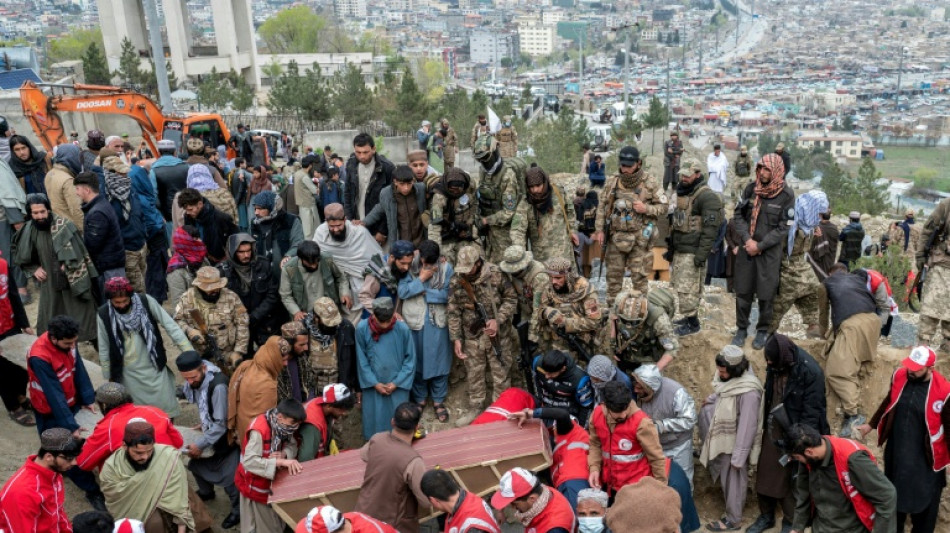
The high proportion of men was attributed to the March 16 strikes on a Kabul drug treatment hospital which admitted only male patients. At least 269 people were killed and 122 wounded.
Many bodies "could not be identified because they were reduced to dismembered body parts", while others were unrecognisable "due to extensive burns", the report said.
"The real figure may be significantly higher," the UN added.
The Taliban government reported more than 400 civilians killed in that incident.
In a written response included in the report, Pakistan insisted "no hospital, drug rehabilitation centre, or civilian facility was targeted".
"Pakistan's actions were directed solely against terrorist and military infrastructure," Islamabad said.
The UN mission urged Afghan authorities to "compile a record of the missing" from the hospital strike to help their relatives find answers about their fate.
UNAMA also called on the warring parties to respect international law by refraining from targeting health facilities or from firing shells or grenades into areas populated by civilians.
The report recounted the death of a female Afghan employee of an NGO in Nuristan on March 19 during the Eid al-Fitr holiday -- even though a ceasefire had been agreed a day earlier.
As she tried to return home with her husband and three children, "Pakistani military forces began firing at their vehicle", the UN said.
They stepped out of the car to cross the river and reach a safer area when "the NGO worker was shot in her right side and fell into the water and drowned with her three-year-old son".
Since talks in early April in China, Pakistan and Afghanistan have committed to avoiding any escalation, according to Beijing.
Incidents have decreased without stopping entirely.
On April 27, seven civilians were killed and 85 wounded by shelling that hit, among other places, a university in Asadabad, according to Afghan authorities.
L.Kwan--ThChM