Botanists comb Gabon's rich rainforests with nature on the line / Photo: © AFP

Each year, Gabon's lush rainforests yield the discovery of previously unknown plant species to botanists like Archange Boupoya -- who believes that this exceptional yet largely mysterious natural wealth needs cataloguing to save.
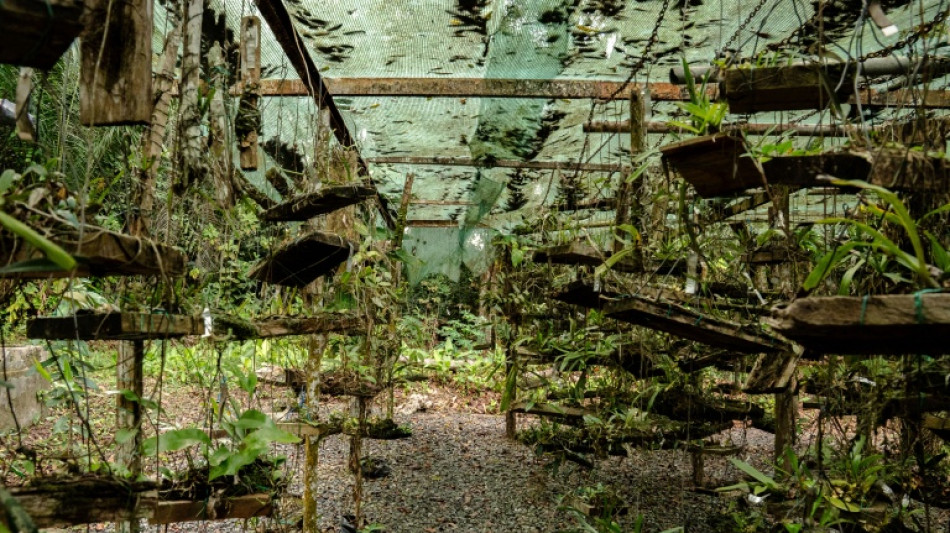
"We cannot preserve that which we do not understand," said Boupoya, the director of the Sibang botanical garden, a sliver of tropical forest in the heart of the capital Libreville, brimming with orchids snaking up metal columns or floating down from the shaded canopy.
"So we're continuing still today to identify this biodiversity so that we can save it."
Together with a thirty-some-strong team of fellow botanists, Boupoya strives to make Sibang a sort of "museum of plants" for his central African country, 88 percent of which is still covered in jungle.
Understanding and protecting rare and exceptional species -- a key theme of the United Nations' COP17 conference on biodiversity which opened on Monday in Armenia -- is both their life's work and a monumental task.
"Unlike countries that are well-known botanically, like in Europe and Asia, Gabon remains very little understood," he explained -- despite the importance of the country's forests for the whole planet.
- Ten new species a year -
For Gabon is part of the Congo Basin, considered the Earth's second "green lung" after the Amazon rainforest, and a key natural sponge for absorbing planet-warming CO2.
Swathes of the country are carpeted with impassable jungles, with roads lacking.
"Each year, while conducting botanical surveys, we discover an average of 10 new species," said Boupoya.
According to the director, botanists believe that the country is home to between 7,000 and 10,000 known plant species, of which around one-tenth are under threat.
As part of a four-decade partnership with scientists from the Missouri Botanical Garden in the United States, teams from Sibang "will go into the forest for two or three weeks, collecting plants before oven-drying them", Boupoya explained.
After being meticulously documented in Gabon, botanists from the United States, Britain, France and Belgium are drafted into the work of identifying the samples.
For those as-yet unidentified species, the researchers have to offer a full description before having their discovery recognised by the international scientific community.
- 'Guarantee their survival' -
A few kilometres from the botanical garden, the 100,000 or so plants that make up the institution's collection -- whose oldest sample dates back to 1880 -- are stored in alphabetical order in imposing metal cabinets at the headquarters of the national parks agency.
This precious archive of Gabon's flora was transferred here after having escaped the fire that ravaged the collection's former site, at the entrance of the botanical garden, in the middle of the country's post-election violence of 2016.
The cabinets house a record of a biodiversity under threat, especially from creeping urbanisation, industrialisation, deforestation, mining and the fossil fuel-rich country's oil industry.
"We've plants here that we're trying to preserve to guarantee their survival," Boupoya said as he passed a series of aquatic plant specimens pickled in alcohol for posterity.
- 'Much to explore' -
One such family of aquatic plants, the Podostemaceae, which resemble mosses and grow near waterfalls, are among the species threatened. Some of them have only been discovered recently.
But one of their habitats is threatened with destruction by the Kinguele hydroelectric dam, around 100 kilometres (60 miles) from the capital, whose construction is set to be completed within weeks.
Boupoya said he hopes that international donors could help relocate rare species which find themselves endangered by major infrastructure projects like the dam.
For their part, the botanists point to their increasingly tough working conditions.
Top among the list of complaints are inadequate facilities for plant conservation since the fire, a lack of funding and the pressure of urban encroachment on the Sibang botanical garden, whose surface area is shrinking year-by-year.
To help preserve Gabon's dizzying array of plant life for the future, the botanists hope to benefit from private financing, notably through the sort of biodiversity credits dreamed up at a previous UN COP conference on protecting nature.
"We've still got much to do and much to explore," Boupoya said, as he pointed to a map of Gabon showing the sheer size of the area of the country that remains undiscovered.
E.Lau--ThChM