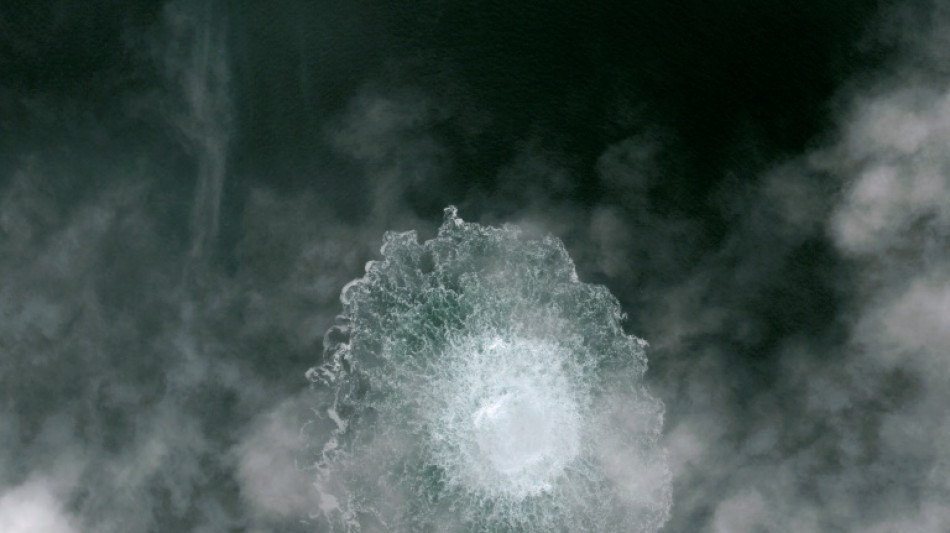
One year on, Nord Stream sabotage remains a mystery / Photo: © Airbus DS 2022/AFP/File

The September 26, 2022 explosions that damaged the Nord Stream pipelines cut off a major route for Russian gas exports to Europe and fuelled geopolitical tensions already running high over Moscow's invasion of Ukraine.
But one year on, and despite investigations in three countries, the question of who was responsible for the brazen act of sabotage remains unanswered.
In the absence of hard evidence, different theories have emerged pointing the finger at Ukraine, Russia or the United States. All have denied involvement.
- What happened? -
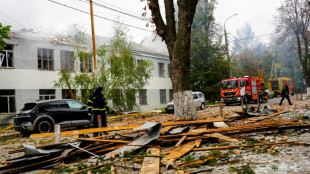
Late last September, a series of underwater blasts ruptured three of the four pipelines that make up Nord Stream 1 and Nord Stream 2, spewing gas into the Baltic Sea.
Russian energy giant Gazprom had in August already halted flows through Nord Stream 1, the main conduit for Russian natural gas to Germany, amid disputes over the war in Ukraine.
The newly completed Nord Stream 2 twin pipelines never opened as Berlin pulled the plug on the project days before Russian troops entered Ukraine on February 24, 2022.
The 10-billion-euro ($10.6 billion) Nord Stream 2 had long been opposed by Ukraine, the US and eastern European countries who feared it would give Russia too much influence over Germany's energy security.
- Tight-lipped investigators -
Because the leaks occurred in their exclusive economic zones, Denmark and Sweden opened probes into the attack, as did Germany.
All three countries have kept a tight lid on their investigations, which analysts say is unsurprising given the potential diplomatic fallout of what they might uncover.
Sweden's public prosecutor Mats Ljungqvist has said the "primary assumption is that a state is behind it".
Sweden was now "in the final phase of the investigation", he told AFP this week.
German federal prosecutors searched a sailing yacht in January that may have been used to transport the explosives. They seized objects from the vessel and found traces of explosives.
They have refused to comment on media speculation that a team of five men and one woman chartered the "Andromeda" sailing yacht from Rostock port to carry out the operation.
"The identity of the perpetrators and their motives" remain the subject of ongoing investigations, the federal prosecution's office told AFP.
- Ships and CIA tip-offs -
Investigative journalists have been carrying out their own research to solve the Nord Stream whodunnit, leading to sometimes sensational -- if unconfirmed -- reports.
Dutch military intelligence warned the CIA of a Ukrainian plan to blow up the pipelines three months before the attack, Dutch broadcaster NOS and Germany's Die Zeit and ARD said in June. The Washington Post made a similar claim.
Ukraine's President Volodymyr Zelensky has repeatedly denied his country was behind the sabotage.
"I would never do that," he told Germany's Bild newspaper in June, adding that he would "like to see proof".
The New York Times wrote in March that US officials had seen intelligence indicating that a "pro-Ukrainian group" was responsible, without Zelensky's knowledge.
German media have focussed their attention on the "Andromeda", with reporters from Der Spiegel magazine and broadcaster ZDF recreating the journey they believe was made by the six-person crew.
According to their reporting, a forged passport used to hire the sailboat leads back to a Ukrainian soldier while the charter fee was paid by a company registered in Poland with ties to a woman in Kyiv.
However, Danish media have reported that a Russian naval vessel specialised in submarine operations, the SS-750, was photographed near the site of the blasts days before the attack.
A claim by US investigative journalist Seymour Hersh in February that the US was behind the attacks and that Norway assisted was dismissed as "fiction" by the White House.
- False flag? -
Experts have not ruled out a "false flag" operation by Russia, with clues deliberately placed to pin the blame on Ukraine.
Andreas Umland, an analyst at the Stockholm Centre for Eastern European Studies, sees Russia as "the most likely" culprit.
Any suspected involvement by Kyiv in an attack on Europe's energy infrastructure could threaten the support of allies, which would benefit Russia.
At the same time, the destroyed pipelines could help Gazprom avoid compensation claims for undelivered gas, even though the company displayed a reluctance to keep the taps open before the blasts.
Moscow may have sought "to kill two birds with one stone", Umland said.
The Kremlin has strongly denied responsibility.
C.Smith--ThChM