'Are we safe?' Mixed emotions for Venezuelan migrants reaching the US / Photo: © AFP

After weeks of travel on dangerous roads and rugged trails, hundreds of Venezuelan migrants experienced a bittersweet moment Saturday when they reached Eagle Pass, Texas, on the US border with Mexico, only to encounter a thicket of barbed wire and armed soldiers.
"Are we safe?" asked Karlen Ramirez, who was in tears after crossing the Rio Grande, the natural border separating the two countries, and struggling through the barbed wire barriers.
Eagle Pass, a town of almost 30,000, has for decades been one of the border points most heavily used by arriving migrants searching for opportunity or escaping from hunger, violence or political turmoil in their home countries.
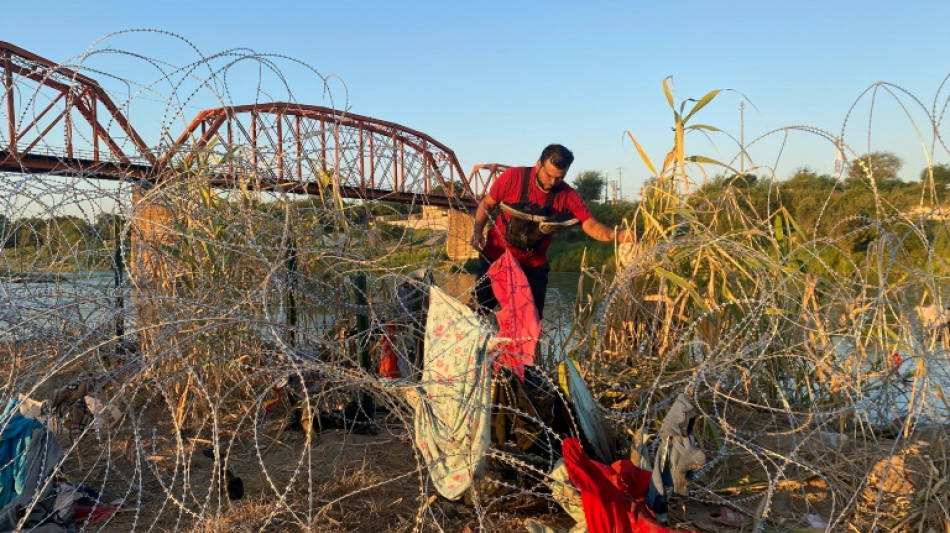
Next to a golf course that extends under a bridge between the two countries, the US authorities have placed new rolls of barbed wire, the latest challenging obstacle for migrants pursuing the American "dream."
"I was frightened when I saw this," said Luis Duran, 37, one of roughly 500 migrants, nearly all of them Venezuelans, to arrive on Saturday. "I thought they were going to mistreat us."
He alternately cried and nervously smiled after managing to wriggle through a gap in the fencing.
"They robbed us in other countries; they mistreated us," said Duran, who was limping after leaping from the roof of a train that had carried him, his brothers and nieces across a stretch of Mexico.
"Over there," he said, pointing to the river, "some armed men tried to take my niece." In tears again, he hugged a seven-year-old girl, who fixed an empty gaze on the horizon.
"But Venezuela is worse," Duran added. "We are afraid to be there."
"Now we are calmer," said his sister, 28-year-old Lexibel Duran, as border authorities approached.
"Now that we are here," the mother of three added, "everything is better."
- 'No comparison' -
With 2.2 million migrants intercepted at its southern border -- 1.8 million of them at relatively remote places like this crossing -- the United States will end its fiscal year on September 30 in record territory.
The numbers convey a sense of the enormous challenge the US government faces in dealing with immigration.
The issue divides American society, bitterly pitting Republicans against Democrats.
With tensions rising in the conservative border state of Texas, US Homeland Security Secretary Alejandro Mayorkas was to meet Honduran President Xiomara Castro on Saturday in the Texas city of McAllen for talks on migration.
President Joe Biden's handling of the crisis has drawn criticism from both political sides. His administration has attempted to stem the migratory flow through special programs to process asylum and visa requests in migrants' home countries.
Authorities on the ground have applied other deterrent strategies.
On Saturday, a US military convoy arrived to close gaps in the wire fencing made by earlier arrivals.
Scraps of clothing hanging from the barbed wire provide a reminder of the ferocity of this final obstacle.
But for migrants who have walked sometimes thousands of miles on foot, and many of whom passed through the treacherous Darien Gap from Colombia into Panama, determination has been their guide.
They burrow through the sand under the wire, or squeeze through, inch by painful inch, as soldiers watch unmoving. The troops act only once the migrants make it through. They are then turned over to nearby border patrols.
"This here," says 17-year-old Venezuelan Dileidys Urdaneta, "is nothing. Because what we have experienced, what we have gone through, is much worse. And what we left behind -- don't even mention it.
"There is no comparison."
She had reached Eagle Pass carrying only her documents, a phone with no battery and the clothes she was wearing -- shorts and a sports top.
"Now," she added, "it can only get better."
E.Lau--ThChM