Portugal: Europe's last open door for immigrants / Photo: © AFP

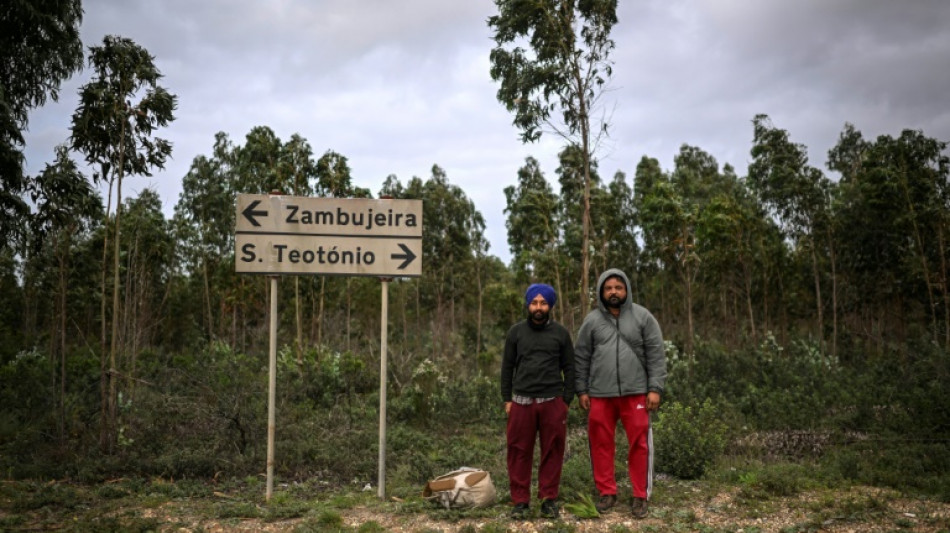
In Sao Teotonio, a small country town in southwest Portugal, there are more Indian and Nepalese restaurants than Portuguese ones.
Which makes sense when you discover South Asian workers keep the fruit farms that are the mainstay of the region going.
Nepalese immigrant Mesch Khatri, 36, picks raspberries and strawberries in the greenhouses around Sao Teotonio while his wife Ritu, 28, runs their cafe, called the Nepali, in the town.
Their seven-year-old son speaks Portuguese, a little English, but no Nepali at all.
Khatri moved to Portugal in December 2012 after working in Belgium. "I came here because it was hard to get a resident's permit in Belgium. It's easier to get papers here."
Five years after arriving in Portugal he had residency, and two years after that a Portuguese passport.
While migrants in most other European countries face a deliberately dissuasive obstacle course to get papers, resulting in many working illegally, in Portugal it is the other way around.
Immigrants are quickly absorbed into the legal economy, paying taxes and social charges straight away.
While the agricultural Alentejo region has been losing its people for decades, the population of the municipality that includes Sao Teotonio has gone up 13 percent in the last decade.
Migrant farm workers have brought life back to an area badly hit by the flight from the land.
With one of Europe's most open immigration regimes, Portugal has seen its foreign-born population double in five years, partially due to South Asians who have come to work in farming, fishing and restaurants.
The influx has been encouraged by the socialist government, which has been in power since the end of 2015, but all this could change if the country shifts to the right after the March 10 general election.
- 'We need them' -
Fewer than half a million in 2018, last year a million foreigners were living in Portugal -- one in 10 of the population, according to provisional figures given to AFP by AIMA, the state agency for integration, migration and asylum.
Brazilians, with their long historical links to the country, remain the biggest contingent -- some 400,000-strong -- followed by the British and other Europeans.
But the 58,000 Indians and 40,000 Nepalis are already more numerous than people from Portugal's former African colonies like Angola and Cape Verde.
Bangladeshis and Pakistanis now also figure in the top 10 of new arrivals.
"The main reason Portugal has seen the number of immigrants rise is because it needs them," said Luis Goes Pinheiro, the head of AIMA, saying the country has Europe's most ageing population after Italy.
Far from the "sea of plastic" of greenhouses around Sao Teotonio, Luis Carlos Vila also depends on foreign workers to pick his apples in an isolated corner of the northeast.
"I have no other choice," he told AFP. "We have an elderly population and there are no more agricultural labourers."
Six Indians were hard at work in his orchards in Carrazeda de Ansiaes. "I love Portugal," said Happy Singh, a Punjabi Sikh in halting English. "The money is good, the work is good and the future is good. In India there is no future."
Vila hires his foreign workers completely legally through employment agencies and sees in them a little of his own family history. "My father also had to emigrate (to France) to earn a living," he said.
- 'Generous country' -
Even among the most traditional of Portuguese fishing communities like Caxinas near Porto -- the living embodiment of the country's strong maritime heritage -- half of the crews are made up of Indonesians.
At the helm of his 20-metre trawler the Fugitive, Jose Luis Gomes -- a skipper like his father and grandfather -- is resigned to the fact that his compatriots no longer want to do this tough job when there are better salaries elsewhere.
Javanese fisher Saeful Ardani was working his fourth 18-month contract for Gomes.
Hired through a boat owners' group, the 28-year-old told AFP that the "Indonesian fishermen who work here have no problems. And our families back home are reassured because we are not illegal."
A country of emigrants throughout the 20th century, Portugal has become a destination for immigrants since the turn of the 21st.
"Whatever indicator you take, it is one of the most generous" countries in Europe when it comes to immigration, said Jorge Malheiros, a migration specialist at Lisbon University.
Since 2007, Portugal has been granting papers to all those who declare their earnings.
In 2018 the socialist government extended this to those who had entered the country illegally.
A new amendment in 2022 allowed foreigners looking for work a temporary six-month visa.
- 'More racism' -
"Portugal's laws are not perfect but they are better than a lot of countries with regressive policies," said Timoteo Macedo, of the Immigrant Solidarity group.
While these laws have prevented the people smuggling tragedies that have happened elsewhere, and migrants living under constant fear of expulsion, it hasn't stopped "people making money on the back of human misery", Macedo added.
The authorities have dismantled trafficking networks in the Alentejo region, where farm workers were forced to live in unacceptable conditions.
Leaning on the counter of his cafe in Sao Teotonio, Mesch Khatri acknowledged that the influx of foreigners had brought new challenges.
"Before it was easier to earn your living, now there is more racism. The Portuguese don't like it when there are 10 or 15 people living in a house and if they don't speak Portuguese," added his wife Ritu.
Julia Duarte volunteers in a charity shop right next to a centre where around 20 children are helped with their homework, only one of whom has a Portuguese name.
Originally from Alentejo, the 78-year-old worked in Lisbon before retiring back to Sao Teotonio. "I thought I would be able to enjoy my retirement in peace -- then there was just an avalanche" of migrant workers, she said.
"Lots of people and lots of hustle, everyone looking for a job, for a place to stay...
"Then I realised that these were gentle people."
- Family reunification -
Such is the demand that the anti-poverty NGO Taipa has changed its focus to help to integrate migrants.
"Ten or 15 years ago we were not ready for this," admitted its head Teresa Barradas. "It is quite a big thing for a community that was more closed in on itself and not used to such big cultural differences."
But the biggest problem for immigrants is the lack of homes, "particularly for families", she added.
Portuguese law allows for family reunification, and "that plays a big role in tackling prejudice because you see that your neighbours are a family who have children at school with your own," Barradas said.
Pinheiro, the head of the state integration agency, agrees. "Family reunification is extraordinarily important to guarantee the full integration and rooting of migrants, particularly in rural areas."
Created late last year after the border police agency was wound up, AIMA inherited 350,000 outstanding regularisation applications.
In the capital Lisbon, there are noticeably more South Asian bicycle delivery riders than before.
During Friday prayers hundreds of Muslims queue to get into one of the two mosques in the narrow streets of Mouraria, the medieval Moorish quarter.
- 'Bangladesh Street' -
Its central street, the Rua do Benformoso, now has so many Bengali shops and restaurants that it is nicknamed "Bangladesh Street", said Yasir Anwar, a 43-year-old Pakistani.
He arrived in 2010 without a visa after brief stays in Denmark and Norway. He lived under threat of expulsion until he managed to get his papers thanks to the change in the law in 2018.
After criss-crossing the city selling flowers in bars and restaurants, Anwar got a job with a restaurateur who taught him both the language and how to cook Portuguese food.
He is now waiting for Portuguese nationality -- which he should normally get after five years of legal residency -- and hopes one day to bring his wife and two children to join him.
"When I arrived there was nothing for us," said Anwar, who now volunteers for Immigrant Solidarity. Since then "Portugal has become a good country for immigrants and welcomes them with open arms."
Despite the recent rise of the far-right Chega party, polls show that "immigration is not regarded as a pressing issue in Portugal, and unlike the rest of Europe, the reaction to migration remains positive," Pinheiro said.
Even if Chega, which was only formed in 2019, is polling close to 20 percent ahead of the election, immigration is for now only seventh in its list of manifesto priorities.
H.Au--ThChM