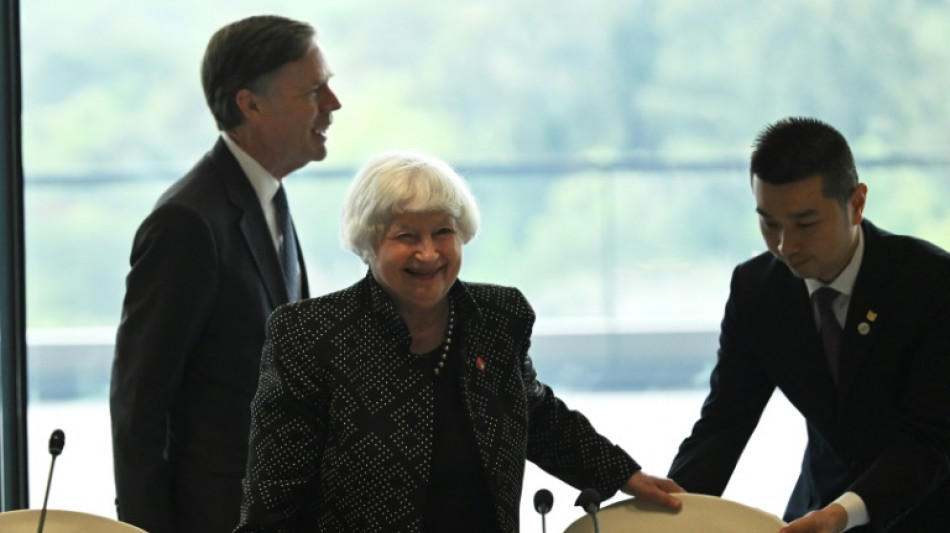
Yellen warns China industrial subsidies pose risk to world economy / Photo: © AFP

US Treasury chief Janet Yellen warned during a visit to China on Friday that Beijing's subsidies for industry could pose a risk to global economic resilience.
Yellen arrived in the city of Guangzhou on Thursday for several days of talks with Chinese officials on what is her second visit to the world's number two economy in less than a year.
Speaking on Friday, she expressed concerns about China's "overcapacity" -- that its huge subsidies for industry risk creating an excess of goods that then flood global markets -- undercutting American and other countries' firms.
"Direct and indirect government support is currently leading to production capacity that significantly exceeds China's domestic demand, as well as what the global market can bear," she told a gathering of the American business community in the city.
"Overcapacity can lead to large volumes of exports at depressed prices," she said.
"And it can lead to overconcentration of supply chains, posing a risk to global economic resilience."
Yellen in the morning told the governor of Guangdong -- a vast province emblematic of the reforms and development that drove China's breakneck growth -- that the US was committed to a "healthy economic relationship".
But, she stressed, that required "a level playing field for American workers and firms", as well as "open and direct communication on areas where we disagree".
"This includes the issue of China's industrial overcapacity, which the United States and other countries are concerned can cause global spillovers," she said.
- China pushback -
Beijing has dismissed concerns over its vast state support for industry, last month condemning an EU probe into its subsidies for EVs as "protectionism" and part of a Western effort to politicise international trade.
Washington's worries about a flood of exports come as US President Joe Biden pushes to boost domestic manufacturing in clean energy -- with policymakers warning that China's excess capacity could harm the growth of those industries.
The Biden administration is very sensitive to the US auto industry's concerns about China and EVs, especially in an election year, said Paul Triolo, associate partner for China at Albright Stonebridge Group.
"It is likely that the administration will take some action to show it is willing to act pre-emptively to prevent future problems from China's overcapacity in EVs," he told AFP.
But he warned that Beijing would likely "react badly", given the impact on US automakers remains to be seen.
- Stabilising ties -
During her trip, Yellen plans to meet with Chinese Premier Li Qiang and Vice Premier He Lifeng, as well as central bank governor Pan Gongsheng and Finance Minister Lan Fo'an.
Talks with He will see the two dive deep into both countries' economic conditions and address more sensitive areas such as national security and Beijing's alleged support for Russia's defence industrial base.
Beijing and Washington have clashed in recent years on flashpoint issues ranging from technology and trade to human rights, as well as over the self-ruled island of Taiwan and the South China Sea.
Relations have stabilised somewhat since Presidents Biden and Xi Jinping met in San Francisco in November for talks that both sides described as a qualified success.
Yellen's July 2023 visit helped restart dialogue after a period of heightened tensions, notably over Taiwan, and culminated in the launching of bilateral working groups on economic and financial policy.
US Secretary of State Antony Blinken is also expected to make another China trip in the coming weeks, a sign that both sides are returning to more routine engagements.
O.Tse--ThChM