How the EU wants to reshape its asylum system / Photo: © AFP

The European Parliament votes Wednesday on a landmark reform of EU laws on asylum-seekers and irregular migrants.
Here are the main changes which, if adopted, will come into force from 2026:
- Border filtering -
The new EU Asylum and Migration Pact will see migrants irregularly entering the EU undergo identity, health and security checks and have biometric readings of their faces and fingerprints recorded, which can take up to seven days.
Children will get special treatment, and member countries are to have independent monitoring mechanisms in place to ensure rights are upheld.
The procedure aims to determine which migrants should receive an accelerated or normal asylum application process, and which ones should be sent back to their country of origin or transit.
- Streamlined vetting -
Asylum-seekers with lower chances of receiving protection status -- defined as those coming from countries whose nationals' asylum applications are, on average, rejected in at least 80 percent of cases -- will be processed faster.
Nationals from countries such as Tunisia, Morocco and Bangladesh figure in that category.
Their streamlined applications would be processed in centres not far from the EU's "external borders" -- meaning mostly land frontiers and ports, but also airports -- so they could be quickly sent back if their request is judged to be unfounded or inadmissible.
This would require using detention centres, though alternative measures can be used, such as confinement in residences.
Up to 30,000 people can be held in the centres at any period, with the EU expecting up to 120,000 migrants annually to pass through them.
Unaccompanied minors believed to pose a security risk and families with children would also be held in them.
- Solidarity mechanism -
The new system would reform the EU's so-called Dublin III mechanism under which, generally, the country in which an irregular migrant first sets foot is responsible for handling their case.
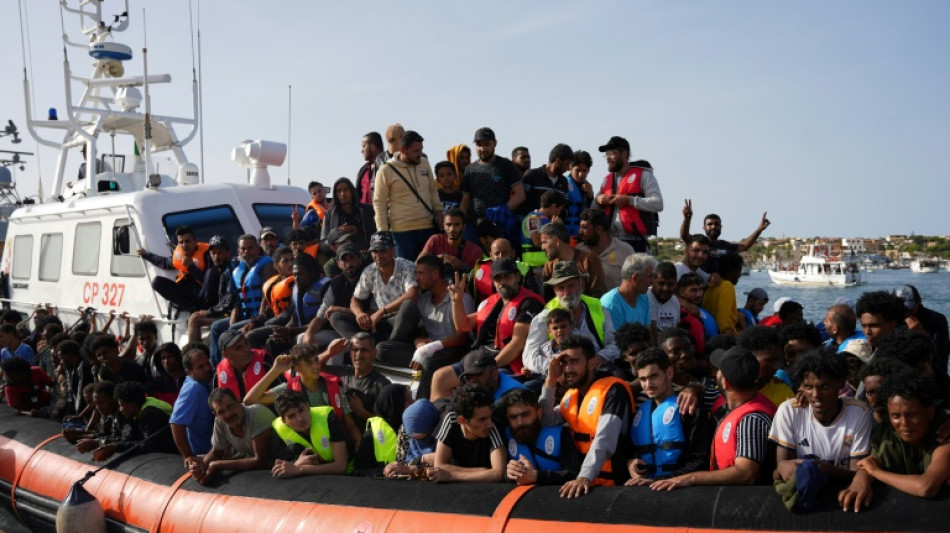
Currently that places stress on Italy, Greece and Malta, which have received the bulk of land and sea arrivals in recent years.
Under the new rules, the Dublin III principle of first-country responsibility would be maintained, but with extra criteria that could shift the asylum-seeker's file to another EU country.
And a mandatory solidarity mechanism would oblige member states to take in a certain number of asylum-seekers arriving in the outer-rim EU countries.
If they choose not to, those other countries could instead provide money or other material or personnel contributions.
At least 30,000 asylum-seekers a year will come under this relocation system. An annual financial compensation of 600 million euros ($650 million) would be fixed for those preferring to pay instead of host.
- Surge response -
The package establishes an emergency response in the event of unexpected migration surges -- the same sort of crisis the EU faced in 2015-2016 when more than two million asylum-seekers entered the bloc, many of them from war-torn Syria and Afghanistan.
Asylum requests stood at 1.14 million in 2023, the highest level since 2016.
It would allow member states to reduce protections for asylum-seekers, making it possible to hold them longer than usually permitted in detention centres on the EU's external borders.
EU members also want to address the "instrumentalisation" of migratory flows by outside countries. Belarus and Russia, for example, have been accused of encouraging migrants to try to enter the EU to destabilise the bloc.
- 'Safe third country' -
The concept of a "safe third country" will be allowed when vetting asylum-seekers.
That could mean that an irregular migrant who came to the EU via a country deemed "safe" enough to lodge a request for protection there could have their EU application rejected. But for that to be invoked, a sufficient "link" has to be established between the asylum-seeker and the transit country.
O.Tse--ThChM