The China Mail - 'Robust' US has helped improve global economic outlook: IMF chief

USD -
AED 3.673005
AFN 65.000583
ALL 81.749936
AMD 362.319598
ANG 1.790365
AOA 917.000207
ARS 1517.512699
AUD 1.435431
AWG 1.8
AZN 1.697925
BAM 1.747811
BBD 2.014182
BDT 123.181412
BGN 1.683441
BHD 0.37705
BIF 3000
BMD 1
BND 1.28025
BOB 11.999867
BRL 4.99967
BSD 0.999987
BTN 96.714521
BWP 13.824844
BYN 3.066935
BYR 19600
BZD 2.01126
CAD 1.425715
CDF 2317.50247
CHF 0.83295
CLF 0.024737
CLP 976.740347
CNY 6.704601
CNH 6.70181
COP 3241.58
CRC 456.562244
CUC 1
CUP 24.000894
CVE 98.050251
CZK 21.796016
DJF 177.719818
DKK 6.674415
DOP 60.350259
DZD 134.523655
EGP 52.376404
ERN 15
ETB 161.000247
EUR 0.89294
FJD 2.24975
FKP 0.753189
GBP 0.756645
GEL 2.57497
GGP 0.753189
GHS 11.780212
GIP 0.753189
GMD 74.000229
GNF 8750.000029
GTQ 7.637967
GYD 209.155291
HKD 7.848205
HNL 26.845398
HRK 6.7267
HTG 130.956211
HUF 326.393959
IDR 17912
ILS 3.072199
IMP 0.753189
INR 96.751699
IQD 1310
IRR 1732150.000247
ISK 122.330007
JEP 0.753189
JMD 158.865058
JOD 0.70898
JPY 157.952498
KES 130.130045
KGS 87.448501
KHR 4062.495472
KMF 438.00041
KPW 900.000318
KRW 1338.110355
KWD 0.31032
KYD 0.833423
KZT 447.018136
LAK 22480.000121
LBP 89599.999834
LKR 330.857909
LRD 170.999714
LSL 16.530184
LTL 2.95274
LVL 0.60489
LYD 6.430172
MAD 9.967503
MDL 17.810545
MGA 4500.00026
MKD 55.022341
MMK 2099.693644
MNT 3596.990612
MOP 8.084004
MRU 40.16024
MUR 47.40406
MVR 15.409603
MWK 1740.999777
MXN 17.95633
MYR 4.086899
MZN 63.900789
NAD 16.570192
NGN 1326.460269
NIO 36.67025
NOK 9.575805
NPR 154.747383
NZD 1.78461
OMR 0.384507
PAB 1
PEN 3.44625
PGK 4.450026
PHP 62.700961
PKR 276.99972
PLN 3.908275
PYG 5834.699887
QAR 3.643396
RON 4.780303
RSD 104.914006
RUB 85.500781
RWF 1475
SAR 3.750804
SBD 8.065041
SCR 13.918462
SDG 601.506766
SEK 9.99763
SGD 1.279385
SHP 0.754461
SLE 24.680009
SLL 20969.491881
SOS 571.498647
SRD 37.87102
STD 20697.981008
STN 22.15
SVC 8.750592
SYP 13002.000254
SZL 16.569969
THB 33.645503
TJS 9.230295
TMT 3.5
TND 2.99705
TOP 2.40776
TRY 49.195302
TTD 6.783645
TWD 31.846898
TZS 2635.000254
UAH 44.87185
UGX 4075.012399
UYU 40.10688
UZS 11795.000253
VES 872.77465
VND 25980.5
VUV 120.182413
WST 2.784712
XAF 585.730117
XAG 0.016702
XAU 0.00024307539
XCD 2.70255
XCG 1.802299
XDR 0.707052
XOF 585.730117
XPF 106.593742
YER 236.224982
ZAR 16.608285
ZMK 9001.191881
ZMW 19.890974
ZWL 321.999592
SSP 5747.740458
MXV 2.029503
  • RYCEF

    0.4000

    19.71

    +2.03%

  • CMSC

    0.0000

    20.4

    0%

  • BTI

    0.4200

    56.05

    +0.75%

  • BP

    0.2800

    44.43

    +0.63%

  • RBGPF

    1.6000

    67

    +2.39%

  • RIO

    -0.1500

    94.41

    -0.16%

  • AZN

    -0.4300

    166.15

    -0.26%

  • GSK

    0.4600

    49.7

    +0.93%

  • BCE

    -0.4100

    20.56

    -1.99%

  • NGG

    -0.2500

    75.24

    -0.33%

  • VOD

    -0.0400

    16.58

    -0.24%

  • RELX

    -0.4500

    33.07

    -1.36%

  • BCC

    -0.5500

    76.59

    -0.72%

  • CMSD

    -0.0300

    20.27

    -0.15%

  • JRI

    -0.2500

    10.77

    -2.32%

'Robust' US has helped improve global economic outlook: IMF chief
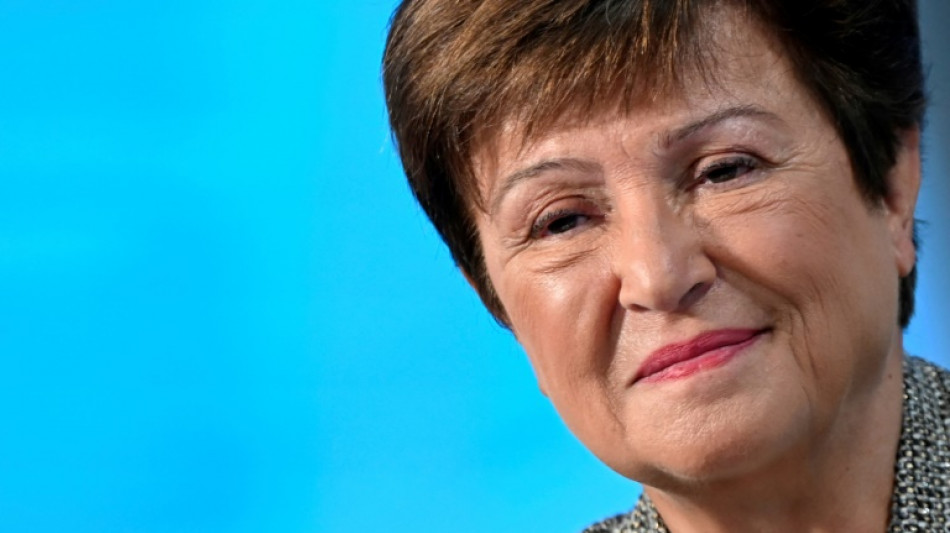
'Robust' US has helped improve global economic outlook: IMF chief / Photo: © AFP

'Robust' US has helped improve global economic outlook: IMF chief

Strong growth in the United States has helped to lift the outlook for the world economy, but more needs to be done to stem a slide in productivity, the head of the IMF said Thursday.

Text size:

"Global growth is marginally stronger on account of robust activity in the United States and in a number of emerging markets economies," International Monetary Fund managing director Kristalina Georgieva said in a speech in Washington.

The US economy grew by a robust 2.5 percent last year, according to the Commerce Department, far outstripping most other advanced economies.

"Sustained household consumption and business investment, and an easing of supply chain problems helped," Georgieva added. "And inflation is going down."

She spoke days before the IMF-World Bank spring meetings of world financial leaders in Washington, one of two such gatherings hosted annually by the international institutions.

Her remarks suggest the IMF now expects the world economy to grow faster than it predicted in January, when it forecast global growth to rise by 3.1 percent in 2024, and 3.2 percent in 2025.

"It is tempting to breathe a sigh of relief. We have avoided a global recession and a period of stagflation," Georgieva said.

"But there are still plenty of things to worry about."

- Geopolitical tension -

A challenge Georgieva mentioned was rising geopolitical tension, which increases the risk of fragmentation in the global economy.

"We have to buckle up for more to come," she told a question-and-answer session when asked if volatility is the new normal in international affairs.

Georgieva also noted that while China, the world's second biggest economy, has taken steps to address problems in its struggling property sector, "they can do more."

This includes being more decisive in dealing with failing companies and directing support towards uncompleted construction, given the key role real estate has in boosting people's confidence.

Beijing also needs to improve domestic demand and deal with issues like local government debt, she said, stressing that China contributes a third of global growth and is important for the world.

Georgieva also broadly highlighted the challenges of growing public debt and a "broad-based slowdown in productivity."

Because of this, the IMF expects growth to remain at just above three percent over the medium term -- below its historical average.

To help the global economy to heal and fix the productivity challenge, Georgieva laid out steps to bring global inflation and public debt back down to sustainable levels, and also called for moves to eliminate "constraints to economic activity."

"In short, if there is a market failure that needs to be addressed -- such as accelerating innovation to address the existential threat of climate change -- there is a case for government intervention, including through industrial policy," she said.

"If there is no market failure, there is a need for caution," she added.

K.Leung--ThChM