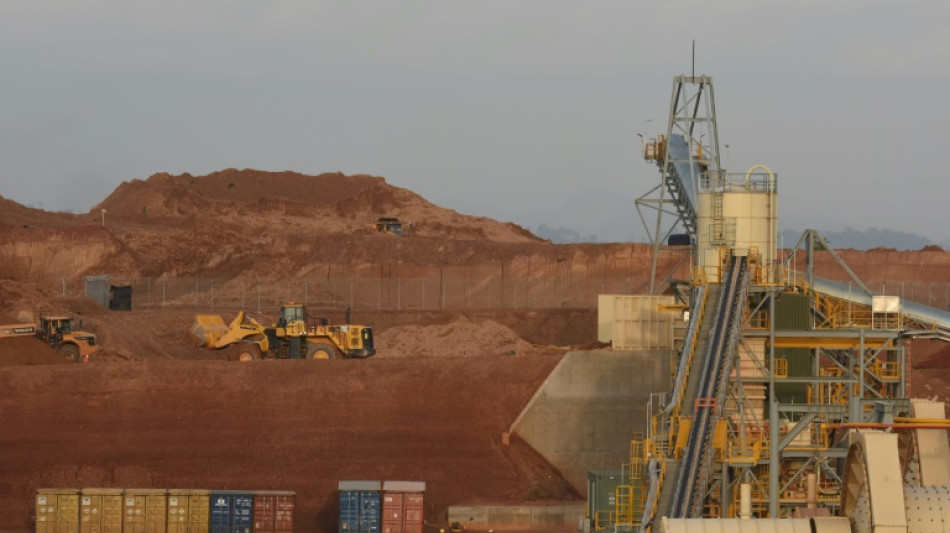
Ivory Coast tilts economy from farming to natural resources / Photo: © AFP

The discovery of huge deposits of natural resources including oil, gas and gold in the Ivory Coast is pushing the country’s economy in a new direction as it explores its underground potential.
Over the last three years, the West African country -- traditionally focused on agriculture, in particular cocoa -- has leaned into a new role as an oil and gas producer.
Three discoveries of oil deposits were made in September 2021, July 2022 and February this year, revealing huge reserves estimated at six billion barrels.
The discoveries give the country the potential to become a net exporter by the end of the decade.
The first deposit, called Whale, is already up and running, operated by Italian company Eni.
It aims to supply 200,000 barrels per day by 2026, and 200 million cubic feet per day of gas.
The minister of mines, oil and energy, Mamadou Sangafowa Coulibaly, said the country could now have the chance of joining the OPEC group of oil-producing countries.
Other discoveries of raw materials are also opening potential new revenue streams.
The number of mining permits and projects in process have tripled since 2012 -- from nine to 28 -- while research permits have increased from 120 to nearly 200 over the period.
Sangafowa Coulibaly says the tax revenues generated are already 20 times higher than they were in 2012, at 372 billion CFA francs ($620 million).
"The western half and the northeast of our country are full of strategic and critical minerals," he said.
- 'Everything related to raw materials' –
"The Ivorian economy is diversifying into everything related to raw materials," said Cedrick Sehe, president of CAMP2E, an organisation that promotes mining in the country.
In May, the country's largest gold deposit was discovered in the west, with the potential to be the third-largest mine in West Africa.
Lithium, manganese, nickel and even coltan –- a precious ore used to make electronic devices – have also been found in Ivorian soil.
"These minerals are particularly sought after because they are part of energy transition policies. They are, for example, used for the manufacture of electric cars," Serge Parfait Dioman, an engineering expert in the oil and energy industries, told AFP.
In a sign of its changing role, Ivory Coast will host the SIREXE conference -– its first international mining industry exhibition -- in November and December this year.
But some have cautioned that the country could fall into the "raw materials curse", where a focus on extracting an abundance of resources can end up having negative impacts on the economy.
Parfait Dioman countered that "the more diversified your raw materials are, the less risk you have of falling into this trap".
- Environmental fears –
Experts have also warned about the risk of environmental damage.
Eni has said it plans to make the Whale field the first "carbon-neutral" in Africa, mostly by using less-polluting technologies and by setting up projects to restore forests in the country.
But while this aim is linked to its own operations, it does not mention the significant amount of indirect emissions from the project.
Eni told AFP that it aims to be carbon-neutral worldwide by 2050, in both direct and indirect emissions.
Last year, the Institute for Security Studies also noted a risk of increased deforestation through more drilling and mining.
The country has already lost nearly 90 percent of its forest cover in half a century.
Fears have also been raised over the toxicity of chemicals used in extraction processes.
In June the Cavally river in the west of the Ivory Coast was polluted by cyanide discharges after an incident in the Ity gold mine.
C.Mak--ThChM