US-German trio wins medicine Nobel for work on optogenetics / Photo: © AFP

The Nobel medicine prize was awarded Monday to US psychiatrist and neurologist Karl Deisseroth and German scientists Peter Hegemann and Georg Nagel for their pioneering work in the field of optogenetics.
Optogenetics involves controlling nerve signals with light, and helps researchers understand how specific cell types contribute to behaviours like learning, fear, addiction and movement.
The trio were honoured "for their discovery of a molecular switch for nerve cells", the Nobel Assembly said.
Using light, researchers are now able to switch individual neural circuits on or off in a brain.
They have been able to reveal neural circuits governing specific memories, feelings, and behaviours relevant for neurological and psychiatric disorders.
In clinical medicine, the method is being used in attempts to restore sight in people with visual impairment, and may one day lead to treatments for disorders such as Parkinson's disease and epilepsy.
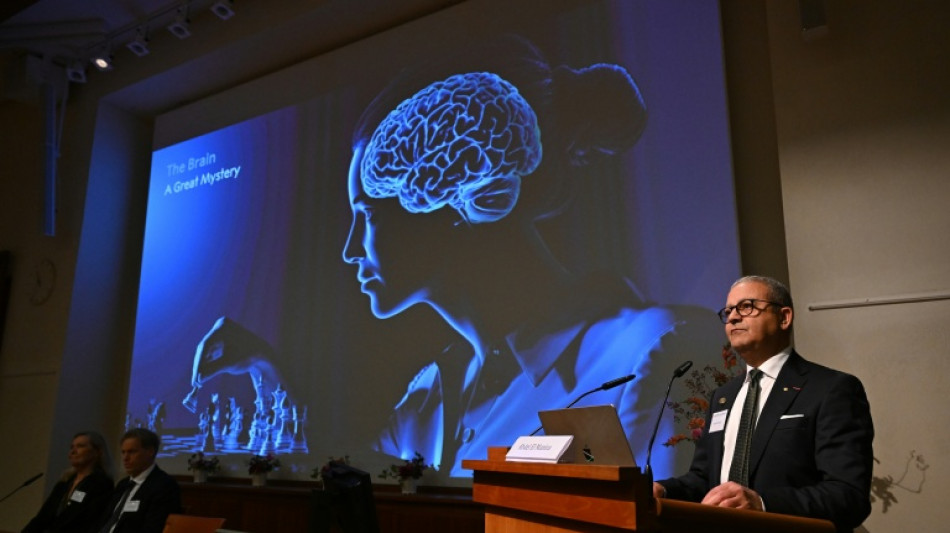
"Optogenetics provides opportunities for mapping the brain in a way that we could once only dream of," Per Svenningsson, chair of the Nobel committee, said in a statement.
"Optogenetics has fundamentally altered our understanding of the brain. Every day brings new discoveries, helping to solve one of humanity's great mysteries: how our incredible brain works," the Nobel Assembly said.
The secretary general of the assembly, Thomas Perlmann, told reporters he was able to reach the three laureates by phone to break the news.
"That was great to talk to them. I first called Deisseroth, he was very tired when he answered. He was definitely asleep, but he woke up," he said.
- Illumination -
In the early 2000s, Hegemann and Nagel were examining why a single-celled alga was able to swim toward a light source.
They discovered an algal protein with unique properties, called channelrhodopsin, found on the surface of the cell.
When illuminated by blue light, a channel opens through the protein.
Charged ions then flow into the cell, creating an electrical impulse. They found that any cell they put the protein in became light sensitive.
Deisseroth then introduced the gene for channelrhodopsin into nerve cells from rats.
By illuminating the cells with blue light, he was able to trigger a nerve signal.
He published his breakthrough in 2005, and two years later, made the light-controlled switch for nerve cells work in the brains of living mice.
In 2021, Deisseroth and Hegemann won the Lasker Prize for their work in the field, often considered a precursor to the Nobel.
Deisseroth, 54, is a professor at Stanford University in the US, while Hegemann, 71, is a neuroscience professor at Humboldt University of Berlin.
Nagel, 73, is a biophysics professor at the University of Wurzburg.
The Nobel prize for physics will be announced on Tuesday, followed by the chemistry prize on Wednesday and the literature prize on Thursday.
Some pundits have suggested that for literature, the Swedish Academy could follow up last year's award to Hungary's Laszlo Krasznahorkai with a woman writer, possibly from Central or Latin America.
Argentine author Samanta Schweblin, 48, could be one such pick, literary critic Lina Kalmteg told AFP.
- All eyes on peace -
Perhaps the most keenly anticipated award is that due on Friday, the peace prize -- the only Nobel to be awarded in Oslo.
This year, some experts have suggested the jury could choose a laureate who enjoys broad consensus, after last year's winner, Venezuelan opposition leader Maria Corina Machado, stirred controversy.
Among possible laureates this year are a joint prize to Save the Children and Mykola Kuleba, a Ukrainian children's rights activist campaigning for the return of Ukrainian children illegally taken to Russia from occupied territories.
Others include Sudan's Emergency Response Rooms (ERR), a vast network of volunteers risking their lives to help people facing the double threat of war and hunger, and the Committee to Protect Journalists (CPJ) after the deadliest year on record for the profession in 2025.
The economics prize wraps up the Nobel season on October 12.
This year's laureates will receive their prizes -- a diploma, a gold medal and a $1.2-million cheque -- on December 10, the anniversary of the death in 1896 of the prize's creator, scientist Alfred Nobel.
K.Leung--ThChM