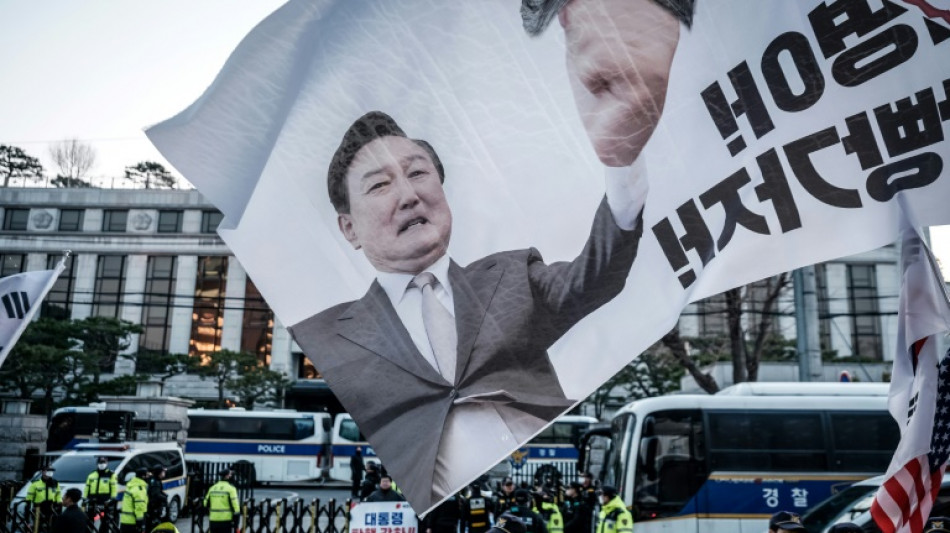
How anti-China disinformation shaped South Korea's year of crisis / Photo: © AFP

Yoon Suk Yeol's botched attempt to impose martial law last year plunged South Korea into its worst political crisis in decades, providing fertile ground for disinformation to grow.
A common refrain, posted on right-wing forums, amplified by YouTubers and echoed by lawmakers: China was to blame.
Yoon supporters claimed Beijing had infiltrated protests, funded his impeachment campaign and manipulated online opinion ahead of the June snap election that brought opposition leader Lee Jae Myung to power.
Yoon himself fuelled the suspicion last December during televised remarks defending his failed decree, warning that "forces linked to North Korea and China are threatening our democracy from within".
But an AFP Fact Check review of the most widespread claims, including alleged "spy arrests" and Chinese-backed protests, found no solid evidence to support them.
Instead, experts say the narrative was a homegrown reflection of political rivalries and long-simmering anti-China sentiment.
"There used to be goodwill toward China, a sense of economic partnership," said Ha Nam-suk, a professor at the University of Seoul.
"But as competition deepened and cultural disputes intensified, frustration turned into resentment. Politicians understood that, and some used it as a convenient rallying tool".
Anger over China's purported meddling spilt over into the streets of Seoul this autumn, where groups waved flags and chanted slogans against "Chinese infiltration".
AFP examined the origins of the disinformation onslaught.
- '99 Chinese spies' -
Shortly after Yoon's impeachment, right-wing YouTubers claimed "99 Chinese spies" had been arrested at the National Election Commission (NEC) and flown to Okinawa by the US military.
Users on forums such as Ilbe and DC Inside picked up the story, which was later reprinted by conservative media outlets and on Facebook.
AFP found the corresponding photos were taken in 2016 of Chinese fishermen detained for illegal fishing. The NEC and US Forces Korea said the reports were "entirely false".
Still, the claim spread through pro-Yoon networks, and his lawyer later mentioned it before the Constitutional Court.
"Younger Koreans already had strong resentment toward China over cultural and historical issues," Ha said. "After Yoon's impeachment, online influencers weaponised that resentment, turning frustration into political identity".
A video showing dozens of social media dashboards running on one screen later circulated as a "Chinese AI bot farm".
AFP traced it to a developer demonstrating an AI agent.
- Courts and conspiracies -
As the Constitutional Court considered Yoon's removal from office in the spring, top judge Moon Hyung-bae was targeted by a doctored image showing him "swearing allegiance before a Chinese flag".
The original Yonhap photograph showed South Korea's flag.
Moon continued to face disinformation, and when the Court unanimously voted to oust Yoon in April, the rumour gained traction among supporters who believed the judiciary had been "compromised".
Several surveys conducted early this year indicated public distrust in the court had risen beyond 40 percent.
Anti-Yoon protests also became the target of falsehoods, with posts sharing a Chinese-language poster seen in Seoul after the president's removal.
AFP geolocated it to Gwanghwamun Gate, where demonstrators informed tourists about ongoing protests. The awkward phrasing indicated it had been translated from Korean.
- 'Chinese influence' -
When Lee won the presidency, similar anti-China themes resurfaced, with posts falsely claiming The Guardian reported China helped Lee win.
The article in question cited a White House official's concerns about Chinese influence in democracies -- without referring to South Korea's vote.
But the distortion gained traction, with one post from conservative lawmaker Yoo Sang-bum claiming Chinese nationals "heavily participated in pro-impeachment rallies".
Popular right-wing YouTuber Shin In-kyun said the election "proved how deeply Chinese influence runs in our politics".
"Once those stories took hold, they became symbols of something larger," said Kim Hee-gyo, a professor at Kwangwoon University.
- Visas and voter fraud -
The Justice Ministry's introduction of a visa-free programme for Chinese group tourists in August further stoked tensions, with former prime minister Hwang Kyo-ahn claiming it was a plot to enable fraud in next year's elections.
The NEC clarified that only foreigners with at least three years of permanent residency can vote in local elections.
But soon after, a new falsehood spread that all Chinese nationals could enter South Korea without passports or health checks.
Kim said with Yoon no longer a viable focal point, hard-liners needed a new rallying cry.
"They filled the vacuum by constructing an external enemy, turning general anti-China feeling into ideological sinophobia," he said.
The problem is not just happening in South Korea, Ha separately noted.
"Across democracies, we're watching crusade-style politics take root -- where one side must die for the other to survive."
J.Liv--ThChM