Daraya reborn: the rebels rebuilding Syria's deserted city / Photo: © AFP

Like a ghost in the night, Bilal Shorba, the artist they call the "Syrian Banksy", slipped through the rubble of Daraya to paint his murals, praying that Bashar al-Assad's gunners wouldn't spot him.
Returning from exile to one of the devastated cradles of the Syrian revolution -- the only city that lost its entire population during the near-14-year civil war -- he was amazed that some of his work had survived.
On the wall of a destroyed house, one of his bullet-riddled murals, "The Symphony of the Revolution", shows its tragic evolution from non-violent idealism to unrelenting death -- a woman plays the violin as pro- and anti- Assad gunmen all take aim at her with their Kalashnikovs.
Its very survival is "a victory", said Shorba, 31. Despite the massacres, despite Assad forcing the people of Daraya from their homes, "despite our exile, these simple murals have remained, and the regime is gone", he said.
Daraya occupies a special place in the story of the Syrian revolution.
Only seven kilometres (four miles) from the capital Damascus and within sight of Assad's sprawling presidential palace, its people handed roses to the soldiers who were sent to quell their peaceful protests in March 2011.
But they paid a heavy price for their defiance. At least 700 were killed in one of the worst massacres of the war in August 2012, when soldiers went from house to house executing anyone they found.
A horrendous four-year siege followed, with the city starved, shelled and pummelled with barrel bombs, till Assad's forces broke the resistance in 2016 and emptied the city of its people.
Not a single one of its 250,000 pre-war inhabitants was allowed to stay, and many were forced into exile.
Shorba came to Daraya from nearby Damascus in 2013 to join the rebels, armed with nothing more than "clothes for two or three days, pencils, a sketchbook" and a copy of Victor Hugo's "Les Miserables" in Arabic.
He stayed for three years, enduring the siege and the bombardment, eating weeds and wild herbs to survive, until he and the other fighters were evacuated with the remaining residents to the rebel-held northwest of Syria in August 2016.
He eventually made his way to neighbouring Turkey where he honed his art.
There is much to do in Daraya now he's back. But Shorba wants to start by painting over the giant murals glorifying the Assad clan that still stare down from the walls.
- Not waiting to be helped -
Women, children and those men who could prove they were not involved with the opposition were slowly allowed to trickle back to Daraya from 2019. But most men had to wait till after the fall of Assad on December 8, 2024.
Many have since returned -- doctors, engineers, teachers, workers and farmers -- often bringing new skills learned abroad or money collected from expatriates to help the rebuilding. Others are bringing back the experience of having lived in a democracy to a country that has never really known it.
Everyone in Syria talks of Daraya's indomitable spirit, its people long renowned for their get-up-and-go attitude.
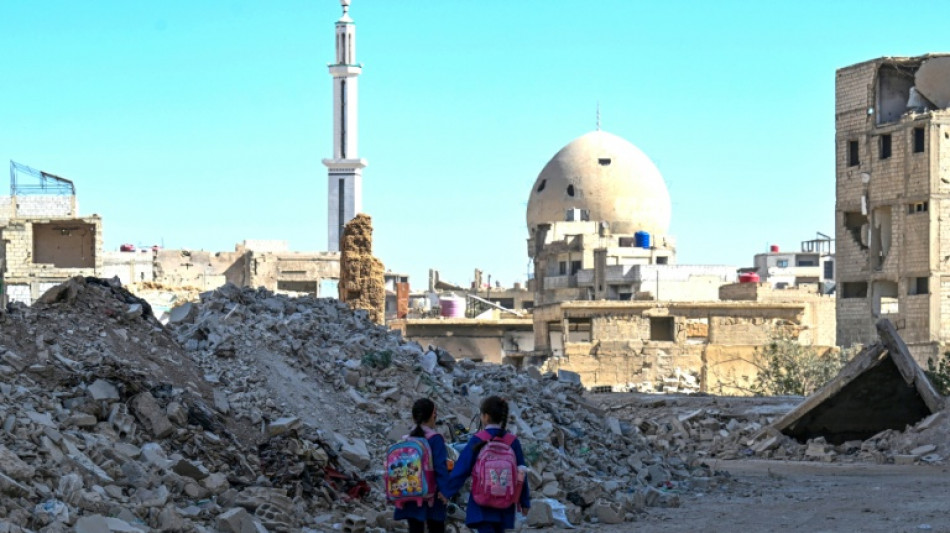
But how do you bring up a family in a city where 65 percent of buildings are destroyed -- according to a study by the Syrian American Engineers Association -- and another 14 percent are badly damaged?
There are power and water shortages, with only a quarter of the city's wells working. In some areas sewage overflows into the street.
Yet Hussam Lahham didn't hesitate for a second to bring his young family back, the youngest of his three daughters born earlier this year after the liberation.
One of the last to leave the city in 2016, the 35-year-old civil society leader was among the first to return. He organised food relief during the early days of the siege and ended it as a military commander.
"We are the only ones capable of rebuilding our homes," Lahham told AFP. "If we were to wait for the international community and NGOs, we may never have been able to return."
The dead also drew him back. Lahham lost more than 30 friends and relatives and feels acutely the debt owed for "the sacrifices Daraya made to regain its freedom".
Now a volunteer in the city's civil administration, he's keen to show that life goes on, even in the most precarious of circumstances. One family has moved back into an upper-storey apartment even though most of the outside walls are gone.
Some areas are a hive of activity, with workers fixing roofs, repairing bomb-damaged facades or fixing water pumps. Many of the city's furniture workshops, for which it was long famous, are also back in business.
But whole neighbourhoods are still deserted, with little more than rubble and the gutted skeletons of residential blocks.
- Gutted hospitals -
None of Daraya's four hospitals are functioning.
The city's National Hospital, which once served a million people, was bombed to bits in 2016. All that remains is its concrete shell overlooking the completely destroyed al-Khaleej district. Even its copper pipes and electricity cables were looted after Assad's forces took the city.
"There is no hospital, no operating theatre" and no casualty department left in Daraya, Lahham said. Many healthcare professionals fled to Egypt, Jordan, Turkey or Europe and most have not returned.
The only real cover comes from a team from the charity Doctors Without Borders, who are committed to running the only medical centre until the end of the year.
Lahham is convinced that if there were more health services, "more people would return".
When Dr Hussam Jamus came back to Daraya, he did not recognise his city. "I expected it to be destroyed but not to this extent," said the 55-year-old ear, nose and throat specialist, who fled with his family at the start of the siege in 2012.
Having had a flourishing practice with 30,000 patients, he found himself in exile in Jordan, unable at first to practise as a consultant. So he volunteered, retrained and worked in a hospital run by the Emirati Red Crescent.
He returned as soon as he could, hanging his plaque at the bullet-riddled entrance to his surgery.
In just a few weeks, he had treated hundreds of patients, ranging from children with inflamed tonsils to "perforated eardrums or broken ones caused by beatings in detention".
"Just as I served my fellow citizens who were refugees in Jordan, I continue to serve them today in my own country" as it rebuilds, he said.
This is also the goal of journalists at Enab Baladi, a media outlet born at the start of the war in Daraya, which has since become Syria's leading independent voice.
Four of its original team of 20 were killed between 2012 and 2016, before the survivors moved its newsroom to Germany and Turkey, where its reporters were trained.
Enab Baladi has correspondents from Syria's mosaic of communities -- Sunnis, Alawites, Christians, Kurds and Druze -- and does not shy from sensitive subjects, even when it makes things uncomfortable with the new Islamist authorities.
They covered the sectarian killings of Alawites, the branch of Shia Islam from which the Assad clan comes, in Latakia in March as well as the violence against the Druze minority in July in Sweida in the south.
Standing in front of the ruins of the house from where it was first published, co-founder Ammar Ziadeh, 35, said he hoped that "independent media can maintain a space for freedom" in a country where journalists were silenced for decades.
- Traumatised children -
Mohammed Nakkash said he wanted to bring his two children, who were born in exile in Turkey, back to Daraya so they could finally feel at home -- even though that home was in ruins.
He hadn't realised how much his boys Omar, six, and Hamza, eight, had been marked by the racism and isolation of being refugees until they returned. That was when he noticed how they had trouble "bonding with my parents and my siblings", having been ignored by their Turkish classmates.
Worried they might be autistic, he took them to a doctor. But they are now adapting, are back at school and are learning to relearn everything, having been taught in the Roman alphabet in Turkey.
Daraya lost seven of its 24 schools in the war and is also struggling with a shortage of teachers and equipment now that 80 percent of the pre-war population has returned.
Many pupils were born in exile in Jordan, Egypt or Lebanon. Those who went to school in Turkey "struggle with Arabic, which they speak but cannot write", an education official said.
Having buried "eight friends with my own hands" before fleeing, Nakkash, 31, is working as a carpenter. He is focused on rebuilding in every sense of the term.
Like many who have lost their homes, he and his young family live with relatives, moving from one to the next as they outlive their welcome.
"Every day we deal with returning residents who find their homes in ruins and ask us for shelter or help to rebuild," said city council leader Mohammed Jaanina.
But to rebuild you have to have your deeds -- which often have been lost in the bombing or during their flight.
- Hiding the dead -
In the final days before Daraya fell in 2016, the last remaining fighters and activists -- including Bilal Shorba and Hussam Lahham -- tried to save the dignity of the dead.
They took photos of the graves in the Cemetery of the Martyrs of all who had been massacred or killed during the siege, then removed the headstones in case they were desecrated by Assad's fighters.
Thanks to the photos, they have been able to put up 421 new gravestones for those whose names were known.
In the plot opposite, under beds of well-tended shrubs, lie the mass graves of yet-to-be-identified victims of the August 2012 massacre, when government forces and allied militias rampaged through the city killing 700 people in just three days.
"I am fighting to give my brothers a grave," said Amneh Khoulani, holding back tears as she prayed in the cemetery.
Three of her brothers were arrested and never seen again.
A photo of one later appeared in the leaked "Caesar Files", which contained images of some of the thousands who were disappeared in Assad's torture and detention centres.
"There is great suffering in Daraya. Many do not know where their children are," said Khoulani, a member of the National Commission for the Missing who has twice spoken at the UN Security Council to appeal for justice.
"We fought to rid ourselves of Assad, but now we are searching for graves," said the activist, who divides her time between Britain and Syria.
At the cemetery entrance, strings of faded photos of the missing flutter in the wind, with a banner reading, "They are not numbers."
Bilal Shorba has painted a mural on one of the cemetery walls. A little girl picks roses in memory of her father, but has no grave to put them on.
D.Peng--ThChM