Iran blasts EU 'mistake' after Guards terror designation / Photo: © AFP

Iran reacted with fury on Thursday after the EU blacklisted the country's Revolutionary Guards as a terror group, as Tehran faced off with Washington after US President Donald Trump warned time was running out for a nuclear deal.
The European Union piled on mounting pressure on Iran on Thursday by designating the Islamic Revolutionary Guard Corps (IRGC) a "terrorist organisation" over a deadly crackdown on recent mass protests
"'Terrorist' is indeed how you call a regime that crushes its own people's protests in blood," said EU chief Ursula von der Leyen, welcoming the "overdue" decision.
Though largely symbolic, the EU decision has already drawn a warning from Tehran that it would have "destructive consequences".
Iranian Foreign Minister Abbas Araghchi called it a "another major strategic mistake" after key European powers last year triggered the return of UN sanctions on Iran over its nuclear programme.
Iran's military slammed "the illogical, irresponsible and spite-driven action of the European Union", alleging the bloc was acting out of "obedience" to Tehran's arch-foes the United States and Israel.
Iranian officials have blamed the recent protest wave on the two countries, claiming their agents spurred "riots" and a "terrorist operation" that hijacked peaceful rallies sparked over economic grievances.
Rights groups have said thousands of people were killed during the protests by security forces, including the IRGC -- the ideological arm of Tehran's military.
Trump had threatened military action if protesters were killed in the anti-government demonstrations that erupted in late December and peaked on January 8 and 9.
But his recent statements have turned to Iran's nuclear programme, which the West believes is aimed at making an atomic bomb.
- Diplomatic push -
On Wednesday he said "time is running out" for Tehran to make a deal, warning a US naval strike group that arrived in Middle East waters on Monday was "ready, willing and able" to hit Iran.
The United States had hit Iranian nuclear targets when it briefly joined Israel's war against Iran in June.
Iranian officials have also ratcheted up warnings that Tehran would respond forcefully to any US military action, while not ruling out diplomatic solutions.
Iran's army chief Amir Hatami on Thursday vowed a "crushing response" to any attack, according to state television, which reported 1,000 "strategic drones" had joined the combat regiments.
Iranian First Vice President Mohammad Reza Aref said the country "must be prepared for a state of war", according to the official IRNA news agency.
"Our strategy is that we will never start a war, but if it is imposed, we will defend ourselves," he said, adding that Iran was "ready" for negotiations with the United States but wanted unspecified guarantees.
The face-off has sent diplomatic shock waves across the region, with calls for negotiations to defuse tensions drawing in key regional actors.
An official in the Gulf -- where states host US military sites -- told AFP that fears of a US strike on Iran are "very clear".
"It would bring the region into chaos, it would hurt the economy not just in the region but in the US and cause oil and gas prices to skyrocket," the official added.
Turkey said it would offer to mediate between Washington and Tehran during an upcoming visit by Araghchi, after Ankara's top diplomat urged Washington to start nuclear talks with Tehran.
Iran ally Russia on Thursday also said "the potential for negotiations is not exhausted".
"Any use of force can only create chaos in the region and lead to very dangerous consequences," Kremlin spokesman Dmitry Peskov told journalists.
- Region doesn't need 'new war' -
Despite the EU's IRGC designation and addition of another 15 Iranian officials and six entities to its asset freeze and visa ban blacklist, the bloc's top diplomat warned the United States against starting a new Middle East conflict.
"When it comes to attacks, then I think the region does not need a new war," foreign policy chief Kaja Kallas said.
However, she hit out at Iran's clerical leadership, saying on X that "any regime that kills thousands of its own people is working toward its own demise".
The US-based Human Rights Activists News Agency (HRANA) said it has confirmed 6,373 people were killed in the protests, as internet restrictions imposed on January 8 continue to slow verification.
But rights groups warn the toll is likely far higher, with estimates in the tens of thousands.
Iranian authorities acknowledge that thousands were killed during the protests, giving a toll of more than 3,000 deaths, but say the majority were members of the security forces or bystanders killed by "rioters".
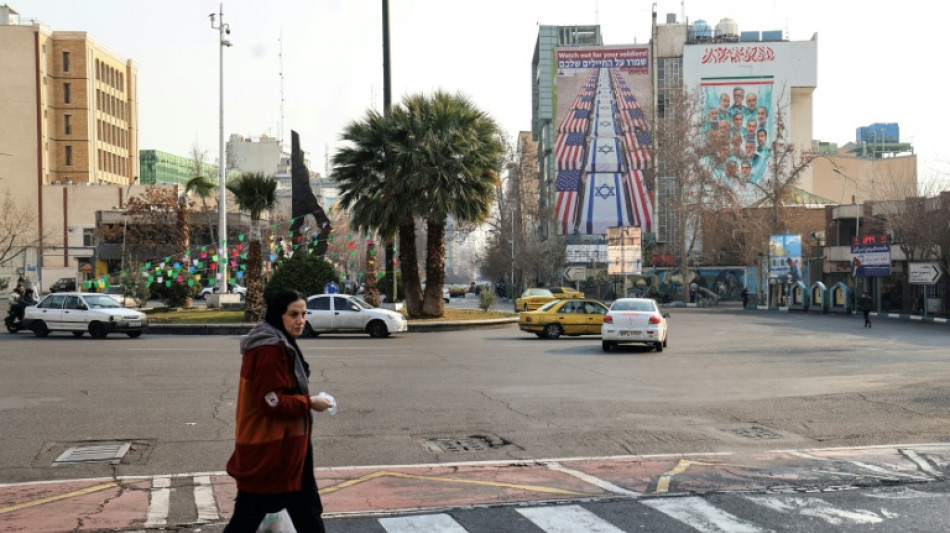
Billboards and banners have gone up in the capital Tehran to bolster the authorities' messages. One massive poster appears to show an American aircraft carrier being destroyed.
burs-sw/sjw/dc
U.Chen--ThChM