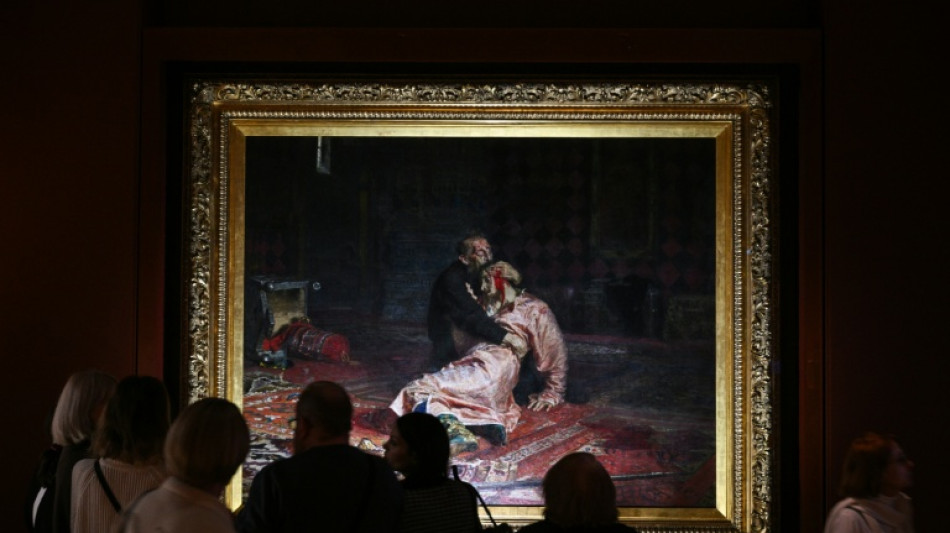
'Close our eyes': To escape war, Muscovites flock to high culture / Photo: © AFP

In front of Moscow's ornate Bolshoi Theatre, its soft yellow lights illuminating a snowstorm in the Russian capital, Valentina Ivakina had come to "escape today's problems".
It is a knowing reference to the war that has been raging between Russia and Ukraine for the past four years, with Muscovites increasingly turning to culture and art to detach from the reality of the conflict, unleashed by the Kremlin's February 2022 offensive.
Concert halls are packed, the famed Tretyakov Gallery is teeming even on a midweek afternoon. A Marc Chagall exhibition at the Pushkin Museum: sold out.
Museum attendance in Moscow, which competes with Saint Petersburg as Russia's cultural capital, jumped 30 percent in 2025, according to deputy mayor Natalya Sergunina.
Ivakina has spent much of the winter bouncing from show to show.
On a stormy evening, the 45-year-old marketing specialist was heading to a Sergei Prokofiev opera at the Bolshoi's historic stage. The night before, at its New Stage, she was at a ballet based on an Anton Chekhov work. A week ago, the theatre.
"It's a certain attempt to escape reality," she said, standing on the glittering square in front of the Bolshoi as she talked about having "fewer opportunities to go somewhere and leave the country."
Russians have become accustomed to alluding about the war in code, avoiding specific phrases or opinions that could land them years in prison under military censorship laws.
Usually a single phrase -- "the context" -- is enough to know the underlying topic of conversation.
The conflict, launched when Vladimir Putin ordered troops into Ukraine on February 24, 2022, has become Europe's deadliest since World War II, killing tens of thousands of civilians and hundreds of thousands of soldiers.
Immediately hit with sanctions, Russia has been pushed off the world stage -- athletes banned, artists' shows cancelled and tourist visas harder to obtain.
At home, the state has pushed the war into daily life -- promoting the army, soldiers, and masculine narratives of "patriotic values" as core Russian values.
Those who openly oppose are liable to arrest and prosecution.
- 'Silent conspiracy' -
"There seems to be very few things left to cling to," said Viktor Chelin, a photographer coming out of the Chagall exhibition, titled "The Joy of Earthly Gravity", with his wife.
Trips to the museum are "a kind of silent conspiracy," he told AFP.
"You walk around and understand that you're united with others by the admiration of a certain beauty."
"Something enormous happened in Russia, which we are all afraid of. We close our eyes to it, but try to live and maintain and certain normality," said Chelin, 30.
Wearing a cap pulled low, he talked about "the feeling, as they say, of a feast in time of plague," a reference to the 1830s play by Alexander Pushkin, Russia's national poet, written during a cholera epidemic.
He and his wife moved to Georgia for two years after Russia launched its offensive, before returning to Saint Petersburg.
They are now regular visitors to the grand Hermitage Museum, housed in the former palace of the Tsars.
"We're not even going to see specific works of art, we're grounding ourselves, as if we're connecting to something familiar," he said.
Sociologist Denis Volkov of the Levada Centre -- designated a "foreign agent" by Russian authorities -- said escapism is prevalent across Russia.
"People don't want to follow events, they don't want to get information about what's happening on the battlefield," he told AFP.
"There's been a continuous desire to cut down the flow of bad news, to filter it out somehow, not to discuss it with relatives or friends. Perhaps that's where this surge in interest in culture comes from."
He added, however, that the mindset also chimes with the line being put out by the authorities -- that life in Russia continues as normal, despite the war.
"Festivals, parties, concerns -- it reflects the authorities' policy that life goes on. They fight somewhere over there, and here we live our lives without worry," Volkov said.
Outside of the Chagall exhibition in Moscow, former piano teacher Irina refutes the idea of trying to escape from the war.
In her short fur coat and bright pink lips, she said she is well aware of "everything that's happening in the world, and where black and white lie."
"We live with it, yes, we live with it," she said. "We often go to all the exhibitions that nourish us and lift our spirits."
W.Tam--ThChM