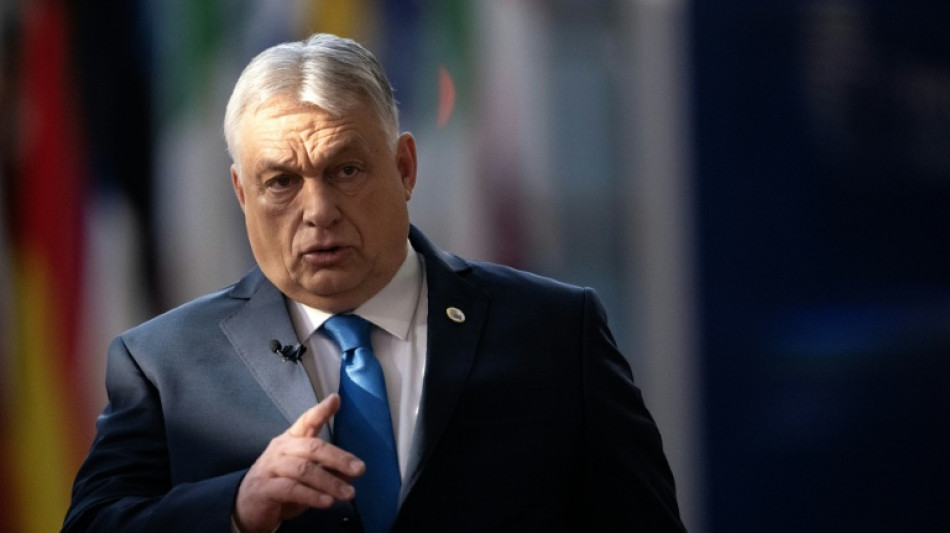
'Blackmail': EU leaders round on Orban for stalling Ukraine loan / Photo: © AFP

Outraged EU leaders rounded on Viktor Orban after the Hungarian nationalist refused to lift his veto on funds for Ukraine's war effort at a Thursday summit, accusing him of a "gross act of disloyalty" tantamount to "blackmail."
Moscow's closest partner in the bloc, Hungary's prime minister has long resisted helping Kyiv to repel Russia's invasion by stalling EU aid and repeated rounds of sanctions.
This time, Orban is holding up a 90-billion-euro ($104 billion) loan -- which he previously greenlit -- as leverage in a feud over damage to a pipeline through Ukraine, which has choked the flow of Russian oil to Hungary and Slovakia.
"No oil = no money," the Hungarian leader posted on X after the talks, refusing to budge despite concerted pressure from fellow leaders and a video address from Ukraine's Volodymyr Zelensky pleading for the funds' release.
Leaders lined up after the summit to condemn Hungary's U-turn -- with France's President Emmanuel Macron calling it "unprecedented" and German Chancellor Friedrich Merz slamming "a gross act of disloyalty."
"I am firmly convinced that it will leave deep marks," Merz told a press conference in the early hours of Friday.
Orban had made it clear he planned to play hardball, as he leans into anti-EU and anti-Ukrainian narratives ahead of close-fought national elections on April 12.
"I held my ground and we are exactly where we were this morning: if there is oil, there will be money," Orban said afterwards.
At odds with his EU peers on many fronts, Orban has held up countless decisions on Ukraine though solutions have ultimately been found -- in one famous case by having him leave the room while the bloc approved the start of membership talks with Kyiv.
This time, though, EU leaders made clear he had crossed a line.
"Nobody can blackmail the European institutions," warned Antonio Costa, who chairs the council of the EU's member states, calling Hungary's stance "completely unacceptable."
Budapest, joined by Bratislava, refused to endorse summit conclusions reaffirming the intent to release the funds -- which requires unanimity -- with leaders agreeing to revisit the matter at their next planned meeting.
But Macron told reporters after the summit there would be "no Plan B."
"When heads of state and government reach a decision, it must be honoured," he said. "The credibility of the Council is at stake."
- Election 'weapon' -
At the root of the standoff is a weeks-long dispute in which landlocked Hungary and Slovakia accuse Ukraine of stalling on pipeline repairs -- while Zelensky has branded linking the issue to support for Kyiv's war effort "blackmail".
The European Commission moved this week to unblock the situation by sending a team to help restore oil transit, but Orban dismissed the scheme as a "fairy tale".
Briefing on Thursday's closed-door talks, an EU diplomat said that "all the other leaders said Orban's stance was unacceptable" with the exception of Italy's Giorgia Meloni, who voiced sympathy with his situation in the election run-up.
Although Orban denies it, many of his counterparts see his blocking as squarely motivated by national politics.
"He's using Ukraine as a weapon in his election campaign, and it's not good. We had a deal," Finland's Prime Minister Petteri Orpo told reporters in Brussels.
"We all know it's linked to the elections -- we are going to have to be creative," summed up a second EU diplomat.
- Shortfall -
But this time it remains unclear when he might blink.
Complicating matters, leaders have been wary of offering Orban -- who is trailing main rival Peter Magyar in the polls -- a chance to bolster his image as an EU maverick by escalating the standoff with him.
Facing a budget shortfall four years into the war, Kyiv is estimated to need an influx of funds in early May -- implying a decision to unlock the EU loan by mid-April.
The failure to break the deadlock may push the issue back until after the Hungarian vote, whatever its outcome.
Can Ukraine hold out until then? Unclear, say EU diplomats.
U.Chen--ThChM