The China Mail - Kenya, Uganda double down on rail extension burdened by Chinese debt

USD -
AED 3.672504
AFN 63.000368
ALL 82.732897
AMD 367.370222
ANG 1.790403
AOA 917.000367
ARS 1478.086972
AUD 1.450326
AWG 1.80125
AZN 1.70397
BAM 1.716442
BBD 2.015885
BDT 123.112028
BGN 1.69088
BHD 0.377375
BIF 2972.662249
BMD 1
BND 1.295099
BOB 6.916495
BRL 5.177041
BSD 1.000921
BTN 93.946202
BWP 13.602176
BYN 2.902892
BYR 19600
BZD 2.012989
CAD 1.41895
CDF 2267.50392
CHF 0.809775
CLF 0.023439
CLP 922.497696
CNY 6.79815
CNH 6.804685
COP 3438.325508
CRC 454.429769
CUC 1
CUP 26.5
CVE 96.770372
CZK 21.30904
DJF 178.235113
DKK 6.565804
DOP 58.809075
DZD 133.424898
EGP 49.510392
ERN 15
ETB 161.36601
EUR 0.877704
FJD 2.266104
FKP 0.756395
GBP 0.757719
GEL 2.64504
GGP 0.756395
GHS 11.285269
GIP 0.756395
GMD 73.000355
GNF 8770.020624
GTQ 7.63614
GYD 209.469481
HKD 7.843504
HNL 26.780464
HRK 6.617804
HTG 130.8175
HUF 310.850388
IDR 17860.6
ILS 3.00205
IMP 0.756395
INR 94.360504
IQD 1311.158892
IRR 1375250.000352
ISK 126.490386
JEP 0.756395
JMD 157.637457
JOD 0.70904
JPY 161.70504
KES 129.518627
KGS 87.450384
KHR 4017.727851
KMF 434.00035
KPW 900.00035
KRW 1535.130383
KWD 0.30961
KYD 0.834087
KZT 485.637808
LAK 21969.371188
LBP 89630.523498
LKR 336.443021
LRD 182.31603
LSL 16.452675
LTL 2.95274
LVL 0.60489
LYD 6.42503
MAD 9.385493
MDL 17.746281
MGA 4233.621484
MKD 54.091886
MMK 2099.386013
MNT 3578.909161
MOP 8.085217
MRU 39.945588
MUR 47.250378
MVR 15.450378
MWK 1735.574181
MXN 17.504204
MYR 4.088039
MZN 63.903729
NAD 16.452675
NGN 1376.130377
NIO 36.83356
NOK 9.933039
NPR 150.313748
NZD 1.769755
OMR 0.384504
PAB 1.000921
PEN 3.41305
PGK 4.39247
PHP 61.312038
PKR 278.550353
PLN 3.76695
PYG 6109.087718
QAR 3.648427
RON 4.603104
RSD 103.014612
RUB 77.756812
RWF 1465.794901
SAR 3.758743
SBD 8.051953
SCR 14.057835
SDG 600.000339
SEK 9.73761
SGD 1.294204
SHP 0.746601
SLE 24.803667
SLL 20969.503664
SOS 572.030366
SRD 37.483038
STD 20697.981008
STN 21.501602
SVC 8.757734
SYP 110.532098
SZL 16.443021
THB 33.378038
TJS 9.263329
TMT 3.5
TND 2.966607
TOP 2.40776
TRY 46.553304
TTD 6.802405
TWD 31.859804
TZS 2632.322612
UAH 44.926675
UGX 3673.702225
UYU 40.177279
UZS 12022.46698
VES 620.752985
VND 26300
VUV 119.628449
WST 2.780038
XAF 575.678617
XAG 0.017058
XAU 0.000246
XCD 2.70255
XCG 1.803853
XDR 0.715959
XOF 575.678617
XPF 104.664531
YER 238.625037
ZAR 16.987795
ZMK 9001.203584
ZMW 18.029751
ZWL 321.999592
  • CMSC

    -0.1160

    21.93

    -0.53%

  • CMSD

    -0.1600

    21.77

    -0.73%

  • RIO

    -1.3700

    93.74

    -1.46%

  • RBGPF

    3.7000

    65

    +5.69%

  • NGG

    -0.4100

    83.01

    -0.49%

  • BCE

    -0.2800

    22.92

    -1.22%

  • AZN

    2.7300

    188.41

    +1.45%

  • BTI

    0.2800

    62.76

    +0.45%

  • BP

    -0.5900

    37.13

    -1.59%

  • JRI

    0.2100

    12.79

    +1.64%

  • VOD

    0.0300

    13.89

    +0.22%

  • BCC

    1.2600

    81.02

    +1.56%

  • RELX

    0.4200

    31.34

    +1.34%

  • RYCEF

    0.3900

    18.39

    +2.12%

  • GSK

    0.6100

    52.5

    +1.16%

Kenya, Uganda double down on rail extension burdened by Chinese debt
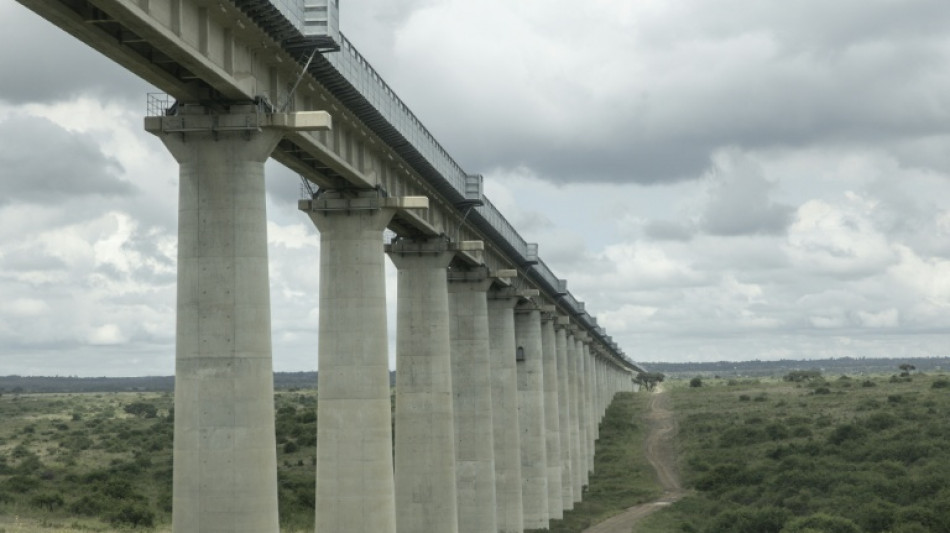
Kenya, Uganda double down on rail extension burdened by Chinese debt / Photo: © AFP/File

Kenya, Uganda double down on rail extension burdened by Chinese debt

The presidents of Kenya and Uganda met near their shared border Saturday to mark the multi-billion-dollar, long-delayed extension of a Chinese-built railway that has left Kenya heavily in debt.

Text size:

The Standard Gauge Railway, built from 2013 to 2019, connects the Kenyan port of Mombasa to its capital Nairobi, and on to the lake town of Naivasha, but China refused further lending before it could be extended to Uganda as planned.

Kenya now spends roughly $1 billion a year servicing Chinese debt, most of it borrowed to build the railway.

That is far more than the line generates in revenue -- around $165 million last year -- even if passenger and cargo numbers have been growing strongly over the past year.

A report by Kenya's auditor general last year found more than $260 million had been wasted just on penalties and interest from late debt payments.

Yet despite the controversy over the cost, Kenya has been keen to finish the line.

Kenyan President William Ruto said the rail link will "define generations", speaking at a ceremony in grand pomp and circumstance with his Ugandan counterpart Yoweri Museveni in Kisumu, near the Kenya-Uganda border.

Ruto argued the line would slash logistics costs that "undermine competitiveness" in east Africa.

If the ambitious building schedule is to be believed, the line is due to reach Kisumu by June 2027. The next phase will then take the line to Malaba, a town on the border.

"Cargo takes an average of 80 hours to move from Mombasa to Malaba and more than 100 hours to reach Kampala," the Ugandan capital, Ruto said.

"We cannot build prosperity on inefficiency."

- 'Irrational and wasteful' -

Museveni said the line would reduce the inefficiencies in his own country's infrastructure.

"The railway is part of the rationalisation of our transport system, especially on the Uganda side, which is irrational and wasteful," the veteran leader told the ceremony.

Later, he posted on X that "by shifting bulk cargo from roads to rail and pipelines, we reduce transport costs, protect infrastructure and improve efficiency".

Ruto broke ground on the next phase in Narok County on Thursday, arguing that it will create jobs and reduce road congestion.

"We have thought through this project (and)... its finance," he insisted.

Treasury estimates say the overall cost will be more than 500 billion shillings ($3.9 billion), according to Kenya's Business Daily.

Kenya is not taking more cash from Chinese banks this time -- instead borrowing against future cargo taxes -- though it is partnering with Chinese transport firms to build the new phase.

China lent Kenya $9.7 billion between 2000 and 2019, according to the Chinese Loans to Africa Database by Boston University, with around half of that going to the railway.

It stopped lending from 2020 to 2023 as Kenya struggled to make repayments, at a time when China revised its broader lending strategy in Africa.

Kenya considers the railway extension crucial for strengthening trade through east and central Africa, hoping to reach landlocked countries such as Uganda, Rwanda, South Sudan and the mineral-rich Democratic Republic of Congo.

V.Fan--ThChM