Silence not an option, says Canadian Sikh activist after fresh threats / Photo: © AFP

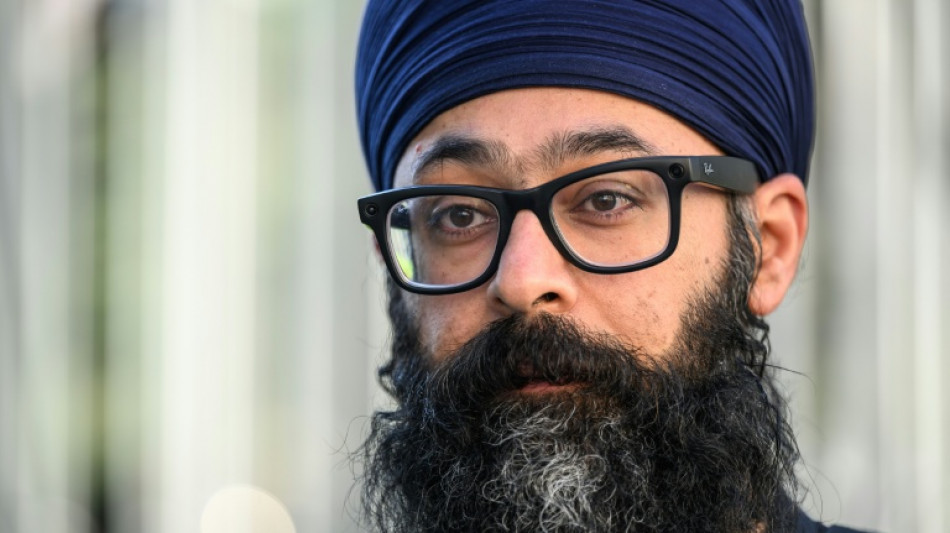
When Moninder Singh learned recently of assassination threats against his family in Canada, where a fellow Sikh activist was killed in 2023, he says he remained defiant.
"We won't be silenced," the chairman of the Sikh Federation of Canada told AFP.
Singh was speaking at the United Nations' European headquarters in Geneva, where he has been appealing for international action against India's alleged targeting of Sikh activists abroad, and against so-called transnational repression more broadly.
Sikh activists accuse India of targeting members of their community around the world, including alleged killings using organised crime groups -- charges India denies.
The best-known case was the 2023 killing of Hardeep Singh Nijjar, a friend of Singh's who was gunned down near the Sikh temple he led in a Vancouver suburb.
Canada's then-prime minister, Justin Trudeau, publicly accused India of involvement in that assassination, a charge later repeated by Canadian intelligence.
India denied the allegations, which chilled ties between the two nations, and saw each expelling a string of diplomats in 2024.
Relations improved after Prime Minister Mark Carney took office last year, culminating with an India visit this month to sign a string of trade deals, and as Canadian authorities downplayed their previous threat assessment.
- 'Deeply disturbing' -
Singh, a 44-year-old Canadian-born citizen, said it was "deeply disturbing" the Canadian government normalised diplomatic relations so quickly "without anything changing".
"We're going into India and shaking hands with the very people that have Canadian blood on their hands," he charged.
Like Nijjar, Singh is part of a fringe group advocating for an independent Sikh state called Khalistan.
The Khalistan campaign dates to India's 1947 independence and has been blamed for the assassination of a prime minister and the bombing of a passenger jet.
It has been a bitter issue between India and several Western nations with large Sikh populations.
A year before Nijjar was killed, Canadian authorities had informed him and Singh of credible threats against their lives.
"We didn't know how to react," Singh told AFP last week. "We didn't think that India would resort to assassinations on foreign soil... We were obviously wrong."
Singh said he was inspired by his friend's courage, and determined not to go quiet.
"I have taken it in the opposite way, (deciding) now is the time to actually double down," he said.
- 'Imminent' assassination threat -
Since then, Singh has received three more so-called "duties to warn" from Canadian police, informing him of a "credible threat to his life".
The last one, last month, was before he left to participate in the UN Human Rights Council's main annual session in Geneva.
He said that an informant working within a criminal syndicate had told police of an "imminent threat of assassination to myself, my wife and my two children".
Singh said he was convinced India was behind the threat.
Canadian police have not confirmed that, although the officer who delivered the warning to Singh seemed to agree with his assessment that he was being targeted for his political activism, according to a recording of the call shared with AFP.
On the call, the officer said that the threat "extended to you, your wife and your two children".
"Am I worried about the safety of my wife and kids? Of course," Singh told AFP, stressing however, that that "is not going to be enough to make me stop".
- UN experts 'alarmed' -
Singh and other Sikh activists are urging the council to appoint an expert to investigate transnational repression, or for existing special rapporteurs to focus more on the issue.
"I think stronger focus would be a positive thing," Ben Saul, the UN special rapporteur on protecting rights while countering terrorism, told AFP.
He was among five independent UN rights experts who sent a communication to the Indian government in 2024 to enquire about Nijjar's assassination.
In it, they asked what steps it had taken to investigate the killing, and why the activist had been listed as a "terrorist".
Saul said the experts were "absolutely not satisfied with the response from the Indian authorities", who essentially denied there was a problem.
"We're still alarmed," he said.
"Their oppression against Sikhs in exile has, far from diminishing, seemed to have gotten worse."
S.Davis--ThChM